
Manual bank reconciliation consumes up to 40% of a finance team’s time. For a region which is growing rapidly like the GCC, they are still following traditional ways of matching transactions across various piles data spread across excel sheets.
Businesses across Saudi, Kuwait, Qatar, Bahrain, UAE and Oman are scaling rapidly in terms of adding subsidiaries, expanding across borders, and processing millions of transactions a month.
According to PwC, finance teams spend up to 40% of their time gathering data, not analysing it. History keeps repeating itself in the back office because finance teams continue to perform bank reconciliations on spreadsheets, chase discrepancies over WhatsApp and email, and close books for days, weeks and even months often.
Financial Complexities are Growing in GCC Countries in 2026
Starting from Saudi, Qatar, UAE, Kuwait, Oman, and Bahrain, the region’s financial complexity has always been growing with time. Conglomerates across sectors – real estate, manufacturing, retail, automobile, logistics, etc. are continuously expanding with multiple subsidiaries, various bank accounts in several currencies.
Each day they continue to transact in high volumes which forces the finance team to stretch and go extra miles. The regulatory mandates are getting upgraded every now and then making it rigid and difficult to align with. All tax and compliance keep requiring accurate, audit-ready financial records always.
What makes the GCC uniquely challenging is the convergence of multiple compliance frameworks, all requiring accurate, real-time, and audit-ready financial records always:
- ZATCA e-Invoicing (Saudi Arabia) — mandates real-time invoice transmission to the Fatoora portal, making every transaction instantly reconcilable and every bank reconciliation cycle shorter.
- SADAD (Saudi Arabia) — requires billers to reconcile daily transaction reports within 24 hours, creating a non-negotiable overnight bank reconciliation obligation for high-volume businesses.
- UAE FTA — VAT & Corporate Tax — demands continuously audit-ready records, with the FTA cross-referencing VAT and corporate tax filings digitally and conducting over 93,000 inspection visits in 2024 alone.
Against this backdrop, manual reconciliation is not just slow, but a compliance liability.
What Manual Reconciliation Is Actually Costing GCC Conglomerates?
GCC businesses are running into millions of costs when it comes to reconciling fragmented data across PDFs, CSVs and emails. Around $21,000 per analyst per year is wasted in salary alone by conglomerates to serve this purpose.
- Finance teams spend up to 40% of their bandwidth on bank reconciliation tasks alone
- Month-end close cycles run 5–10 days longer than necessary
- Skilled finance professionals stay tied to data entry instead of analysis and forecasting
- Duplicate payments and missed deductions sitting unresolved on balance sheets
- Error-prone manual matching creates blind spots for fraud and misappropriation
- Leadership making decisions on stale financial data
- CFOs unable to get a real-time view of cash position across entities
Why Businesses Failed with Partial Fixes?
Finance teams across sectors tried with a better approach to modify and improvise the manual reconciliation process. However, they fail badly –
- More spreadsheets meant more version control risk.
- ERP modules that fail to integrate with bank feeds, payment gateways, or sub-ledgers create new silos.
- Partial automation handles matching but leaves exception management manual.
- Additional headcount scales the problem.
Rather, GCC businesses need a faster and smarter version of the same process but with a different approach. Conglomerates demand something that automates bank reconciliation end-to-end, handles exceptions intelligently, and connects directly to the systems where financial data already lives.
FinRecon: Automated Reconciliation Platform to Digitize and Simplify Reconciliation Processes
FinRecon by Teknospire is a purpose-built reconciliation platform designed for the transaction volumes, regulatory requirements, and operational complexity of the GCC market. To better understand the functioning of the reconciliation system, here’s a note on the excellent features to resolve the bank reconciliation worries of GCC businesses:
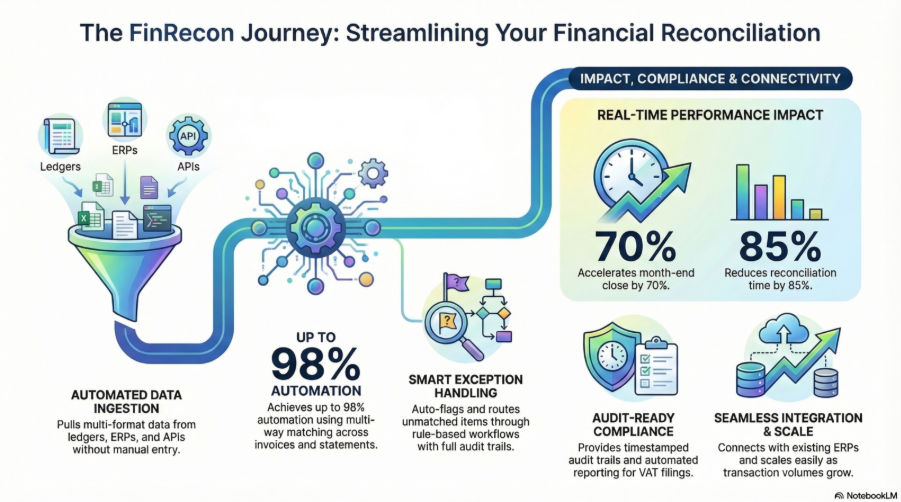
Automated Data Ingestion
- Pulls data from general ledgers, sub-ledgers, bank statements, ERPs, POS systems, payment gateways, and APIs
- Supports all common formats — Excel, CSV, PDF, and email attachments
- No manual data entry or format conversion
Intelligent Matching Engine
- Automates up to 98% of account reconciliations
- Custom matching rules based on amount, date, reference number, or transaction type
- Multi-way matching — invoice, bank statement, and ledger reconciled simultaneously
Smart Exception Handling
- Unmatched items auto-flagged, triaged, and routed to the right case manager in real time
- Rule-based workflows eliminate manual back-and-forth
- Exceptions resolved faster, with a full audit trail at every step
Real-Time Dashboards
- 360° view of reconciliation status, records processed, ageing reports, and exceptions
- Month-end close accelerated by up to 70%
- Time spent on bank reconciliation reduced by up to 85%
- CFO-ready real-time visibility across all entities, accounts, and currencies
Audit-Ready Compliance
- Timestamped audit trail for every transaction and reconciliation action
- Role-based access with view-only permissions for external auditors
- Automated regulatory reporting, with no manual compilation ahead of VAT filings or audits
Seamless Integration and Scalability
- Integrates with existing ERP systems without disrupting current workflows
- Scales with transaction volume as the business grows
- Proven in production: a Qatar-based payment gateway used FinRecon to consolidate multi-source financial data and automate merchant settlement reports, reducing manual effort significantly and improving reporting accuracy
| Feature | Key Details and Benefits |
| Automated Data Ingestion | Pulls data from multiple sources including ledgers, bank statements, ERPs, and APIs. It supports common formats like Excel, CSV, and PDF, eliminating the need for manual data entry. |
| Intelligent Matching Engine | Automates up to 98% of account reconciliations using custom matching rules based on amount, date, or transaction type. It also supports simultaneous multi-way matching of invoices, bank statements, and ledgers. |
| Smart Exception Handling | Automatically flags and routes unmatched items to case managers in real time using rule-based workflows. This ensures faster resolution and maintains a full audit trail. |
| Real-Time Dashboards | Provides a 360° view of reconciliation status and ageing reports. It can accelerate month-end close by up to 70% and reduce time spent on reconciliation by up to 85%. |
| Audit-Ready Compliance | Features a timestamped audit trail for every action and offers role-based access for external auditors. It automates regulatory reporting for VAT filings and audits. |
| Seamless Integration & Scalability | Integrates into existing ERP workflows without disruption and scales as transaction volumes grow. It has been proven in production to improve reporting accuracy and reduce manual effort. |
How has Automated Bank Reconciliation Impacted on GCC Businesses?
Platforms like FinRecon not only bring change to the business but also regulate the way finance teams manage the reconciliation process better and help CFOs and leadership teams gain a unified view of the business finances.
For CFOs and finance leaders:
- Real-time financial visibility across the entire business, anytime
- Faster financial close enabling faster, better-informed decisions
- Audit readiness maintained continuously, not scrambled for at year-end
- Compliance with ZATCA, FTA, and corporate tax requirements, without manual reporting overhead
For finance teams:
- Shift from data entry to analysis, forecasting, and value-added work
- Significant reduction in month-end pressure and overtime
- Reduced errors and corrections with fewer escalations
For the business:
- Reduced operational costs with less headcount on repetitive tasks
- Fraud and discrepancy risks identified in real time
- A finance function that scales with the business
The Cost of Clinging to Unreadiness: Time to Switch to FinRecon
In 2026, the GCC’s regulatory environment is more demanding than ever. Saudi Arabia alone processed 10.8 billion transactions in 2023, growing 24% year-on-year, with volumes continuing to climb. Transaction volumes are higher and 57% of CFOs are now expected to drive strategy at the leadership level.
However, most of them are still waiting on month-end closes which take longer than a week. Every month that manual bank reconciliation continues, the cost compounds. Only 18% of finance teams close their books in 3 days or less. Six in ten organisations still rely heavily on manual processes.
FinRecon was built specifically for the transaction volumes, regulatory frameworks, and multi-entity complexity that define doing business in the GCC today. It automates up to 98% of reconciliations, accelerates month-end close by 70%, and maintains continuous audit readiness without adding headcount or disrupting existing systems.
The question for GCC finance leaders is how quickly they can automate bank reconciliation. Book a demo with us and find out how fast FinRecon can transform your reconciliation operations.
Frequently Asked Questions:
What is bank reconciliation?
Bank reconciliation is the process of matching a company’s internal financial records against its bank statements to ensure both are accurate and consistent. Any missing transaction, timing difference, or error is identified and resolved by FinRecon.
How do you reconcile bank transactions?
FinRecon automates every step: obtaining the bank statement, comparing it against internal ledger records, identifying mismatches, resolving exceptions, and confirming closing balances match.
What items are included in bank reconciliation?
A standard bank reconciliation covers:
Deposits in transit: Recorded internally but not yet reflected in the bank statement.
Outstanding cheques: Issued but not yet cleared.
Bank charges and fees: Debited by the bank but not yet posted internally.
Interest earned: Credited by the bank but not yet recorded.
Errors and duplicates: Data entry mistakes or system discrepancies.
Unrecorded transactions: Direct debits or credits processed without prior internal entry.
What is the purpose of bank reconciliation?
Bank reconciliation is required for improved accuracy, compliance, and control. It confirms cash positions are correct, catches errors and fraud early, and keeps records audit-ready.
What is a bank reconciliation statement?
A bank reconciliation statement is a formal document that summarizes the differences between a company’s book balances and bank balances at a point in time. FinRecon generates timestamped, role-based bank reconciliation statements that explain how those differences are resolved. It is a key document during audits, tax inspections, and regulatory reviews.
How often should bank reconciliation be done?
The best practice for bank reconciliation is daily or real-time. FinRecon runs reconciliation continuously in the background which causes the books to be audit ready.