

The real estate industry deals with multiple transactions across the GCC and MEA. Deals are signed, funds are transferred, and projects are committed to. However, the query still hovers around how the money gets transferred from the buyer to the real-estate developer? When is the payment completed, what are the conditions or terms set, how are the agreements made and several other questions.
Escrow is the most suitable answer for all these questions. The escrow management process ensures that funds are held securely, released only when conditions are met, and traceable at every step.
However, businesses still clinging to traditional escrow systems are undergoing the same pain; trust issues between parties, failure to deliver projects on time, lack of proper framework, non-existence of escrow agreements, etc.
Digital escrow can fill the gap. For beginners, this guide can be the absolute pick to help them understand what escrow is, how an escrow account works, and why getting it is a necessity for anyone handling high-value transactions.
What Is Escrow?
Escrow is the process of holding funds by a neutral third party, typically a bank, until specific, pre-agreed conditions are met. No funds move until obligations on both sides are fulfilled.
The model involves three parties: the buyer, the seller or developer, and the escrow agent. The process follows three steps:
- Deposit: The buyer transfers funds into a dedicated escrow account held by the bank.
- Verify: An independent consultant or regulator confirms that the agreed conditions are met.
- Release: The bank transfers funds to the developer only upon verified completion.
Why Is Real Estate Escrow Mandatory in the UAE?
Dubai Law No. 8 of 2007 mandates RERA-approved escrow accounts for all off-plan real estate developers. Buyer funds must be ring-fenced in project-specific accounts and released to the developer only upon verified construction milestones monitored by the Dubai Land Department (DLD) and RERA.
Why Traditional Escrow Is No Longer Enough?
The regulatory requirement for escrow has existed in the UAE since 2007. In most banks and developer offices today, escrow operations involve the following process:
- Developer profiles managed across disconnected systems
- Fund release approvals delayed by manual document collection and email coordination
- Milestone records submitted via physical paperwork prone to errors
- Regulatory reporting to DLD and RERA compiled manually, creating compliance risk at every step.
For buyers, the experience is worse:
- No real-time visibility into how payments are being utilised.
- Milestone updates received irregularly.
- No single place to track financial commitments across a project.
An escrow system that works should deliver four things consistently:
- Security: Funds must be held and released only when all contractual conditions are verified.
- Trust: A neutral bank should remove the need for either party to take the other on faith.
- Transparency: All transactions and conditions must be documented and visible in real time.
- Compliance: The system should have a built-in regulatory framework to ensure that every transaction meets local requirements.
Traditional escrow acknowledges these four principles. It just does not consistently deliver them. That is the gap digital escrow was built to close.
What Does a Digital Escrow Platform Look Like? Introducing FinEscrow?
FinEscrow by Teknospire is a purpose-built digital escrow management platform designed around the actual workflow of GCC real estate transactions, from account inception through to final handover.
Where traditional escrow relies on email and physical documentation, FinEscrow automates the entire sequence within a single platform:
- Accounts are created digitally
- Agreements are generated and e-signed automatically
- Milestones are tracked in real time
- Fund release requests are reviewed and approved within FinEscrow
- A complete, timestamped audit trail maintained at every step
Here is how that compares to how most banks and developers are operating today:
| Feature | Traditional Escrow | FinEscrow |
| Agreement Generation | Manual, paper-based, weeks of delays | Auto-generates agreements, e-signature ready |
| Milestone Tracking | Email threads and physical documents | Tracks milestones in real time, in-platform |
| Fund Release Approval | Manual review, days to weeks | Automates approval workflows, hours not weeks |
| Regulatory Reporting | Manual compilation for DLD/RERA | Exchanges data via real-time API integration |
| Buyer Visibility | Periodic, inconsistent updates | Buyer portal — live dashboard, anytime |
| Audit Trail | Fragmented across emails and files | Timestamped, centralised, regulator-ready |
How Does FinEscrow Support Compliance?
FinEscrow integrates directly with the Dubai Land Department, RERA, and the Ministry of Housing via real-time APIs. It automates the exchange of project details, escrow account data, NOC initiation for fund releases, and milestone completion records at every stage. Compliance is not a manual exercise with FinEscrow. It is built into the process itself.
How Does FinEscrow Handle Milestone-Based Fund Release?
For any escrow management platform, funds move in stages, tied directly to verified construction progress:
- Developer and bank agree on project milestones at account inception
- Developer completes a construction phase and submits documentation through the platform
- Developer consultant reviews project files, images, and supporting evidence within FinEscrow
- Consultant issues a Milestone Completion Certificate
- Developer initiates a fund release request to the bank
- Bank reviews the certificate and triggers disbursement with NOC from the Ministry of Housing exchanged via API
- Buyer receives an automated alert; their FinEscrow dashboard updates in real time
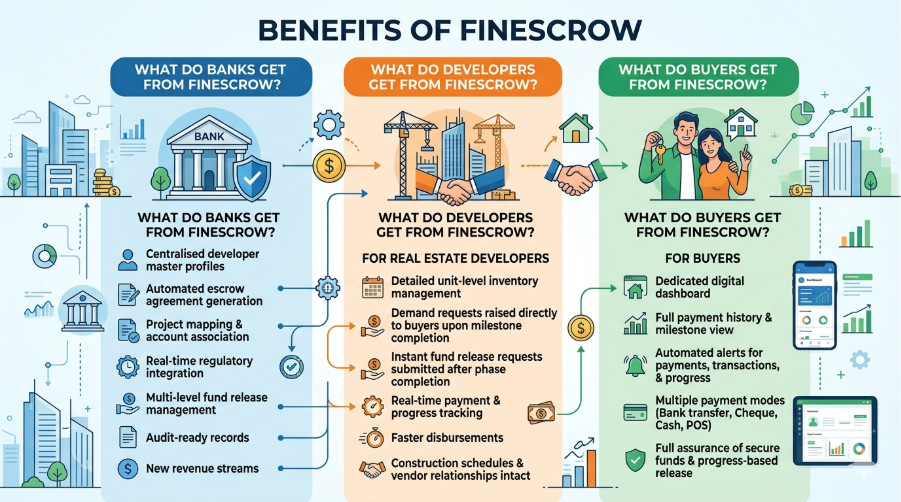
What Do Banks Get from FinEscrow?
For banks, it is a revenue and relationship opportunity:
- Centralised developer master profiles
- Automated escrow agreement generation
- Project mapping and escrow account association
- Real-time regulatory integration
- Multi-level fund release management
- Audit-ready records
- New revenue streams
What Do Developers and Buyers Get from FinEscrow?
For Real Estate Developers
- Detailed unit-level inventory management
- Demand requests raised directly to buyers upon milestone completion
- Instant fund release requests submitted to banks immediately after construction phase completion
- Real-time payment and project progress tracking
- Faster disbursements that keep construction schedules and vendor relationships intact
For Buyers
- A dedicated digital dashboard with full payment history and milestone-based disbursement view
- Automated alerts for upcoming payments, successful transactions, and project progress updates
- Multiple payment modes — bank transfers, cheques, cash via CDMs or bank tellers, and developer POS
- Full assurance that funds are held securely and released only upon verified construction progress
Escrow is Mandatory for Real-Estate Transactions
Escrow in the GCC is not optional — it is regulatory. But the way most banks and developers are running it today is creating compliance risk, payment delays, and zero visibility for the buyers whose money is on the line.
FinEscrow brings the entire escrow lifecycle — from escrow account inception and agreement generation to milestone verification, fund release, and regulatory reporting — into a single automated platform.
For banks, it reduces risk and opens new revenue. For developers, it means faster access to funds and cleaner project management. For buyers, it means their money moves only when their building does.
To learn more about FinEscrow, visit us here – https://teknospire.com/digital-escrow-platform/.
Frequently Asked Questions
What is an escrow account in Dubai?
An escrow account in Dubai is a dedicated bank account held by a RERA-approved financial institution where buyer funds are ring-fenced for a specific real estate project. The bank holds the funds and releases them to the developer only upon verified construction milestones, monitored by the Dubai Land Department and RERA. It is the legal backbone of off-plan property transactions in the UAE.
How does an escrow account work in real estate?
Three steps: the buyer deposits funds into a project-specific escrow account held by the bank. An independent consultant verifies that agreed construction milestones are complete. The bank then releases funds to the developer only upon that verified completion.
Is an escrow account mandatory in the UAE?
Yes. Dubai Law No. 8 of 2007 mandates RERA-approved escrow accounts for all off-plan real estate developers. Buyer funds must be ring-fenced in project-specific accounts and released only upon verified construction milestones. Developers cannot access buyer funds outside this framework.
How does an escrow account protect buyers?
It ensures their money cannot be touched until the building progresses. Funds are held by a neutral bank and not the developer. Payments are released only after an independent consultant verifies each construction milestone. Buyers also receive automated alerts and real-time dashboard visibility into how and when their payments move.
What is the purpose of an escrow account in real estate?
To protect all three parties simultaneously. Buyers are assured their funds are secure and milestone linked. Developers receive timely, verified disbursements that keep construction on schedule. Banks maintain a compliant, documented audit trail for every transaction.