
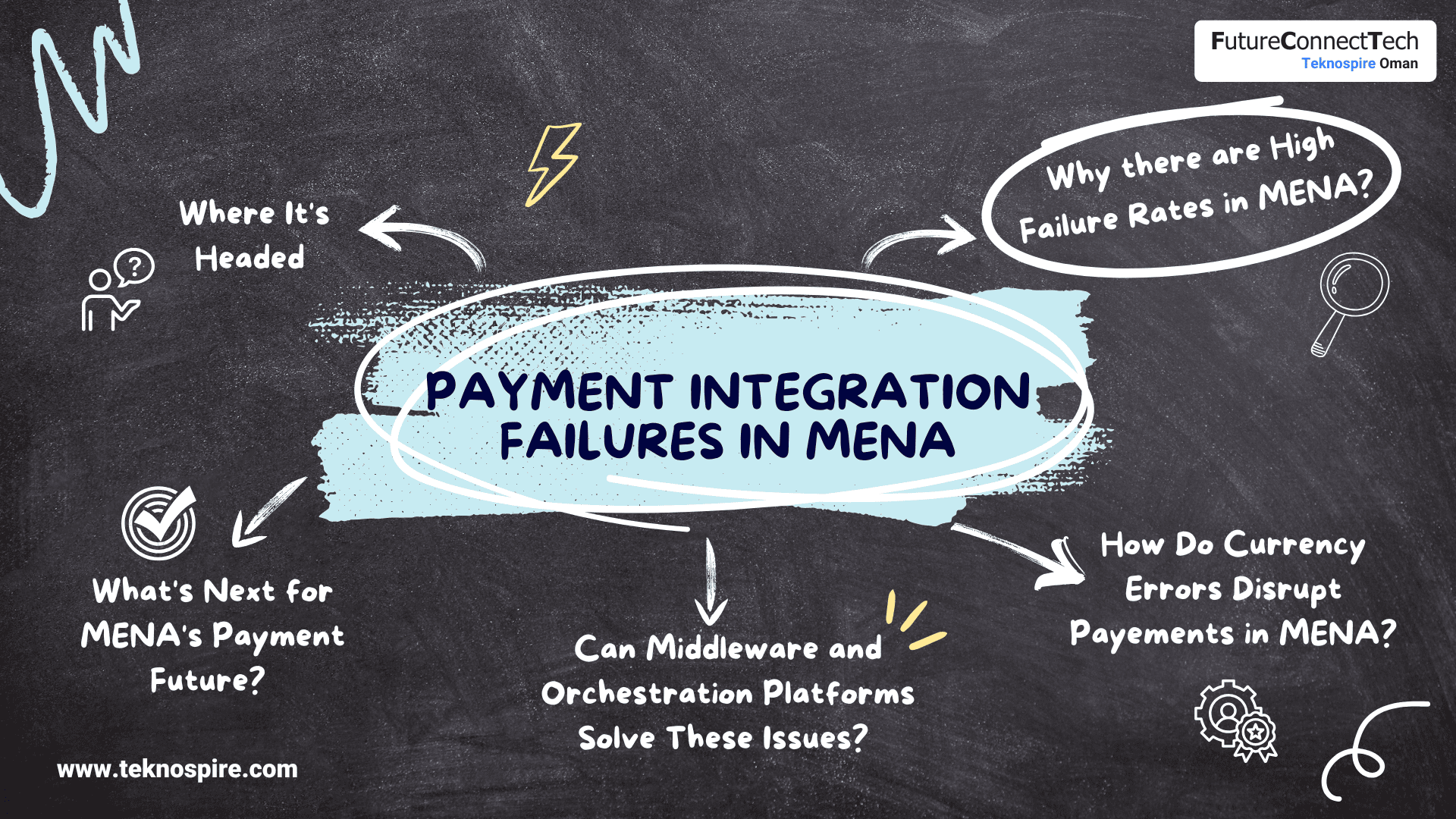
What if a significant portion of your payment integrations failed due to technical glitches in currency handling or AML compliance? In the fast-growing MENA fintech landscape, these challenges cause many projects to require major rework, delays, or even abandonment – with industry reports indicating rates around 60% in emerging markets.
As real-time payments in the region approach $1 trillion in transaction value by 2028, these issues translate into lost revenue, higher costs, and missed opportunities. The good news? Modern middleware and payment orchestration platforms help businesses overcome these hurdles efficiently.
Let’s explore the main pain points and practical solutions.
Why Are Payment Integrations Facing High Failure Rates in MENA?
Complex currency environments and stringent AML requirements often clash with legacy systems, leading to integration of bottlenecks.
- Currency Handling Challenges: Real-time conversions can fail when exchange rates fluctuate, or multi-currency wallets don’t align properly, contributing to decline rates of 10-20% in some cross-border scenarios. For example, mismatches involving pegged currencies like the UAE dirham can trigger unexpected fees or rejections.
- AML Compliance Obstacles: Inefficient monitoring systems generate excessive false alerts while potentially missing risks, especially in high-volume sectors like trade finance. In 2024, UAE authorities revoked or suspended licenses of multiple firms for AML breaches. Globally, failed payments have been estimated to cost the economy $118.5 billion annually (based on 2020 data), with $41.1 billion impacting EMEA.
The outcome? Integration projects frequently face significant delays and budget overruns of 30-50%, while SMEs in markets like Saudi Arabia experience B2B payment delays exceeding 60 days in 35% of cases. Consumer trust also suffers, with many citing fraud concerns as a barrier to digital payments.
How Do Currency Errors Disrupt MENA Payments?
Quick fact: Fluctuating rates and suboptimal conversion logic can reject legitimate transactions, particularly in GCC-Europe corridors where unchecked fees add friction. Common issues include:
- OTP and authentication delays or failures during verification.
- Unsupported currency switches in digital wallets, especially in remittance-heavy markets.
- Volatility-triggered declines involving pegged currencies.
Even modest failure rates can lead to substantial revenue loss in high-volume e-commerce environments.
What AML Challenges Are Hitting MENA Fintechs Hardest?
Traditional systems often produce false positive rates of 90-95%, overwhelming compliance teams and creating operational bottlenecks. Regulators such as Saudi Arabia’s SAMA and the UAE Central Bank are enforcing stricter standards, with penalties and license actions on the rise. Key pain points:
- Incomplete KYC data in cross-border flows.
- Legacy tools struggling with real-time transaction scrutiny.
- Alert fatigue reduces overall effectiveness.
Addressing these not only avoids fines but also builds customer confidence.
Can Middleware and Orchestration Platforms Solve These Issues?
Yes – effectively and quickly. Middleware acts as an intelligent layer that dynamically routes transactions, applies localized rules, and embeds compliance checks without requiring full system overhauls. Platforms like MoneyHash, Primer, and Apaya enable smart fallbacks (e.g., switching from card to wallet) that can recover up to 20% of otherwise declined payments.
How it helps:
1. For Currency Handling
- Applies real-time localized conversion logic.
- Optimize routing to minimize declines.
- Integrates smoothly with ERP systems to reduce data mismatches.
2. For AML Compliance
- Use AI to filter alerts, reducing false positives by up to 90%.
- Embeds region-specific rules (e.g., UAE VAT, SAMA guidelines).
- Provides predictive dashboards for proactive risk management.
Real-world impact: Leading BNPL provider Tamara has significantly improved conversion rates and processing efficiency using orchestration tools.
| Challenge | Middleware Fix | Expected Impact |
| Currency Conversion Errors | Dynamic routing & hedging | 20% fewer declines |
| AML False Positives | AI monitoring | 90% alert reduction |
| Integration Delays | API decoupling | 30-50% cost savings |
| Cross-Border Friction | Geo-specific rules | 15% conversion lift |
What’s Next for MENA’s Payment Future?
MENA remains one of the world’s fastest-growing fintech regions, with projected annual revenue growth of around 35% through 2028 and e-commerce expected to reach approximately $50 billion by the same period.
To capitalize on this growth, businesses should:
- Audit current integrations for currency and AML vulnerabilities.
- Pilot modern orchestration platforms like MoneyHash or Primer.
- Adopt vendor-agnostic solutions for long-term flexibility.
Note: The figures mentioned in the above article are derived from multiple industry reports and discussions like SPAYZ.io, McKinsey, Stripe & Edgar, Dunn & Company Report, KPMG MENA Fintech Report.
FAQ: Quick Answers on MENA Payment Integrations
Q: What drives high integration failure rates?
A: Primarily currency complexity and AML compliance mismatches in diverse regulatory environments.
Q: How costly are these failures?
A: Significant – from direct revenue loss to regulatory fines and operational overhead.
Q: Are middleware solutions worth adopting?
A: Yes – they recover declined transactions and streamline compliance substantially.
Q: Which platforms suit MENA best?
A: MoneyHash, Primer, and Apaya are popular for their regional optimization and routing capabilities.
Q: How should we get started?
A: Begin with an integration audit, test orchestration tools, and monitor performance metrics.
Have questions about your payment stack? Share them in the comments below.
Visit Teknospire for more insights on MENA fintech trends.