Security is often viewed as the responsibility of a dedicated security team. Every software engineer influences the security posture of a platform through architecture decisions, coding practices, infrastructure choices, and deployment strategies.
When building financial technology, it is easy to focus all our energy on big, visible defenses like firewalls and secure networks. Yet, some of the most devastating data breaches don’t happen because a hacker cracked a firewall. Rather, they happen because of a tiny, overlooked vulnerability hidden deep inside an application’s everyday code. This makes secure software development a foundational pillar for any modern financial application.
To pull back the curtain on how banking-grade data defense works, we recently sat down with Pramod Kumar, our resident technical expert at Teknospire, who handed us a massive master-bundle of technical insights and answers to our deepest security questions.
He broke down complex software engineering protocols into practical, real-world lessons that everyone needs to understand. Whether you are a backend developer for building microservices, an operations manager tracking client workflows, or a CFO evaluating corporate risk, here is the blueprint to software security in fintech from the very first line of code.
What are the absolute security habits a developer must form?
Developers must adopt software security best practices early in their careers to protect systems from exploitation.
- Never Trust User Input: Treat every single piece of data entering your software application as potentially hostile. For example, if a user is asked to upload a simple profile picture, an attacker might try to upload a hidden malicious script instead. Without strict validation, the application stores the file without validating its type or content, and later serves or executes it. Similarly, directly inserting raw user data into queries makes payment applications highly vulnerable to SQL Injection attacks.
- Authentication is Not Authorization: Verifying who someone is (Authentication) is completely different from verifying what they are allowed to do (Authorization). Consider a banking application: a customer logs in successfully, but what happens if they manually alter the account digits in the URL bar (e.g., swapping /accounts/123 to /accounts/124)? In the engineering world, this is a classic vulnerability known as Insecure Direct Object Reference (IDOR), also recognized as Broken Object Level Authorization (BOLA) in the OWASP API Security Top 10. Without strict authorization logic checking permissions on every single request, a valid login becomes an open backstage pass to a stranger’s private data.
- Evict Secrets from Source Code: Passwords, API keys, and cloud credentials must never live inside code repositories. A developer might temporarily hardcode a credential during a late-night testing session and push it to GitHub. Within minutes, automated hacker bots scan these public spaces, discover the exposed key, and compromise your entire cloud infrastructure. Always leverage dedicated secret management platforms, enforce regular credential rotation, and implement short-lived tokens.
- Assume Breaches Will Happen: Modern banking cybersecurity isn’t just about building higher walls; it’s about active detection and rapid recovery. If an internal employee account is compromised, having immutable audit trails and real-time monitoring allows security operations teams to isolate, contain, and neutralize the incident before it spirals.
What is the most common security mistake developers make under tight deadlines?
Pramod points out three common deadline mistakes that introduce systemic risk and cause developers to adapt to measures of software security in fintech:
- Hardcoded Credentials: Leaving database passwords directly inside configuration files eventually slip into system backups and codebase histories, leaving a permanent trail for attackers.
- Missing Authorization Checks: Rushing a new dashboard feature to production while forgetting to implement backend validation. The user interface may look great, but any user can alter request parameters to view data belonging to other corporate clients.
- Excessive Permissions: Granting a background reporting service full administrative rights ‘temporarily’ to bypass a configuration hurdle, then forgetting to revoke those privileges months down the line.
We must note that many corporate data breaches do not stem from sophisticated cyber warfare, but they start with everyday convenience and minor oversight.
APIs: The New Attack Surface
Because modern enterprise applications are overwhelmingly API-driven, comprehensive API security has become a primary battlefield. If an attacker launches an automated ‘credential stuffing’ attack, attempting thousands of rapid-fire login requests against an authentication of API, it can quickly consume vital system resources and compromise customer accounts.
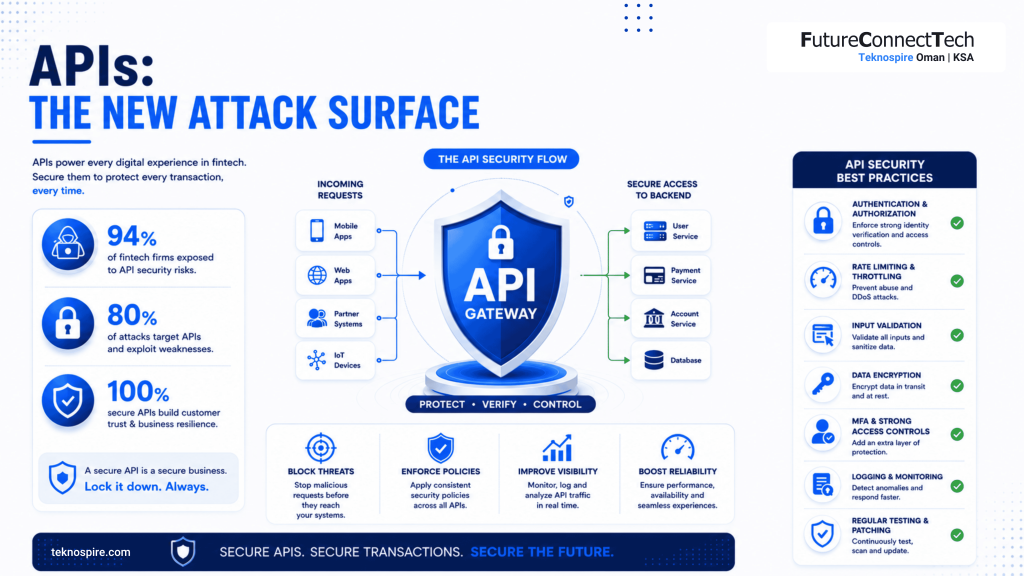
Thus, engineers must ensure that APIs are safeguarded with automated rate limiting to block automated request spikes, Multi-Factor Authentication (MFA) to verify identity, and breached password detection to flag compromised credentials.
What practical security lessons drive the Teknospire product suite?
Maintaining reliable software security in fintech requires building operational truths directly into the product suite. At Teknospire, this compliance layer governs four core engineering decisions:
- Absolute API Verification: In our ecosystem, trust is never assumed based on location. Whether a transaction request initiates from a customer’s smartphone, an external partner bank, or an internal microservice, every single interaction is independently authenticated, authorized, and validated.
- Context-Aware, Secure Logging: System logs are critical for operational visibility and forensic investigations, but they create massive security risks if they accidentally leak sensitive customer data. Our development guidelines draw a strict line between what is necessary for tracing and what must be completely masked:
- The Restricted Approach (What to Mask): We explicitly strip or mask highly confidential data parameters from ever touching a plaintext log file:
- Passwords & Access Tokens
- One-Time Passwords (OTPs)
- CVVs & Card Details
- The Secure Approach (What to Log): We log clear, non-sensitive telemetry to trace operational steps:
{
“userId”: “123”,
“action”: “PAYMENT_CREATED”,
“requestId”: “abc123”
}
- Mutual Authentication Across Services: Our architecture treats the internal corporate network as potentially hostile. Our Fraud Engine, Payment Service, and Notification Service are required to continuously verify identity, permissions, and request integrity during every exchange.
- Engineered Incident Readiness: Our platforms are backed by deep real-time monitoring, automated anomaly alerting, unalterable audit trails, and structured incident runbooks designed for instant recovery. We focus heavily on minimizing our Mean Time To Detect (MTTD) and Mean Time To Respond (MTTR) to ensure minimal business impact.
How does secure code translate directly into measurable corporate value?
For non-technical executives and CFOs, security investments can occasionally feel abstract—like paying a premium for an insurance policy you hope to never use. But when framed through the lens of corporate governance, secure engineering is an active value driver.
From a CFO’s perspective, software security in fintech means active risk reduction, revenue protection, and business continuity.
| The Strategic ROI of Security | |
| Prevents Financial Losses | Isolates payment APIs to stop unauthorized fraud. |
| Protects Brand Equity | Maintains user trust; market reputation is hard to rebuild. |
| Simplifies Compliance | Streamlines regulatory audits (RBI, PCI-DSS, ISO 27001, SOC 2). |
| Lowers Operational Cost | Avoid emergency fixes and costly downtime incidents. |
- PCI-DSS: Satisfied by implementing card-data tokenization, ensuring raw card numbers are never stored or exposed within the internal database architecture.
- RBI Regulations: Achieved through strict cloud infrastructure design that enforces data-localization requirements, ensuring all payment and transaction data is stored and processed end-to-end within regional geographic boundaries.
- ISO 27001 & SOC 2: Met effortlessly by providing immutable audit trails, role-based access management, and continuous encryption standards across the entire environment.
In layman’s terms, security accelerates long-term product delivery by eliminating emergency software patches, system downtime, and unexpected regulatory penalties.
How has software security in FinTech evolved, and what are the major trends in 2026?
Back in 2015, corporate security was focused on locking down the physical data center using firewalls, VPNs, and network boundaries. The old rule was: If you’re inside our office network, you are trusted. However, today, modern software architecture relies on cloud workloads, open-source dependencies, microservices, and continuous deployment pipelines.
Consider a routine ₹50,000 digital payment. In a matter of milliseconds, that single request travels across an intricate ecosystem: Every single handoff across this chain introduces a unique security risk. This structural shift has brought forth three massive trends defining our current era:
- Zero Trust Security: In a Zero Trust framework, we verify every user, every service, and every request. Even if two microservices live inside the exact same internal cluster, they must explicitly authenticate each other before exchanging a single line of data.
- Software Supply Chain Integrity: Organizations continuously scan open-source libraries, container environments, and deployment pipelines. A single vulnerability hidden inside a deeply nested third-party library can expose thousands of global enterprises simultaneously.
- AI-Assisted Defensive Security: With artificial intelligence at the core of engineering workflows, development teams are using AI defensively to automate vulnerability detection, conduct deep code reviews, and flag anomalous user patterns in real time. Simultaneously, it is mention-worthy that attackers are leveraging AI to automate complex threats. Hence, defensive AI is an absolute necessity to counter sophisticated, AI-driven exploits.
Software Security in FinTech: A Collaborative Responsibility
The single biggest takeaway from our engineering floor is simple: Security is not a separate feature sitting beside a software product. Security is part of the product itself. It is a continuous engineering discipline.
Every API, every database query, every infrastructure configuration, every deployment pipeline, and every architecture decision contribute to the security posture of a system.
Building a resilient digital enterprise requires open collaboration between the engineers who write the code, the operations teams who manage the workflows, and the executive leaders who set corporate strategy. When everyone understands the core principles of data defense, the entire organization moves faster, innovates with confidence, and protects its most asset: customer trust.
Frequently Asked questions:
Why is software security important for fintech companies?
Fintech security is vital because these companies handle sensitive financial data and real-time asset transfers. Strong security prevents direct financial losses from fraud, shields companies from severe regulatory fines, and protects consumer trust, which is incredibly difficult to rebuild after a breach.
What are the most common software security vulnerabilities in fintech applications?
The most common vulnerabilities include Broken Object Level Authorization (BOLA/IDOR), hardcoded credentials inside source code, unvalidated user inputs (leading to SQL injection or malicious file execution), and unhardened APIs vulnerable to automated credential stuffing attacks.
How can developers improve software security during application development?
Developers should enforce software security best practices: implement parameterized queries, validate and sanitize all incoming data, completely remove configuration secrets from source code, and ensure all internal services authenticate each other using Zero Trust principles.
What is secure coding and why is it important?
Secure coding is the practice of writing software in a way that guards against the accidental creation of security vulnerabilities. It is important because external tools like firewalls cannot fix poor internal code design; security must be built directly into the software’s DNA.
What is the difference between authentication and authorization?
Authentication verifies the identity of a user (answers “Who are you?”), while authorization verifies their specific access permissions (answers “What are you allowed to do?”). Missing authorization controls allow valid users to view data belonging to other clients.
How does API security help protect fintech applications?
Because fintech apps rely heavily on microservices, API security acts as the primary gatekeeper. It safeguards handoffs by validating payloads, authenticating automated service-to-service requests, and blocking malicious bots via rate limiting and Multi-Factor Authentication.
What is Zero Trust security in Software Development?
Zero Trust security is a development paradigm that eliminates implicit trust based on network location. It requires every user, device, and internal microservice to be continuously authenticated, authorized, and validated before data can be exchanged.
How can fintech companies prevent API security breaches?
Companies can prevent breaches by validating all request payloads at the backend, enforcing strict rate limiting to stop automated traffic spikes, utilizing AI for anomaly detection, and conducting continuous dependency scanning across their software supply chain.