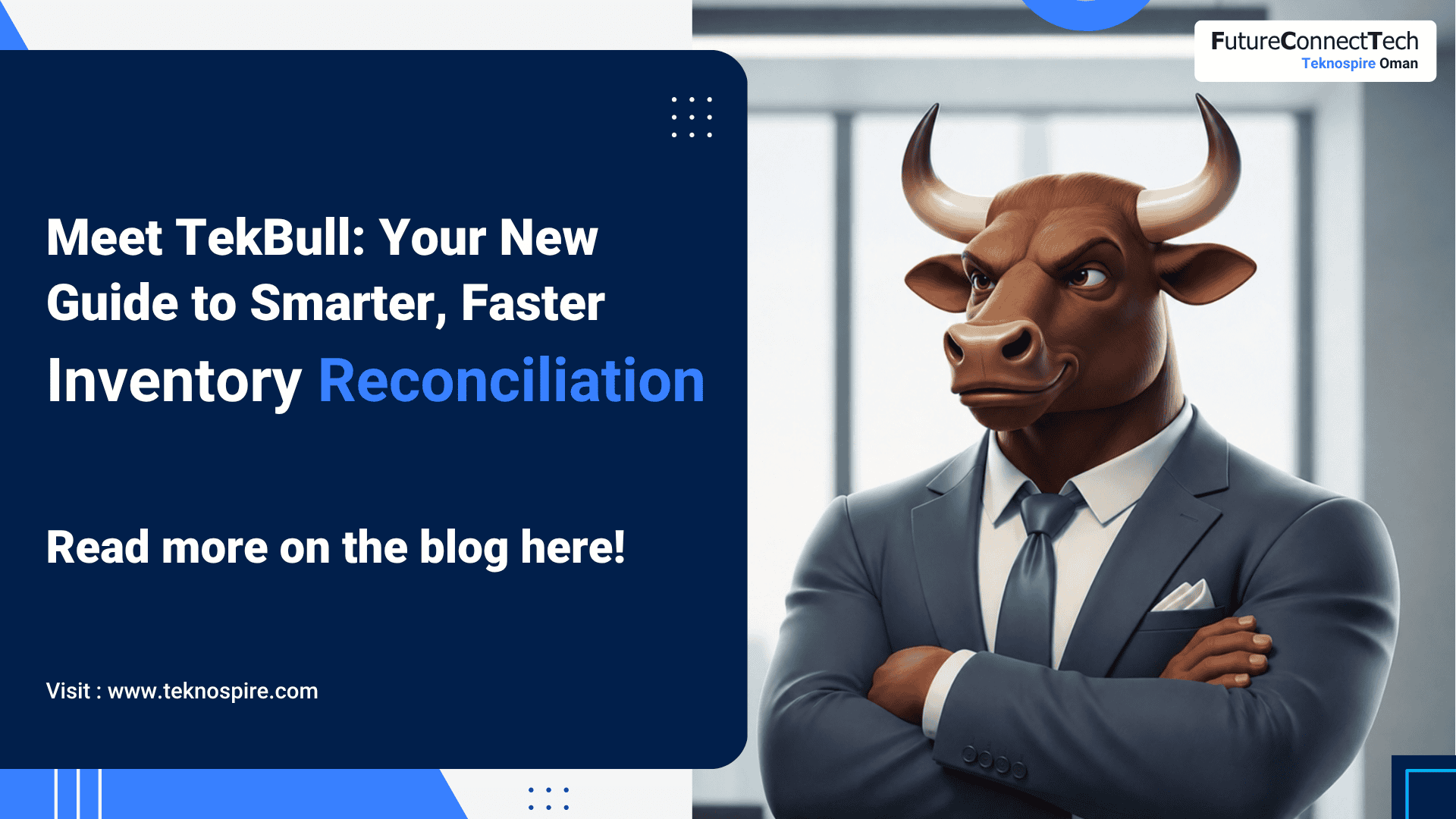
Before We Begin – A Quick Question
Which is faster?
A. A professional athlete completing a 100-meter sprint.
B. Your finance team completing the month-end close.
If you answered A, we have a reality check ahead. If you answered B, you are likely the target audience I’m speaking to because you know the truth: The month-end ‘close’ and the complex, manual inventory reconciliation that supports it has become a month-long marathon.
Who Am I?
I’m TekBull. I am the strategic guide at Teknospire and am here to help you and your team navigate the complexities of modern finance. I will show you how to build a strong and reliable finance function in the current market.
In the financial world, to be ‘Bullish’ is to look forward, stay strong, and commit to growth. While your competitors are stuck looking backward at old spreadsheets, I’m here to help your team trade that chaos for the strength of automated, data-backed precision.
I have seen 21 day month-end closes and met brilliant analysts who spend their weeks buried in spreadsheets to reconcile manually. There is a better way, and it has been available for a while now. I have something interesting for your finance and accounts team to know.
What is the real-time scenario faced by businesses in the GCC and MEA now?
Across the GCC and MEA, finance teams are managing more transactions than ever before. More subsidiaries. More currencies. More regulatory frameworks demanding audit-ready records at shorter notice.
And yet – the dominant tool in most finance functions for inventory reconciliation is still the spreadsheet.
Teams are manually exporting data from ERPs, converting file formats, matching rows by hand, chasing discrepancies over WhatsApp, and discovering million-dollar leakage problems three weeks after they happened. Month-end closes that should take days are stretching into weeks. Skilled professionals who were hired to analyse and advise are spending 60% of their time on data entry.
If you can connect and recall the situation at your office premises, I’ve something advisable for you to know! To start with, let’s understand the basic difference between traditional and modern reconciliation processes and what are the smart tips for the finance team to let go of bottlenecks and seek faster financial close.
Traditional Reconciliation vs Modern AI-Augmented Reconciliation
The Traditional Way
Someone walks around with a clipboard or a basic scanner. They count items. They type those numbers into a spreadsheet. They compare the spreadsheet against the ERP – manually, row by row. By the time the count is complete, new sales have already moved the numbers. The data is stale before the ink is dry.
Then comes the matching. Hundreds or thousands of transactions, cross-referenced by hand across purchase orders, sales records, and inventory logs. Errors creep in. Discrepancies get missed. And when month-end arrives, the whole team works overtime to close something that should have been running continuously all along.
The Modern Way
AI-augmented reconciliation platforms do not wait for month-end. They sync continuously – pulling purchase orders, sales records, and digital inventory logs automatically, matching them in real time, and flagging discrepancies the moment they occur.
No manual export. No format conversion. No row-by-row matching. The system handles the transactions. The team handles the strategy.
TekBull’s 5 Tips for Finance Teams Ready to Upgrade
Five things your finance team should be doing differently – starting now.
Tip 1: Data Collection is not Finance Work but more of Admin work
When the finance team is spending hours every month exporting files, converting formats, and copy-pasting numbers from one system to another, business owners are just investing into the team’s time and efforts which could be easily utilised for something more.
Modern AI-augmented platforms plug directly into your ERPs, warehouse management systems, and payment gateways. Once connected, data flows automatically across every site, every currency, every format. The gathering phase disappears entirely.
TekBull’s rule 1: If a human is doing it every month without thinking, a machine should be doing it instead.
Tip 2: Replace the Spreadsheet Match with a 3-Way Intelligence Engine
When we talk about the core of inventory reconciliation, matching 50,000 transaction rows by hand is not a finance strategy but a punishment.
A modern 3-way matching engine reconciles physical stock levels, consumed inventory, and invoiced sales simultaneously in minutes, not weeks. We are talking about 94% of reconciliations running without any human intervention at all.
TekBull’s rule 2: Your analysts should be reviewing exceptions – not creating them by making manual errors.
Tip 3: Find Your Phantom Inventory
Most finance teams discover leakage after it has already compounded for months. Phantom inventory – stock recorded in the system that does not exist in the warehouse. Vendor over-billing that slips through because nobody has time to cross-check. Shrinkage that sits undetected until the year-end audit.
Effective inventory reconciliation via AI-augmented platforms can catch these in real-time. One GCC conglomerate identified $2.1 million in annual leakage within a single quarter of switching to an automated platform.
TekBull’s rule 3: Leakage you cannot see is leakage you cannot stop. It’s important to get real-time visibility first.
Tip 4: Demand Mismatch with Explanations
A discrepancy demands an explanation that tells the team/leaders whether it is an FX variance, a partial settlement, a duplicate entry, or a counting error in plain language, before we even start investigating.
Modern AI platforms retrieve the most relevant historical records and surface the explanation automatically. CFOs should be getting answers before they ask questions to the finance team.
TekBull’s rule 4: 2026 is a timeline where leadership teams need a system that not only finds problems but also solves them.
Tip 5: Build Your Audit Trail in Real-time
Every time a finance team scrambles to compile audit documentation at year-end, it is a sign that compliance was treated as a destination instead of a process.
AI-augmented reconciliation platforms build an immutable, timestamped audit trail continuously — every transaction, every exception resolution, every approval logged automatically. When ZATCA, the UAE FTA, or any regional tax authority comes knocking, the documentation is already there.
TekBull’s rule 5: Compliance readiness must be a daily output and not a month-end task.
Final Takeaways from TekBull’s Diary
A 21-day month-end close doesn’t prove of how much efforts your team is putting up but needs a certain kind of technology to adopt to streamline the process.
The shift to AI-augmented inventory reconciliation is available now, and the businesses that have made the move are already closing books in 72 hours, recovering millions in leakage.
Let smart platforms handle the transactions and you can handle the strategy.
Are you ready to stop the manual data chase and start the charge?
TekBull will be back with more tips, smarter tactics, and the occasional uncomfortable question your finance team probably needs to hear. Follow this page to stay ahead of the curve with our upcoming tactical financial briefs.
Frequently Asked Questions:
What is Inventory Reconciliation in Accounting?
Inventory reconciliation is the systematic accounting process of comparing physical stock counts against the quantities recorded in the ERP system or ledger. The “book value” of assets must match the “actual value” on hand, identifying any gaps caused by shrinkage, damage, or reporting errors.
How Do You Reconcile Physical Stock with ERP Records?
This involves three steps:
1. Cycle Counting: Regularly verifying physical inventory against stock records.
2. Variance Analysis: Running a reconciliation report to compare physical data with ERP data to identify discrepancies.
3. Adjustment: Investigating the root cause of variances and updating the ERP to reflect accurate stock levels.
What Causes Inventory Discrepancies?
Inventory discrepancies are caused by clerical errors, shrinkage, vendor/supplier errors, unrecorded movements, and timing differences.
How Can Businesses Detect Phantom Inventory?
Utilizing AI-powered, real-time 3-way matching, it continuously cross-references purchase orders, goods receipts, and invoices. If the system indicates a high stock but sales or receipts suggest otherwise, the AI flags the discrepancy immediately.
How Does AI Improve Inventory Reconciliation?
It automates data ingestion across multiple systems (ERPs, WMS, Bank Portals), eliminates human error in manual data entry, and uses pattern recognition to predict and flag anomalies in real-time.
How Can GCC Businesses Reduce Month-End Close Time?
GCC businesses can significantly reduce month-end close time by shifting from manual, periodic reconciliation to continuous reconciliation. By automating the matching process, discrepancies are addressed daily throughout the month rather than being left to pile up. Books are “pre-reconciled” effectively turning a 21-day marathon into a 72-hour verification process.