The Digital Imperative for Saudi Banking
Saudi Arabia’s financial sector is undergoing one of the most accelerated transformations in the world. The Kingdom achieved a 79% cashless transaction rate in 2024 — surpassing its original Vision 2030 target ahead of schedule (Source: Saudi Central Bank / SAMA). By 2025, electronic payments accounted for 85% of all retail payments (Source: Saudi Central Bank / SAMA).
This pace of digitization is not just an opportunity — it is a mandate. For Saudi banks navigating surging transaction volumes, stringent SAMA compliance requirements, and growing competition from 260+ active fintechs in the Kingdom (Source: Fintech Saudi, Annual Fintech Report 2024), the ability to reconcile financial records accurately and in real time has become mission-critical.
This is where automated reconciliation software — and specifically FinRecon — becomes a decisive operational advantage.
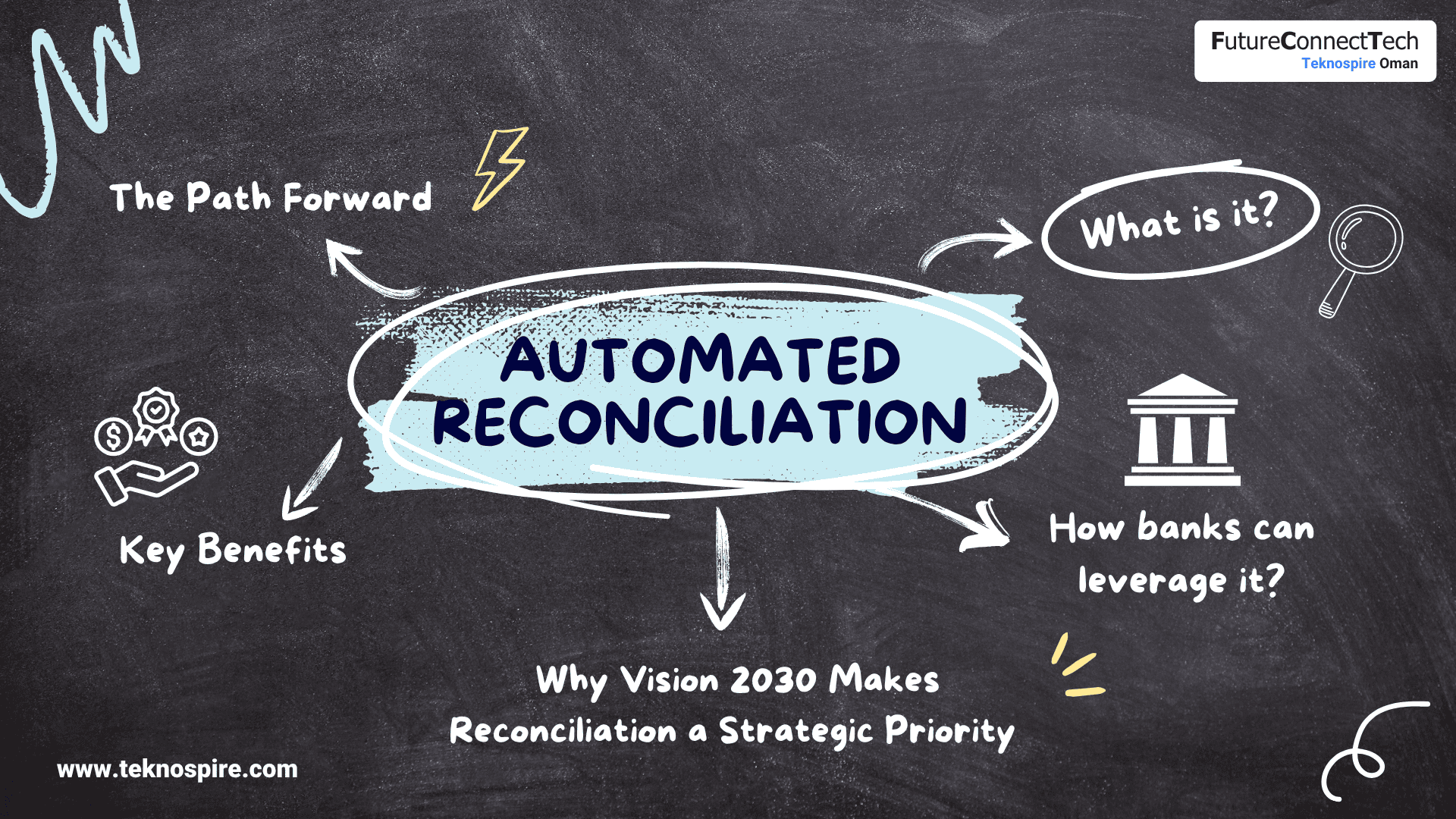
What Is Automated Bank Reconciliation?
Automated bank reconciliation is the use of software, AI algorithms, and real-time data matching to automatically compare and verify financial records across internal ledgers, core banking systems, payment gateways, and external bank statements – without manual intervention.
For Saudi banks processing millions of digital payments daily across SADAD, MADA, SARIE, and open banking channels, manual reconciliation is no longer viable. A single mismatch or delay can cascade into compliance risks, audit failures, and reputational damage.
In short: Automated reconciliation replaces spreadsheets and manual checking with intelligent, rule-based engines that match transactions in real time, flag exceptions, and generate audit-ready reports automatically.
Why Vision 2030 Makes Reconciliation a Strategic Priority
Saudi Arabia’s Financial Sector Development Program (FSDP) – a cornerstone of Vision 2030 – targets increasing the financial sector’s contribution to GDP to 8.2% by 2030 and boosting private sector credit to 200% of GDP (Source: Vision 2030 Financial Sector Development Program). To achieve this, Saudi banks must scale operations without scaling operational risk.
Several Vision 2030 drivers are directly increasing reconciliation complexity for KSA banks:
1. The Cashless Economy Push E-payments surged to 79% of all retail transactions in 2024 (Source: SAMA). Every digital payment creates a reconciliation event. Higher volume means higher reconciliation demand and higher stakes for errors.
2. Open Banking Expansion SAMA launched its Open Banking Framework in 2022, with Payment Initiation Services (PIS) rolled out in September 2024 (Source: SAMA Open Banking Policy). API-based data sharing between banks and licensed fintechs multiplies the number of transaction sources that must be reconciled daily.
3. Real-Time Payment Infrastructure Saudi Arabia’s SARIE (Saudi Arabian Riyal Interbank Express) system demands reconciliation at the speed of the transaction – something only automated systems can reliably deliver at scale.
4. SAMA Compliance Intensification SAMA requires financial institutions to maintain rigorous AML controls, data protection policies, audit trails, and cybersecurity standards under its Cybersecurity Framework and the Personal Data Protection Law (PDPL). Automated reconciliation systems provide the documentation backbone that these requirements demand.
5. The Fintech Surge With over 260 fintechs active in KSA as of 2024 (Source: Fintech Saudi, Annual Fintech Report 2024) and international players entering the market, traditional banks face mounting pressure to modernize back-office operations. Automated reconciliation is a foundational step in becoming a competitive, digital-first institution.
Key Benefits of Automated Reconciliation for Saudi Banks
- Real-Time Transaction Matching
Automated reconciliation engines ingest data from multiple sources — core banking systems, payment switches, digital wallets, and external bank feeds – and match transactions in real time. This eliminates the end-of-day reconciliation backlog that many KSA institutions still face with legacy workflows.
- Exception Management and Alerts
When a transaction cannot be automatically matched, the system flags it immediately and routes it to the relevant team for resolution. This reduces the time spent hunting for discrepancies from days to hours or minutes.
- Audit-Ready Reporting
Saudi banks must maintain detailed audit trails under SAMA’s Cybersecurity Framework and the PDPL. Automated reconciliation platforms generate timestamped, exportable reports that are ready for internal and regulatory audits at any time eliminating last-minute scrambles during review cycles.
- Multi-Channel Reconciliation
From MADA POS transactions to SADAD bill payments, digital wallets to SARIE interbank transfers, automated reconciliation handles multi-source, multi-currency matching within a single platform, critical for banks operating across Saudi Arabia’s increasingly complex payments ecosystem.
- Cost and Operational Efficiency
Manual reconciliation requires large back-office teams and is inherently error-prone. Automation reduces OPEX, reallocates human capital to higher-value tasks, and shrinks the error rate to near zero.
- Fraud Detection and Risk Reduction
AI-driven reconciliation tools detect anomalies, duplicate payments, unexplained variances, suspicious patterns faster than any manual process, providing an early-warning layer for financial crime and fraud that aligns directly with SAMA’s AML requirements.
FinRecon: Built for the Complexity of Modern Saudi Bank
FinRecon is purpose-built to address the reconciliation challenges facing banks and financial institutions in high-growth markets like Saudi Arabia.
FinRecon helps banks to:
- Import data in real time from multiple financial sources and systems
- Define custom reconciliation rules aligned with the bank’s specific products, payment channels, and SAMA requirements
- Reconcile financial records automatically using intelligent AI algorithms
- Access real-time dashboards and reports for management and compliance teams
- Scale without friction as transaction volumes grow alongside the Kingdom’s digital economy
FinRecon integrates naturally into a bank’s existing core banking infrastructure via open APIs, complementing the broader FinX platform suite, without requiring a full technology overhaul. For Saudi banks operating under SAMA’s evolving standards, this means faster deployment, lower implementation risk, and immediate operational impact.
What Saudi Banks Should Do Now
The window for proactive transformation is open. Here is a practical roadmap for KSA banking leaders:
- Audit your current reconciliation process. Identify where manual touchpoints, legacy systems, and unreconciled exceptions are creating operational and regulatory risk.
- Map reconciliation gaps to SAMA compliance requirements. Understand which gaps expose the bank to audit findings or regulatory penalties.
- Evaluate automated reconciliation platforms that offer real-time matching, open API integration, and configurable rule engines compatible with Saudi payment infrastructure (SARIE, SADAD, MADA).
- Pilot with a defined transaction channel before scaling across all payment types – this reduces implementation risk and demonstrates ROI quickly.
- Partner with a vendor experienced in GCC regulatory requirements, high-volume financial environments, and seamless core banking integration.
The Bottom Line
Saudi Arabia’s Vision 2030 is rewriting the rules of banking. With 85% of retail transactions now electronic (Source: SAMA, 2025), open banking live, and SAMA’s compliance standards tightening, the reconciliation function has moved from back-office necessity to strategic capability.
Automated reconciliation is no longer a “nice to have”, it is the operational foundation that makes a modern Saudi bank possible.
FinRecon is built to help Saudi banks meet this moment: reducing cost, ensuring compliance, eliminating errors, and keeping pace with the Kingdom’s ambitions.
Want to explore how FinRecon can transform your bank’s reconciliation operations?
Contact us to request a demo or speak with our GCC team.
Frequently Asked Questions
What is automated bank reconciliation software?
Automated bank reconciliation software uses AI and rule-based engines to match financial transactions across systems in real time, reducing manual effort and errors.
Why is reconciliation important for Saudi banks?
With high digital payment volumes and strict SAMA regulations, accurate reconciliation ensures compliance, prevents fraud, and avoids audit risks.
How does automated reconciliation help with SAMA compliance?
It creates audit trails, ensures data accuracy, supports AML monitoring, and aligns with SAMA’s cybersecurity and PDPL requirements.
Which payment systems need reconciliation in Saudi Arabia?
Banks must reconcile transactions across SADAD, MADA, SARIE, digital wallets, and open banking APIs.
Can reconciliation be done in real time?
Yes, modern automated reconciliation platforms enable real-time transaction matching and instant exception detection.
