TECH CONVERSATIONS AT TEKNOSPIRE • FULL STACK SERIES — PART 1
There are job titles in tech that sound self-explanatory until you ask someone to explain them. A full stack web developer is one of them. Ask five engineers what it means, and you will get five different answers, and all five will be partially right.
We decided to ask ours.
Teknospire is a B2B fintech company that builds financial infrastructure such as reconciliation platforms, treasury management systems, and escrow solutions for banks, conglomerates, and government entities across the GCC and MEA. Behind every platform we ship is an engineering team that builds, maintains, and scales complex financial software. Abhishek Singh is our Engineering Lead and, by any definition, a full stack web developer.
Lakshmi Thampi, our Marketing Manager, sat down with Abhishek to find out what full stack web development means and how one can build from database to dashboard.
This is Part 1 of a three-part series covering the full picture: the history of full stack development, what the role looks like today, what Abhishek does day-to-day, and where AI is taking the role next. Whether you are a developer, someone who works alongside developers, or simply curious about what engineers actually do; this series is for you.
Starting from Scratch: What Is Full Stack Web Development?
Lakshmi: Hello Abhishek. When someone says they are a full-stack developer, what does that actually mean?
Abhishek: Hey Lakshmi. The core idea is simple; a full-stack developer can work on both the front end and the back end of an application. The front end is everything the user sees and interacts with like buttons, pages, and forms. The back end is everything happening behind the scenes like the server, the database, and the logic that makes the app actually do something.
Lakshmi: Okay. Suppose I check my account balance on the banking app, what is the front end and what is back end there?
Abhishek: Great example. The front end is the screen you are looking at, the balance number, the transaction list, and the design. The back end is what happens when you hit the ‘refresh’ button, and a request goes to a server. The server queries a database, finds your account, pulls your balance, and sends it back to be displayed.
Lakshmi: Does taking on the full stack mean handling double the workload, or is it more about owning the entire system?
Abhishek: Not exactly. A full stack developer owns the complete journey of the data; from where it lives, to how it travels, to how it appears on screen.
A full-stack developer owns the complete journey of the data – from where it lives, to how it travels, to how it appears on screen.
How Did Full Stack Web Development Start?
Lakshmi: How long has this been a thing? Was it always like this?
Abhishek: Not at all. The term really took off in the early 2010s, but the idea of one person handling the whole stack goes back to the early days of the web. Back then, the web was simpler; you had a server, a database, and some HTML. One person could reasonably understand all of it.
Lakshmi: What did it actually look like ten years ago versus now?
Abhishek: Ten years ago, full stack meant you knew was a backend language; PHP or Ruby were common with a database like MySQL, and enough HTML and JavaScript to make the frontend look decent. You built the whole thing as one application called a monolith on a server you set yourself up. You owned every line. If something broke, you knew exactly which server and which line of your own code caused it.
Lakshmi: That sounds… stressful but also very satisfying? Like you had complete control.
Abhishek: Exactly right. There was no magic. Everything was transparent. The downside was that before you could build anything interesting, you had to spend weeks just configuring the server, setting up authentication, writing all the plumbing that the product didn’t need you to write. It was slow. There was a term for it, yak-shaving.
Lakshmi: Yak-shaving?
Abhishek: It means doing a long chain of increasingly pointless tasks before you can do the thing you wanted to do. You want to build a feature. At first, you have to update the server. To update the server you need to fix a dependency. To fix the dependency you need to… and so on. The yak needs shaving before you can get to the actual work. That was a real problem in the old approach.
What Does Full Stack Web Development Look Like Today?
Lakshmi: What has changed? What does full stack mean now?
Abhishek: Today, full stack really means systems integration more than it means writing everything yourself. Instead of starting from scratch, you are connecting a frontend framework, like React to a Backend-as-a-Service, wiring in third-party APIs for things like payments or authentication, and deploying it all on cloud infrastructure that someone else manages.
Comparison Table: Full Stack Web Development Scenario – Then Vs Now
Let’s understand how far we have progressed from the earlier days to today in the following table:
| Full Stack Development – Then Vs Now | ||
| Metric / Dimension | Then – Early 2010s | Now – 2026 |
| What does Full Stack Development mean? | A single person built the entire monolith from scratch. | Involves system integration and connects pre-built services, frameworks, & APIs into a working product. |
| Backend | Comprised PHP, Ruby, Python which were written and maintained manually. | Managed by third-party providers and comprises backend-as-a-service. |
| Database | Included MySQL and PostgreSQL which were self-hosted and manually configured. | Cloud hosted managed databases which can be set up in minutes. |
| Frontend | This comprises Basic HTML, CSS, JavaScript | This comprises React, Vue, Next.js frameworks |
| Authentication & Debugging | Was written from scratch hence any breakage could be tracked and fixed | Involved third-party services plugged in via API hence it’s difficult to track bugs which stay hidden |
| Shipping Speed | Required a huge team and weeks to set up features and get to action | A solo developer can handle all the actions all by himself now |
| Foundational Knowledge | One had to understand the base to build anything | Not compulsory. One can build anything with the help of modern tools. |
The biggest shift isn’t that full-stack development became simpler, it became more composable. Developers today can combine frameworks, APIs, cloud infrastructure, managed databases, authentication services, and deployment platforms instead of building every layer from the ground up.
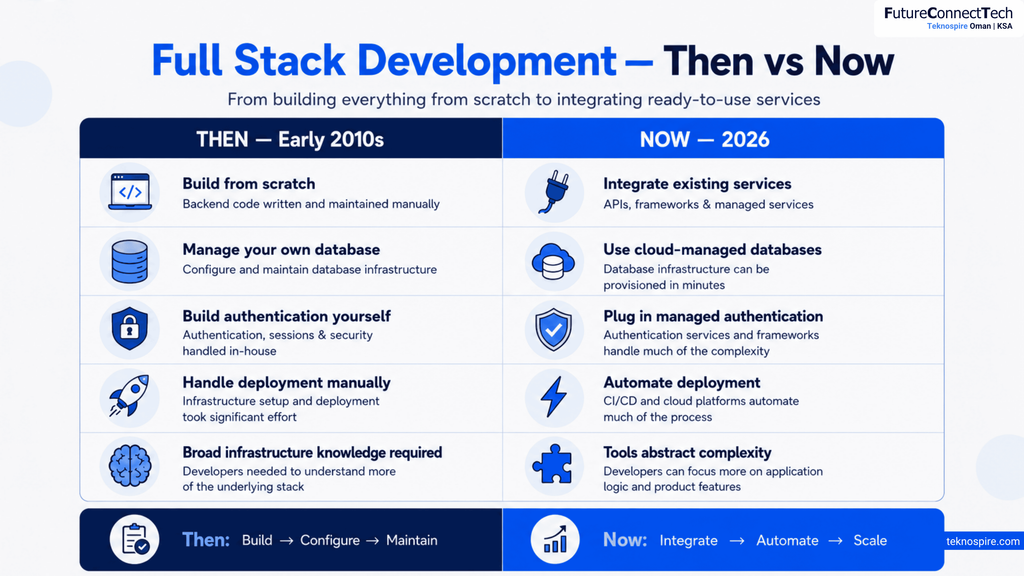
The result is a change in where developers spend their time. Earlier full-stack development often required significant effort across infrastructure, databases, authentication, deployment, and backend configuration.
Modern developers can rely on managed services and development tools for many of these layers, allowing more time to be spent on application logic, integrations, user experience, and business requirements.
Lakshmi: Can you elaborate ‘Backend-as-a-Service’?
Abhishek: Back in the 2000s, if your app needed to store user data, you built your own database server, set it up, secured it, backed it up, and maintained it. Today, you use a service like Supabase or Firebase where someone else runs the database, and you just connect to it.
The same applies for authentication where instead of writing your own login system, you plug in a service like Clerk. For payments, Stripe. The full stack web developer today is assembling powerful pieces that already exist rather than manufacturing every component from scratch.
You can spin up a globally distributed, auto-scaling application over a weekend. What would have taken months now takes days.
A single developer today has the leverage of an entire engineering team from 2015. The velocity is remarkable — and it comes with its own complications.
Has Full Stack Software Improvement brought Changes to the Development Cycle?
Lakshmi: Is modern full-stack development better than it was?
Abhishek: Massive improvement in productivity. The tooling we have today is genuinely phenomenal. TypeScript catches errors before you even run the code. Deployment tools mean you push code to GitHub, and it is live in seconds.
However, the cognitive load is crushing. Developers are burning out trying to keep up with the endless churn of new frameworks and libraries. Every year there is a new ‘best practice’ and everything you learned last year is apparently outdated. That is exhausting, especially for people just entering the field.
Lakshmi: How will you explain cognitive load?
Abhishek: Imagine every day at your job, not only do you have to do your actual work, but you also must learn a new version of the software you use to do that work. And the new version is a completely different way of thinking about the problem. That is what front-end development has been like for the last ten years. The tools keep changing faster than people can master them.
Lakshmi: Does the foundational stuff still matter?
Abhishek: Yes. Modern tools abstract so much away; many developers coming up now have never had to understand what is happening underneath. They can write a complex React hook. But they cannot tell you how HTTP protocols work, how the browser renders the DOM, or how to write an efficient SQL query.
But when the framework breaks, you need the fundamentals to diagnose what is happening. Without them, you are completely stuck.
The framework will break eventually. And when it does, the fundamentals are all you have left.
A Day in the Life of Full Stack Web Developer: KPAs for Abhishek
Lakshmi: When you sit down in the morning, what do you usually look at first?
Abhishek: I usually start with the backend, checking if there are any API failures overnight, reviewing database query performance, and seeing if anything is running slower than it should. My core strength is the backend, so that is where I feel most at home. Architecting databases, writing clean APIs, handling the business logic that makes the product actually do what it is supposed to do.
Lakshmi: Can you explain what ‘architecting a database’ means?
Abhishek: Let’s think of a database as a very large and organised filing cabinet. Architecting means deciding how many drawers to have, what goes in each one, how the drawers relate to each other, and how fast you can find what you are looking for.
How Do You Work With the Rest of the Team?
Lakshmi: Full stack seems like you work alone. But you are on a team. How does that actually work?
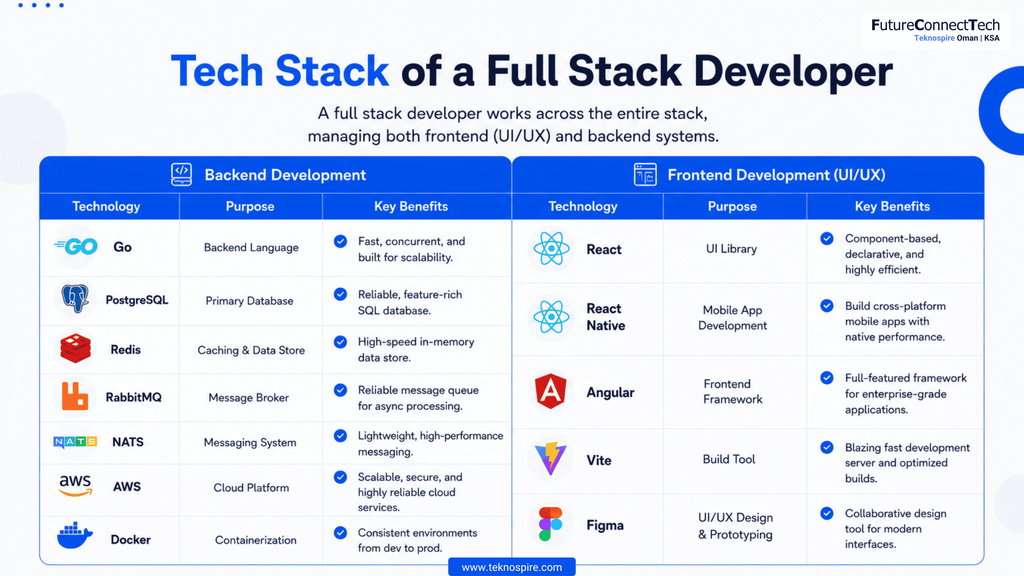
Abhishek: Full stack does not mean solo. It means I can cover the whole range if needed but at Teknospire I collaborate constantly. The three relationships that matter most for me day-to-day are front-end developers, UI/UX designers, and product managers.
With front-end developers, the most important conversation we have is about API contracts. Before we build anything, we agree exactly how the data should look when it travels between the backend and the frontend. What fields are included, what format they are in, and how errors are returned. If we agree on that upfront, both sides can build in parallel without constantly blocking each other. If we skip that conversation, we spend weeks fixing mismatches.
Lakshmi: Tell me about how your regular interactions go around with UI/UX designers.
Abhishek: With UI/UX designers, I look at their layouts and figure out how to map the backend data to what they have designed. Sometimes a designer will create a screen that assumes data exists in a format it does not actually exist in, or that requires joining five different data sources in a way that would be incredibly slow. I translate between what they want to show and what the backend can actually provide efficiently.
Lakshmi: How friendly is your relationship with the product managers at Teknospire?
Abhishek: With PMs, the conversation is about turning business ideas into technical specifications. A PM will say ‘users need to be able to do X.’ My job is to figure out what X actually requires technically, how long it would take, what the risks are, and whether there is a simpler way to achieve the same outcome. PMs bring the what. I help figure out the how and sometimes push back on whether the what is the right thing to build at all.
PMs bring the what. Engineers figure out the how and sometimes push back on whether the what is the right thing to build at all. And in collaboration, both together complete the project.
What Do You Genuinely Enjoy About Being a Full Stack Developer?
Lakshmi: What gets you engaged?
Abhishek: The control over the data flow. Because I build the backend, I know exactly how the data is structured across every field, every relationship, every edge case. When I then write the frontend code to call that API, I am not guessing how it works. I built it. I can move fast, ship confidently, and fix things quickly because I understand the whole system.
Lakshmi: What do u mean by genuinely good? I would like u to ponder?
Abhishek: When you track a complex bug, understand exactly why it was happening, fix it cleanly, and the system runs correctly afterwards. That is a very specific kind of satisfaction.
What Frustrates You?
Lakshmi: What do you find to be the hardest part of the job?
Abhishek: Pixel pushing, frontend CSS work, centering a div and fighting with browser-specific layout bugs. Making something look exactly right on the mobile when it looks fine on the desktop. Ofcourse, the user experience matters but when I have database queries to optimise or server code to refactor, spending an afternoon on why a button is two pixels off on an iPhone feels deeply unrewarding.
What Happens to the Full Stack Developer When AI Writes the Code?
Lakshmi: AI can write good code now at a fast speed. What does that do to your job?
Abhishek: It significantly changes the job but does not end that. However, I think some engineers are underestimating it. The parts of the job that were time-consuming but not intellectually complex like writing boilerplate code, setting up authentication flows, generating test cases, and scaffolding a new API endpoint can now be drafted by an AI tool in minutes. Work that used to take half a day takes an hour.
AI is very good at writing code when you know exactly what you want. The hard part is knowing what you want. That is still human work.
What Do Engineers Actually Need to Be Good at Now?
Lakshmi: So the engineer’s job becomes more about direction than execution?
Abhishek: That is a good way to put it. The value shifts from ‘I can implement this’ to ‘I know what to implement, why, and in what order.’ Architectural thinking. System design. Understanding the business problem deeply enough to translate it into the right technical solution. Those things AI cannot shortcut.
What Does ‘Coding Yourself Out’ Mean to You Personally?
Lakshmi: You mentioned this idea of ‘coding yourself out’. What does that mean?
Abhishek: It means building systems so well that they do not need you to babysit them. The reconciliation engine that catches 98% of mismatches automatically. The monitoring system that alerts the right person before a problem becomes an outage. The deployment pipeline that runs without anyone pressing a button. If I have designed those things correctly, I should not be the one getting called at 2am.
What Would You Tell Someone Starting Out in Full Stack Web Development Today?
Lakshmi: Moving on to the last question. If someone is starting out in full-stack development right now, what do you actually tell them?
Abhishek: Three things.
- Master the Fundamentals: Build a deep understanding of HTTP, databases, and browser rendering before relying on frameworks. Tools will change, but fundamentals are your foundation when systems break.
- Evaluate AI Critically: Don’t blindly accept AI-generated code—read, question, and verify it. The ability to critically audit AI outputs will be a defining engineering skill over the next decade.
- Develop Product Thinking: Care about who uses your feature and why it matters. Technical skills get you in the room, but product thinking is what makes you truly valuable in it.
The technical skill gets you in the room. The product thinking is what makes you useful once you are there.
Lakshmi: That is a good place to end. Thank you, Abhishek.
Abhishek: Thanks for making me think about this out loud. It was useful for me, too.
End of Part 1: A Wrap with Abhishek on the Full Stack Series
Over the conversations, Abhishek walked us from the very definition of full-stack development to what it looks like in daily practice to where the entire role is heading. The picture that emerges is not one of a narrowly technical job but a role that requires systems thinking, cross-functional collaboration, product awareness, and increasingly, the ability to direct intelligent tools rather than simply operate them.
We hope this series was useful whether you are a developer, someone who works alongside developers, or simply someone who has always wondered what engineers actually do all day. The answer, it turns out, is equal parts of building, thinking, collaborating, and occasionally fighting with CSS.
Glossary:
- Front end: Everything on a website or app that you can see and interact with — buttons, menus, text, images, and forms.
- Back end: The invisible engine running behind every app. When you tap a button, the back end receives that action, talks to the database, processes the logic, and sends the result back to your screen.
- Monolith / Monolithic Application: An older style of building software where the entire application — front end, back end, and database logic is built as one big, single unit. Everything is connected and runs together.
- PHP / Ruby: Programming languages used to build the back end of websites, especially popular ten to fifteen years ago.
- MySQL: One of the most widely used database systems in the world. It organizes data into tables and allows developers to search, add, update, or delete records quickly.
- HTML / JavaScript: The two basic building blocks of every website. HTML is the structure on the page (headings, paragraphs, buttons). JavaScript makes the page interactive; when you click something, fill in a form, or see content update without reloading the page.
- Boilerplate Code: Standard, repetitive code that almost every project needs — setting up user login, connecting to a database, handling errors.
- CSS (Cascading Style Sheets): The code that controls how a webpage looks — colours, fonts, spacing, layout.
Frequently Asked Questions
What is a full stack developer?
A full stack web developer is an engineer who works on both the front end (user interface) and back end (servers, databases, and logic) of an application. They own the complete journey of data from where it is stored to how it travels and displays on screen.
What is the difference between front end and back end development?
Front End: Everything the user sees and interacts with directly on screen, such as buttons, pages, layouts, and forms.
Back End: The invisible engine running behind the scenes, including the server, database, security, and business logic that makes the app function.
What does a full stack developer do on a daily basis?
A full stack developer typically:
> Monitors backend health, API performance, and database queries.
> Writes clean APIs, database schemas, and frontend interface code.
> Collaborates with UI/UX designers, product managers, and frontend engineers to translate business requirements into technical specs.
> Resolves edge cases, optimizes system performance, and debugs full-stack issues.
What skills do you need to become a full stack developer?
Core Fundamentals: Deep understanding of HTTP protocols, browser DOM rendering, and database architecture (SQL).
Technical Stack: HTML/CSS, JavaScript/TypeScript, frontend frameworks (e.g., React), backend services, and API development.
Systems & Product Thinking: Architectural design, cross-functional communication, and the ability to critically audit AI-generated code.
Is full stack development still relevant with AI writing code?
Yes. While AI speeds up routine execution (writing boilerplate code, generating tests, and scaffolding APIs), it cannot handle system architecture, product strategy, or complex problem-solving. The developer’s role is evolving from code execution to direction, system design, and auditing AI outputs.
What is a monolithic application vs. modern full stack architecture?
Monolithic Application: An older approach where the front end, back end, and database logic are built and hosted together as one single, tightly-coupled application.
Modern Full Stack Architecture: A modular, integration-based approach where a frontend framework (like React) connects to cloud infrastructure, Backend-as-a-Service (like Supabase), and third-party APIs (like Stripe or Clerk).