Every month, finance teams across the MEA brace themselves for the same grueling ritual of month-end reconciliation. They spend countless late nights juggling massive Excel workbooks, running manual VLOOKUPs, cross-referencing bank statements against ERP ledgers, and hunting down unexplained penny discrepancies.
For decades, spreadsheets were the gold standard of corporate finance. Today, in an era of high-frequency digital payments, multi-currency trade, complex supply chains, and stringent regulatory demands, manual reconciliation has come to a fade. The digital transformation has invaded through large enterprises and financial institutions.
Forward-thinking CFOs and enterprise finance teams are abandoning manual spreadsheet marathons for several reasons like scattered data sources, resource misallocation, payment complexities, transactional mismatches, higher chances of fraudulent actions, etc. Moreover, they are adopting AI-powered automated reconciliation software like Teknospire’s FinRecon; not just to save time, but to convert siloed financial data into real-time operational control.
Finance Teams and their Manual Reconciliation Struggles
As we interacted with finance and accounts teams across several MEA enterprises, we noted a couple of challenges encountered by them while dealing with reconciliation in the traditional form.
- Multiple, disparate and fragmented data sources with manual matching of transactions line by line leading to errors, fraud and misappropriation
- Complexities in partial payments, bulk transactions, or subtle mismatches
- Duplicate payments and missed deductions remain unresolved on balance sheets
- Extended month-end close cycles which run for 5–10 days longer than usual
- Lack of real-time view of cash position across entities which deprives CFOs and leadership teams of wise decision-making
- Increase in audit and compliance vulnerabilities
- Efficiency drains and resource misallocation causing them to devote 40% of their bandwidth on manual data entry and reconciliation task
How does Manual Reconciliation Differ from Automated Reconciliation?
Here, let’s understand the detailed contrast between reconciliation in the traditional way and the AI-empowered way. Enterprises in the MEA are adopting the digital transformation happening under the influence of AI (Artificial Intelligence) and ML (Machine Learning) and are witnessing the advantage in day-to-day activities.
| Manual Vs Automated Reconciliation | ||
| Metric / Dimension | Manual Reconciliation (Excel / Siloed Methods) | Automated Reconciliation Software (FinRecon) |
| Data Ingestion | Manual downloads of PDFs, CSVs, and bank SOAs from emails and portals. | Direct API integration, auto-email extraction, and data lake ingestion. |
| Matching Speed | Days or weeks of manual cross-referencing and line-by-line checks. | Real-time, continuous matching processing thousands of transactions in seconds. |
| Data Types | Handles basic, structured tables; struggles with unstructured scanned PDFs. | Normalizes structured, semi-structured, and unstructured data seamlessly. |
| Error & Fraud Detection | Detective: Errors discovered weeks after occurrence during month-end reviews. | Preventive: Real-time alerts for duplicate payments, policy gaps, and margin leaks. |
| Scalability | Linear: Higher transaction volumes require hiring more administrative staff. | Exponential: Handles millions of transactions without adding operational overhead. |
| Role of Finance Team | Tactical “detectives” stuck doing manual entry and searching for mismatches. | Strategic advisors focusing on liquidity, capital allocation, and risk management. |
Why Finance Teams Prefer Automated Reconciliation software over Manual Reconciliation?
Modern finance teams are willingly moving away from manual spreadsheet workflows to automated reconciliation software due to:
- Elimination of Tedious Data Entry: Automated platforms handle data collection and extraction automatically, freeing accountants from hours of manual copying, pasting, and VLOOKUP formatting.
- Continuous, Real-Time Processing: Instead of waiting for the stressful month-end rush, automated software reconciles transactions continuously throughout the month, turning the close into a quick review step.
- Intelligent Exception Handling: Rather than manually scanning thousands of matching lines to find a few errors, teams only deal with true exceptions that the system automatically flags and routes for review.
- Fewer Discrepancy Debates: Built-in audit trails and automated alerts remove ambiguity, making it easier to resolve vendor or client mismatches without endless email back-and-forth.
- Reduced Burnout and Higher Job Satisfaction: By taking over repetitive, mechanical work, automation allows finance professionals to focus on meaningful financial analysis, business strategy, and career growth.
How AI-Powered Reconciliation Platforms bring in Seamless Financial Operations?
As an AI-native reconciliation platform, FinRecon bridges the gap between fragmented data sources and executive decision-making. The technology behind FinRecon:
- AI-Driven Data Normalization: FinRecon uses machine learning and natural language processing (NLP) to read unstructured Statements of Account (SOAs), scanned invoices, and multi-lingual receipts (e.g., Arabic/English) directly from email inboxes or portals, automatically converting them into clean, structured records.
- Intelligent Multi-Tier Matching: Beyond rigid 1:1 matching, FinRecon’s engine handles complex 1: N (one payment covering multiple invoices) and N: N (bulk settlement batches against individual sub-ledgers) scenarios, accounting for FX variances and bank fees automatically.
- Predictive Exception Routing: Instead of forcing teams to search through thousands of rows, the automated reconciliation software instantly matches clean data and routes true exceptions to a centralized case management workflow with suggested resolution steps.
- Continuous Audit Trails: Every ingestion, match, adjustment, and approval is logged in an immutable, digital audit trail, ensuring continuous compliance with MEA regulatory standards or international audit frameworks.
What Potential Benefits Can be Derived from FinRecon?
The difference becomes even clearer when the traditional reconciliation workflow is viewed alongside an AI-native approach.
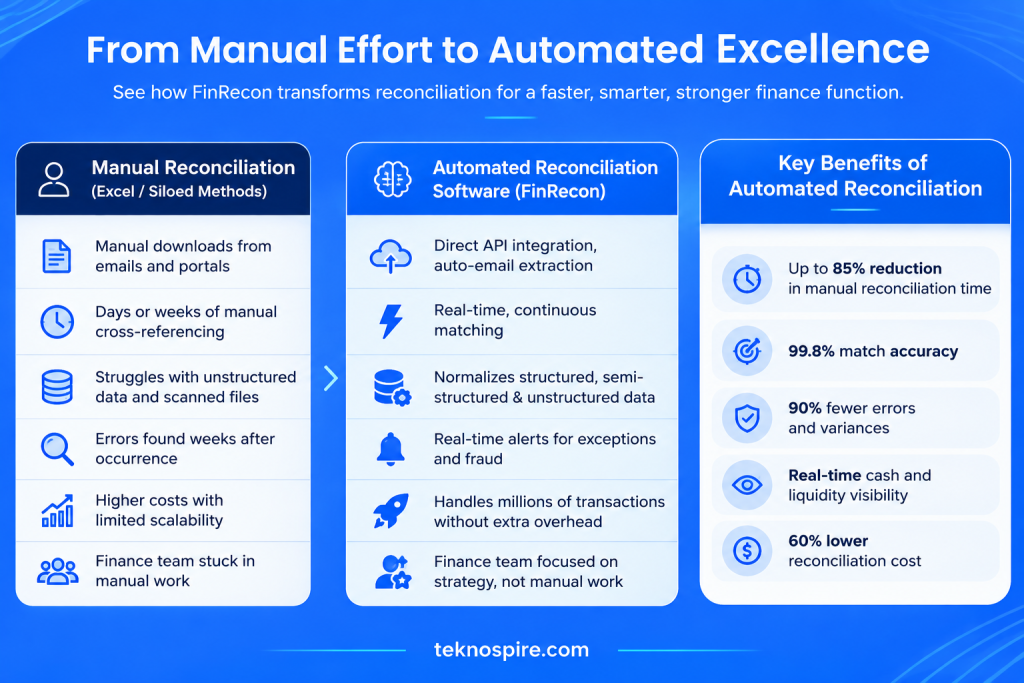
The shift is not simply from spreadsheets to software. It changes how finance teams spend their time, from collecting and comparing data to investigating meaningful exceptions and making faster financial decisions.
FinRecon delivers targeted value across every level of the finance organization; from the analysts managing daily operations to the executive leaders in steering enterprise growth.
For Finance Teams:
- 90%+ High First-Pass Match Rates
- Multi-Format AI Data Ingestion directly from email inboxes and ERPs.
- Automated Case Workflows speeding up dispute resolutions.
- Seamless Multi-Entity Handling of bank accounts, currencies, and business entities
For CFOs and Financial Leaders:
- Accelerated month-end close with faster access to reliable financial statements
- Early detection of financial leakage like duplicate payments, missing credits, unauthorized bank fees, and billing errors
- Real-time cash & liquidity visibility via interactive dashboards
- Guaranteed regulatory & audit readiness with immutable, time-stamped audit logs that ensure effortless regulatory compliance
Choose FinRecon: The AI-Augmented Automated Reconciliation Software
The debate between manual and automated reconciliation is over. Modern enterprises need a sustainable solution to ease their monthly reconciliation instead of relying on manual ones. Automated reconciliation platforms like FinRecon offer far more than operational efficiency when compared to manual spreadsheets.
They give enterprise finance teams control, precision, and strategic agility. By letting AI handle data ingestion, normalization, and complex matching, organizations free up their brightest minds to drive growth, protect margins, and navigate the future with confidence.
Ready to Modernize Your Finance Operations?
Discover how FinRecon can automate your complex reconciliation workflows, eliminate spreadsheet bottlenecks, and deliver real-time financial visibility. Schedule a demo with Teknospire’s experts today!
Frequenlty Asked Questions
What is automated reconciliation software?
Automated reconciliation software is an intelligent platform that uses AI and machine learning to match financial data across bank accounts, ERPs, and ledgers automatically. This eliminates manual spreadsheets and human error.
How does automated reconciliation software work?
It automatically ingests data from multiple sources (bank SOAs, invoices, emails), normalizes unstructured files using AI/NLP, runs multi-tier matching rules (1:1, 1:N, N:N), and routes unmatched items for automated exception management.
What is the difference between manual and automated reconciliation?
> Manual Reconciliation: Slow, error-prone, and relies on human cross-referencing in spreadsheets.
> Automated Reconciliation: Real-time, continuous, handles multi-currency/complex formats automatically, and catches financial leakages instantly.
Is automated reconciliation software suitable for banks and financial institutions in Saudi Arabia?
Yes. Platforms like FinRecon offer localized, cloud/on-premise deployment compliant with local data sovereignty laws and regulations established by SAMA and ZATCA under Saudi Vision 2030.
How does automated reconciliation software help with ERP integration?
It connects directly via APIs or automated connectors to major ERP systems to extract sub-ledger data, perform continuous matching, and post reconciled entries back automatically without manual CSV exports.