Lessons from the Field with Bhavani
Over coffee in our engineering hub, the Teknospire marketing team sat down with Bhavani Madhusudan, the Tech Team Lead, to discuss what it truly takes to engineer digital financial inclusion at scale.
Bhavani leads the end-to-end technical evolution and deployment of the FinX Agency Banking Platform; a multi-tenant, enterprise agency banking solution designed to support multi-country expansion across emerging markets.
Marketing Team: “Bhavani, when non-tech folks hear ‘Agency Banking,’ they think of a slick mobile app for field agents. What was your immediate realization when you took the lead on this multi-country rollout?”
Bhavani: “I had to learn very quickly that agency banking is not simply a mobile banking application. It sits right at the complex intersection of banking operations, field operations, hardware, spotty connectivity, and heterogeneous backend systems. The biggest learning curve was a lot more than just writing code. It was translating complex cross-border regulatory, operational, and currency requirements into configurable system behavior.”
Here is the technical story of how Teknospire evolved its core platform into a multi-tenant agency banking engine built to support cross-border scale, complex workflows, and active agent networks across regions.
Context-Setting for Last-Mile Banking
Deploying financial software across multiple international markets requires a complete shift in engineering mindset. Unlike traditional branch applications that operate on stable local networks, agency banking platforms face real-world field friction across diverse geographical operating environments.
- Regulatory & Compliance Fragmentation: Operating across diverse markets means accommodating drastically different KYC rules, biometric verification policies, identification document requirements, transaction limits, and multi-tier approval flows without hard-coding rules for every individual country.
- Field-First Realities: Agents operate on varying mobile and desktop hardware, under intermittent bandwidth, and in unpredictable physical environments. The software must maintain absolute data integrity even when connections drop mid-transaction.
- The Unknown Factor: “The biggest unknown going in,” Bhavani noted, “was how much regional and operational complexity we could consolidate within a unified, multi-tenant architecture while keeping the codebase maintainable, scalable, and configurable as new markets, currencies, and services were introduced.”
Rather than building bespoke, siloed applications from scratch for each country, Teknospire evolved its established FinX platform foundation into a highly configurable, multi-tenant agency banking platform.
Unfolding the Multi-Tenant Architecture & Technical Requirements
To replace legacy setups and support continuous regional expansion, the FinX Agency Banking platform was engineered around flexibility, scalability, and strict access controls:
- Agent Management & Multi-Tier Hierarchies: Single and bulk agent onboarding, activation workflows, multi-tiered agent network administration, and fine-grained role-based access control (RBAC).
- Dynamic Pricing & Multi-Currency Engine: Flexible service-level pricing and commission engines using amount-based grids with min/max caps. This supports country-specific promotional rates, role-level overrides, and branch-level commission structures.
- Core Financial & Loan Workflows: Seamless support for cash deposits, withdrawals, account-to-account (A2A) transfers, balance inquiries, as well as direct loan inquiry, disbursement, and repayment workflows.
- Digital KYC & Biometric Integration: On-the-spot customer onboarding, document capture with automated Document Management System (DMS) upload, phone number registration, and biometric fingerprint enrollment and validation.
- Multi-Country & Multilingual Governance: A localized tenant engine supporting multi-currency handling, dynamic UI content, localized error responses, and multi-lingual user messaging across different operating environments.
Engineering the Interoperability Layer: The FinX Switch
Integrating an agency banking channel with enterprise backend ecosystems, specifically legacy or heterogeneous Core Banking Systems (CBS) is rarely a single API call.
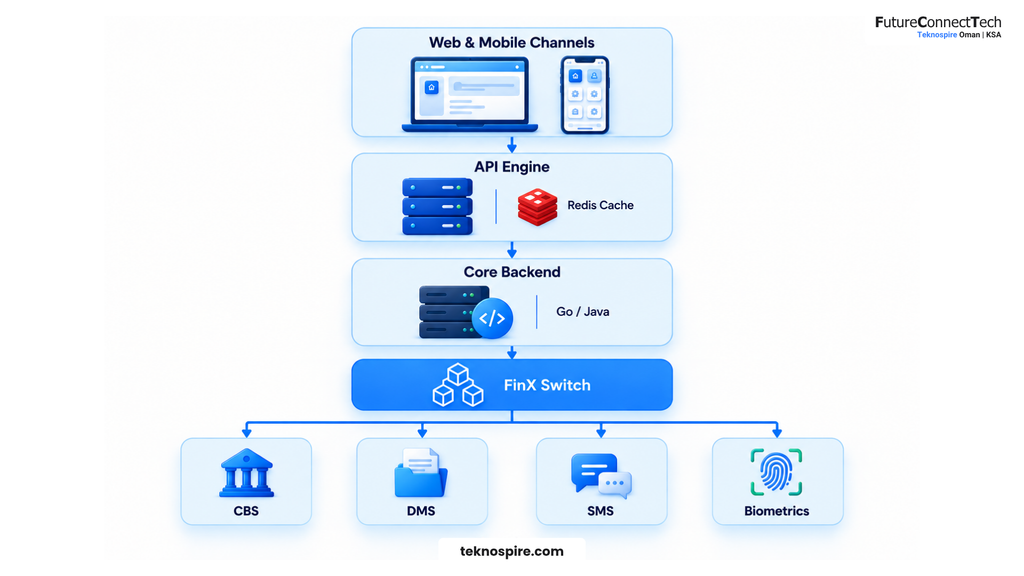
The FinX Switch was architected as the central integration hub and abstraction layer. The Switch orchestrates transactions between the agency channels and backend banking infrastructure, including the client’s Core Banking System (CBS), Document Management System (DMS), SMS Notification Gateways, and Biometric Authentication Servers.
Technical Deep-Dive: Orchestrating Heterogeneous CBS Interfaces
“The CBS integration required interacting with three to four distinct interface standards simultaneously,” Bhavani explained. “Each service interface had its own request/response structures, error formats, and authentication mechanisms. We built dedicated integration handlers within the FinX Switch to parse responses, manage token authentications, and maintain precise state management, ensuring that financial transaction states never get desynchronized between FinX and the backend CBS, even during network drops.”
The Deepest Technical Hurdle: Hardware-to-Cloud Biometric Orchestration
The single most technically complex capability to build was the end-to-end biometric hardware integration and authentication workflow.
To support secure field verification, the agency banking platform needed to integrate with specialized external biometric hardware devices. The challenge was bridging physical biometric scanners, vendor SDKs, mobile/web drivers, and backend banking validation APIs into one seamless, zero-friction field experience.
The Engineering Challenges:
- Cross-Platform Hardware Abstraction: On web portals, the solution had to interact cleanly with hardware drivers across various laptop models. On mobile devices, it had to interface natively with OTG-connected biometric hardware across a defined range of compatible mobile devices.
- Eliminating Driver Friction: To avoid requiring non-technical agents in remote locations to perform manual driver installations, the team packaged biometric drivers and device integration components directly into the application experience.
- API Optimization & Workflow Evolution: Bhavani’s team worked side-by-side with partner technical teams to enhance and optimize biometric APIs; transforming raw biometric template data into low-latency, highly reliable identification and transaction approval calls.
What’s Coming Up in Part 2…
Architecting a multi-country agency banking platform is only half of the battle. What happens when live database tables are locked under heavy field traffic? How do you track down an elusive bug where a cash deposit hits the wrong account due to multi-device agent logins?
Stay tuned for Series 2, where Bhavani opens up about the real engineering stumbles, database refactoring, field bug-hunting, and the personal pride of seeing 163.8K clients served; where 57% of them are women and 54,000+ loans were disbursed across Africa through code her team delivered.
Read part 2 here: https://teknospire.com/agency-banking-solution-saclling-lessons-africa/
Frequently Asked Questions
What is an agency banking platform?
An agency banking platform is an enterprise software solution that allows financial institutions to extend their services, such as cash deposits, withdrawals, transfers, and account openings to remote areas using third-party field agents equipped with mobile or web devices instead of traditional bank branches.
What makes a multi-tenant agency banking platform different from a standard one?
A standard platform serves as a single entity or market with fixed rules, whereas a multi-tenant platform uses a single, shared software architecture to serve multiple financial institutions or regional markets. It isolates each tenant’s data while allowing customized workflows, multi-currency handling, localized branding, and country-specific pricing rules without needing separate codebases.
How does an agency banking platform handle different regulatory requirements across countries?
Rather than hard-coding logic for each country, the platform uses a configurable rule engine. This allows administrators to dynamically set region-specific KYC parameters, transaction limits, biometric verification policies, multi-tiered approval flows, and local tax rules based on operating jurisdictions.
Why is Core Banking System (CBS) integration difficult in agency banking?
CBS integration is complex because legacy banking systems often use disparate, heterogeneous interfaces, varied authentication protocols, and inconsistent data formats. The agency platform must bridge these systems using an abstraction layer (like an API switch) to orchestrate state management and prevent transaction desynchronization during field network drops.
How is biometric authentication integrated into agency banking platforms?
It is integrated through hardware abstraction layers and vendor SDKs that bridge physical fingerprint scanners (via USB or mobile OTG connections) directly with the platform. The software packages device drivers into the application and sends captured biometric data via optimized APIs to backend authentication servers for instant field verification.