Finance teams across the GCC and MEA spend up to 40% of their working hours on reconciliation; matching invoices, comparing statements of accounts on receivables and payables, chasing discrepancies and closing books that should have closed days ago.
The direct costs of traditional methods of reconciliation comprise staff hours, overtime, and error corrections. However, they are visible. On the other hand, delayed decisions, compliance gaps, missed opportunities, and talent wasted on spreadsheet work are not seen under the naked lens and add to extended cost on the organization.
Finance teams across MEA conglomerates admit that manual reconciliation is not only slow but also expensive in ways they can ever fully calculate. FinRecon, Teknospire’s AI-augmented automated reconciliation software, is built to eliminate those costs. In this guide, we will discuss the hidden costs of manual reconciliation, the struggles faced by finance teams, how automated reconciliation resolves these issues, AI-augmented reconciliation, and its impact.
What Is Manual Reconciliation Actually Costing You?
Traditional reconciliation methods hide a couple of costs under them to be classified as an obvious or strategic cost or a compounding or an invisible cost.
- Time and labour: This is the obvious cost. Collections teams reconcile invoices against payments from multiple channels; cash, cheque, online, cards. Procurement teams match stock movements against purchase orders. Finance teams close books manually, consuming hours. Industry data shows $21,000 per analyst per year is spent on manual reconciliation tasks alone.
- Errors and corrections: This is the compounding cost. Manual matching leads to human error; missed entry becomes a discrepancy which then becomes an investigation. This delays the close leading to late hour decisions made on stale data. The cycle repeats every month.
- Compliance exposure: This is the invisible cost. Manual reconciliation rarely produces the audit trail that regulators expect. In markets where ZATCA mandates real-time invoice transmission and UAE FTA inspections exceeded 93,000 visits in 2024, an incomplete audit trail is a liability.
- Delayed financial close: This is the strategic cost. Month-end closes running 15 to 21 days makes the leadership team always work with yesterday’s numbers. Strategic decisions, procurement calls, and cash flow planning all suffer when the financial picture arrives late.
How Does FinRecon Help Finance Teams Save These Costs?
FinRecon automates the reconciliation cycle from data ingestion to exception resolution. In simple terms, all it does as an AI reconciliation platform is replacing manual effort with intelligent, continuous processing; turning finance team to analysts than being data entry operators.
What changes immediately:
- Data is pulled automatically from ERPs, bank statements, payment gateways, and APIs without any kind of manual exports.
- Transactions are matched intelligently across invoices, ledgers, and bank records simultaneously.
- Exceptions are flagged, triaged, and routed to the right person
- Month-end close is accelerated by up to 70%
- Time spent on reconciliation reduced by up to 85%
- 98% of reconciliations handled without human intervention
What Role Does AI Play in FinRecon?
AI makes reconciliation smarter and faster. Most reconciliation tools automate matching. Our automated reconciliation software, FinRecon embeds AI at every stage.
- AI-powered document intelligence: This reads scanned PDFs, bilingual Arabic/English invoices, and non-standard formats automatically. There is no need for manual template mapping.
- RAG-based mismatch explanation: When a discrepancy is found, AI explains why it happened in plain language. FX variance, partial settlement, and duplicate entry are identified and described without manual investigation.
- LLM reasoning layer: Complex reconciliation findings are translated into business-ready summaries for CFOs. Audit-ready reports get generated continuously, instead of bring compiled at year-end.
- Conversational AI agents: Finance managers ask questions in plain English and get an immediate, accurate answer without building a query or pulling a report.
Does AI replace the finance team?
No, AI does not replace the finance team exactly. Rather it empowers and causes the finance team to work in a much smarter way, thereby increasing their productivity. AI removes the work that should never require a finance team in the first place. 98% of routine and repeatable work runs automatically on the automated reconciliation software. The 2% that requires judgment gets to the right person faster, with context already attached.
Real-World Impact of AI Reconciliation Software: A GCC Conglomerate’s Experience
A multi-sector conglomerate in Riyadh was managing over 50,000 monthly transactions across Sarie instant payments and international vendors. Manual reconciliation was taking 12 days to complete; creating visibility gaps and compliance risk ahead of ZATCA audit cycles.
After deploying FinRecon, month-end close dropped to under 48 hours. The AI’s conversational agent surfaced $250,000 in unrecovered bank fees in the first month; funds that had been invisible in the manual process for months.
Let’s understand the contribution of FinRecon over this conglomerate:
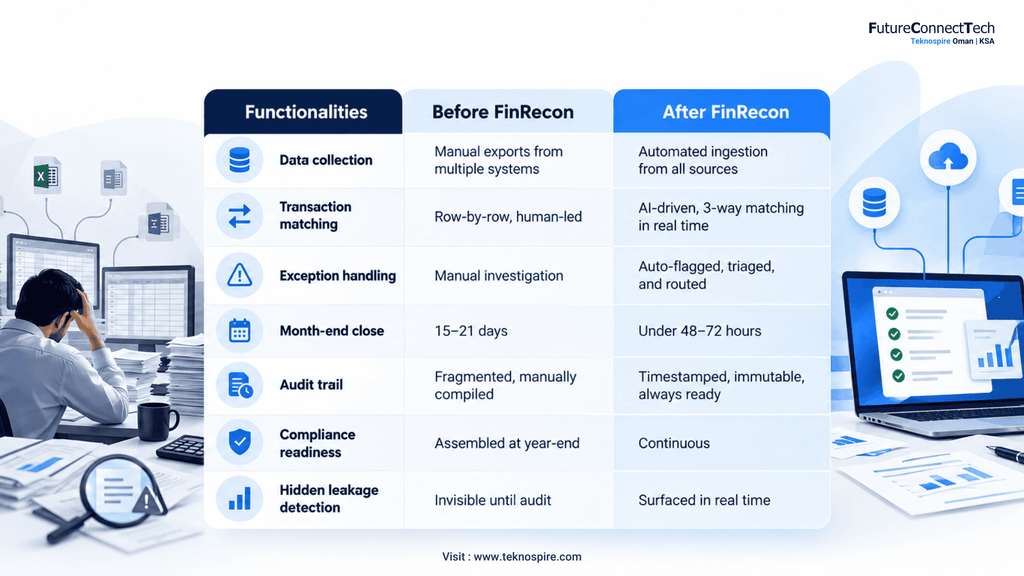
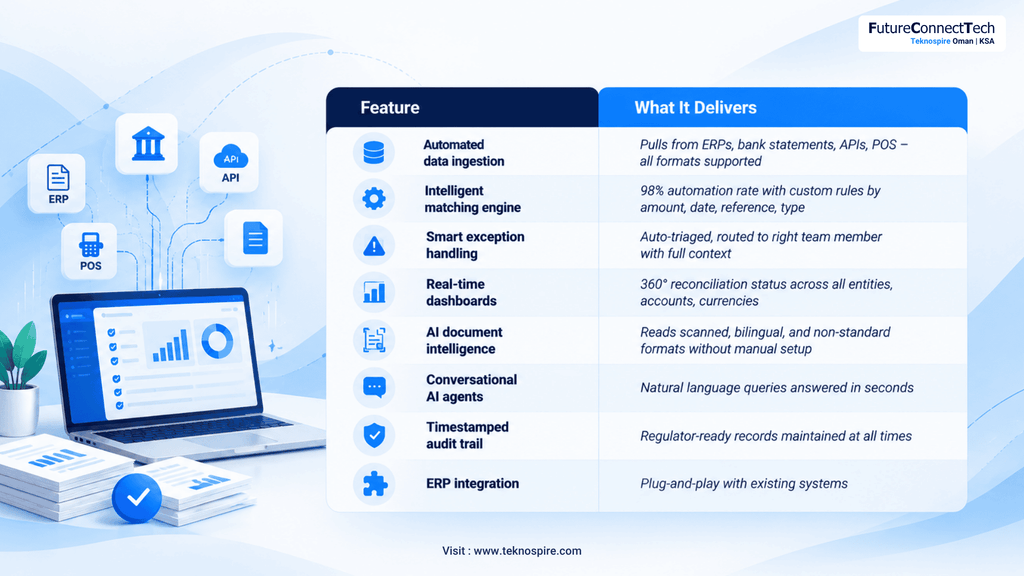
FinRecon Features and What They Deliver
To have a comprehensive understanding of the features and contribution of the AI-augmented automated reconciliation software, refer to the table below:
The Cost of Staying Manual Is Compounding
Every month when manual reconciliation continues, the cost grows in staff hours, delayed decisions, compliance exposure, undetected errors, and talent consumed by work that adds no value.
The GCC’s regulatory environment is not getting simpler. Transaction volumes are not going down. The finance function that cannot close books fast and cleanly will always be reacting rather than leading.
FinRecon was built for this operating environment. It automates 98% of reconciliations, cuts month-end close time by 70%, and gives finance teams their time back permanently.
The question is not whether automated reconciliation software makes sense. The question is how much manual reconciliation costs you every month when the switch does not happen. Join us for a quick demo to get a better understanding of the AI-native reconciliation platform.
Frequently Asked Questions
What is automated reconciliation software?
Automated reconciliation software is an AI-powered platform that automatically matches financial records such as bank statements, ERP ledgers, and invoices; eliminating manual spreadsheets and human error.
How does automated reconciliation software work?
It automatically pulls data from multiple sources (ERPs, APIs, bank statements), uses smart algorithms and AI to match transactions line-by-line, and routes unmatched exceptions to the right person for review.
What are the benefits of automated reconciliation?
The common advantages of automated reconciliation comprise faster month-end close, elimination of errors, audit readiness, and leakage detection.
How does automated reconciliation reduce manual work?
It eliminates manual data entry, statement downloads, and complex Excel VLOOKUPs by automatically ingesting data and matching transactions, allowing finance teams to focus on high-value analysis instead of repetitive admin work.
How do you choose the right automated reconciliation software?
Look for a platform that offers direct ERP and API integrations, multi-format AI document reading, real-time exception tracking, and proven compliance with regional tax and banking regulations.
Can AI automate financial reconciliation?
Yes. Advanced AI handles complex document extraction from scanned PDFs, explains discrepancy causes in plain language, generates executive summaries, and lets managers query financial data using natural language conversational agents.