In Series 1, we broke down the multi-tenant architecture powering the FinX Agency Banking Solution across diverse markets.
In this concluding part, Bhavani, the Tech Team Lead at Teknospire, steps out of the blueprint and enters into the trenches. She shares what happens when live systems break, how her team hunted down an elusive high-stakes field bug, and what it truly feels like to build software that drives real-world financial inclusion.
When Systems Lock: Decoupling Live Banking from Heavy Reporting
“Performance needs to be designed around platform growth, not just patched when an issue appears.” — Bhavani
As daily transaction volumes surged across multiple markets, the engineering team hit a major operational bottleneck: severe performance degradation on the transaction history service.
The Root Problem
Field agents and back-office admins were running heavy historical queries directly against the primary live transaction database. As traffic scaled, analytical reporting began competing for resources with live financial processing.
The Two-Step Architectural Solution
- The Quick Patch: The team temporarily restricted search windows in the agent portal to short date ranges to shield the primary database.
- The Permanent Architectural Fix: To solve this at scale, Bhavani’s team decoupled operational writes from analytical reads. They built a dedicated read-replica database instance dedicated to reporting and audit logs, synchronized automatically from the main database via asynchronous replication.
The Result
Sub-second response times across the board allowing heavy reporting without impacting live financial transactions in the field.
The “Ghost Account” Discrepancy: Hunting Down a High-Stakes Field Bug
In financial engineering, bugs carry direct monetary consequences. Bhavani recalls the most complex edge-case bug her team encountered: a cash deposit credited to the wrong customer account.
An agent initiated a deposit for Customer B, but the funds landed in the account of Customer A (serviced earlier that morning).
THE GHOST ACCOUNT BUG
Agent Logged In on Multiple Devices + 3G/4G Network Delays
│
▼
Stale Session State Created
│
▼
Payload named Customer B ──► Bound to Customer A’s Account Number
The 48-Hour Log Investigation
It took two days of continuous log analysis to reproduce the bug. The investigation revealed a rare alignment of edge-case factors:
- The agent was active across multiple devices simultaneously on shaky field connections.
- An 8-minute gap occurred between initiating the deposit and clicking submit.
- Stale session data on the client side misrouted the payload details.
The 3-Layer Defense Safeguard
To ensure this could never happen again, the team implemented strict session-level validation:
- Strict Account Binding: Payload details and account-to-customer IDs are re-verified at the exact moment of execution.
- Single Active Session Rule: Agent credentials are hard-locked to one active device session at a time.
- Idle Session Timeouts: Inactive field sessions automatically terminate after a set time limit.
Under the Hood: The Modern Tech Stack Powering FinX
To maintain high availability across offline-capable field environments and cloud infrastructures, FinX relies on a modular microservices stack:
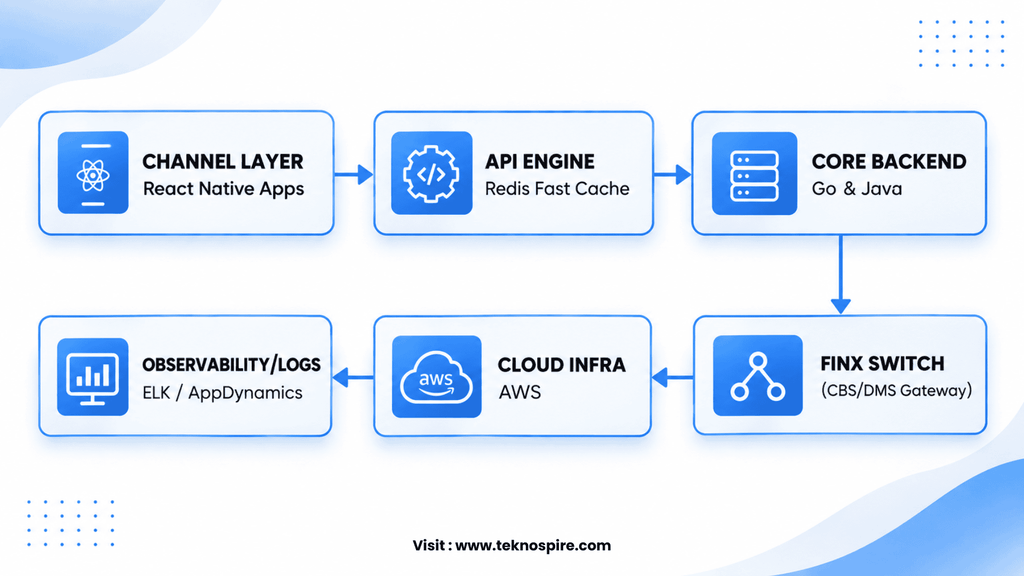
- Frontend Channels: Cross-platform React Native (Web & Mobile).
- API & Caching: Custom API Engine accelerated by Redis.
- Core Logic: High-throughput microservices built in Go and Java.
- Switch & Integration: Decoupled REST API connectors to Core Banking Systems (CBS), Document Management Systems (DMS), and SMS gateways.
- Database Layer: PostgreSQL (Primary transactional + Read-replica reporting stores).
From Code to Community: What Engineering Scale Really Means
For Bhavani, leading this project end-to-end, from initial requirements to multi-country deployment, redefined how she views software engineering.
“When we started, our client was using an incumbent vendor’s solution. Our agency banking solution completely replaced that legacy system across their existing markets and expanded into new countries; even becoming the core tool for internal staff onboarding.” – Bhavani Madhusudan
Impact by the Numbers
- 150,000+ Active Clients: “You realize this isn’t an enterprise demo anymore—real micro-entrepreneurs depend on this platform every single day.”
- Reaching the Underserved: “Seeing first-time users in rural communities’ access digital financial tools prove we are building bridges where inclusion matters most.”
- Tens of Thousands of Loans Disbursed: “A failed transaction isn’t just an error log; it’s a micro-loan that didn’t reach a shopkeeper who needed inventory that day. The impact at this scale changes how you write code.”
Ready to Scale Your Financial Reach?
From handling database loads and edge-case bugs to integrating biometrics and core banking systems, Bhavani’s experience proves that when robust multi-tenant architecture meets deep empathy for end users, technology can transform financial access across entire regions.
Ready to Scale Your Last-Mile Banking Infrastructure?
Is your agency banking solution network built to handle multi-country scale, complex backend integrations, and unpredictable field friction?
Connect with Teknospire’s solutions team today to see how Teknospire can empower your enterprise.
Frequently Asked Questions
What causes performance issues in an agency banking solution as transaction volume grows?
Performance degrades when analytical reporting queries and heavy historical searches run directly against the live transactional database, forcing analytical reads to compete for system resources with real-time financial processing.
How does an agency banking solution prevent transactions from being credited to the wrong account?
It enforces strict session-level safeguards, including strict account-to-customer binding re-verified at the moment of execution, limiting agent credentials to a single active device session, and automated idle session timeouts.
What tech stack powers a modern, scalable agency banking solution?
A modular microservices stack features React Native (frontend), Go and Java (core backend logic), Redis (API caching engine), PostgreSQL (decoupled primary and read-replica databases), and AWS (cloud infrastructure).
Can an agency banking solution replace an incumbent core banking vendor?
Yes. By deploying a modern, multi-tenant architecture with an abstraction layer (like the FinX Switch), the platform can fully replace legacy incumbent systems across existing networks and seamlessly scale into new international markets.
How does an agency banking solution support financial inclusion in underserved or rural areas?
It enables mobile field agents to deliver core services, such as cash deposits, withdrawals, biometric onboarding, and micro-loan disbursements—directly to rural micro-entrepreneurs using offline-resilient digital workflows without requiring physical bank branches.