Welcome back to Part 2 of our series on Full Stack Development. In Part 1, Abhishek broke down the foundational concepts of modern full-stack web development, detailing the core layers that make up modern software architecture.
In this edition, Lakshmi sits down with Nameer, from the Tech Team, to discuss what true end-to-end ownership looks like in daily practice, specifically through full stack development with AI. Whether you are an aspiring engineer or a finance leader in evaluating software delivery efficiency, this conversation offers a pragmatic look into modern engineering workflows.
Part 1 Recap & Setting the Stage
Lakshmi: Welcome, Nameer! In our previous post, Abhishek introduced us to the multi-tier blueprint of full-stack engineering. For deeper understanding, we want to know what kind of application you are currently building with full-stack architecture?
Nameer: Thanks, Lakshmi. Right now, I am building an internal project management system which handles task tracking, sprint management, and workflow visibility for cross-functional teams.
On the technical side, the stack is fast and lightweight:
- Frontend: React with Next.js for server-side rendering and responsive UI.
- Backend: Go (Golang) for high concurrency microservices.
- Data Layer: Connected databases and internal enterprise microservices.
Lakshmi: How does your daily cross-functional collaboration look compared to working in a single-discipline role?
Nameer: I work closely with backend engineers, DevOps specialists for cloud deployments, and product designers for UI expectations. I no longer hand off frontend tasks to a separate team. Rather, I own that layer end-to-end now, which cuts coordination overhead significantly.
Full Stack Development with AI: Tools, Tips, and Real-World Flow
Lakshmi: AI tools are everywhere right now. What specific AI tools sit inside your full-stack workflow?
Nameer: My primary AI coding assistants are Cursor (an AI-native code editor) and Claude.
Lakshmi: How do developers and teams integrate AI assistance into their development pipelines?
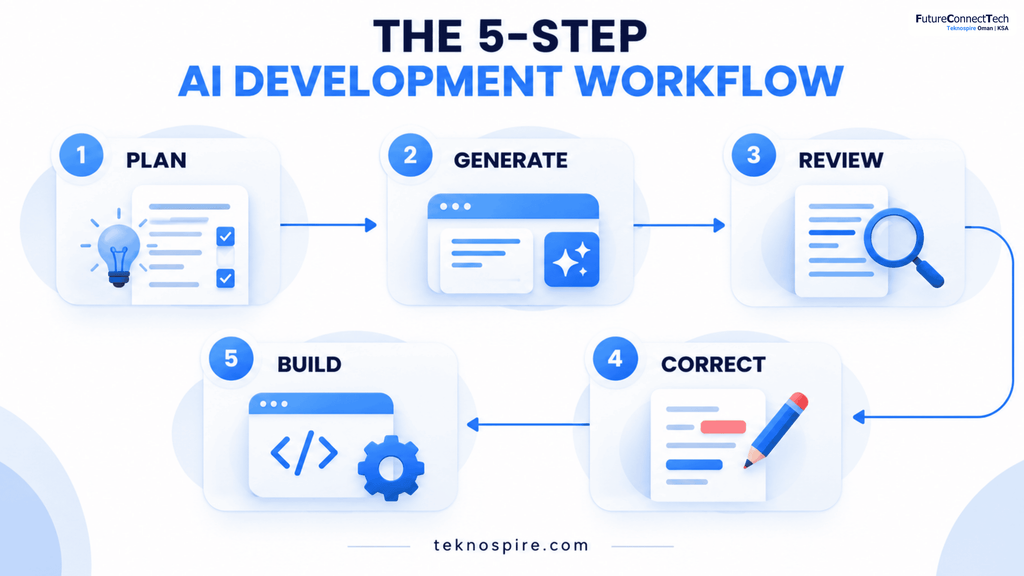
Nameer: Successful full stack development with AI happens through a structured process:
- Start inside your workflow: Use tools like Cursor that integrate directly into your existing editor. You don’t need to reinvent how you work; AI simply accelerates what you are already doing.
- Follow the 5-Step Process: Plan → Generate → Review → Correct → Build.
- Master the fundamentals first: Learn core React state management, API connections, and backend logic. AI makes you faster, not smarter. If your foundation is weak, AI just helps you build broken software quicker.
Lakshmi: What is the biggest advantage AI brings to your daily coding flow?
Nameer: Context switching without losing momentum. On any given day, I switch between Go backend services, Next.js frontend code, PostgreSQL queries, and Docker configs. Before AI tools, every switch required ramp-up time; checking documentation, recalling syntax, or searching online forums. Now, I describe what I need; the AI generates a starting point, and I review and refine. The biggest time savings isn’t writing code but staying in deep focus.
Pitfalls, Code Quality, and Enterprise Security Standards
Lakshmi: What is the most common trap you see developers falling into when relying on tools like Cursor or Claude?
Nameer: Skipping the Review and Correct Steps. Many developers jump straight from Plan to Build, blindly accepting whatever the AI outputs.
“AI-generated code is like a junior developer’s pull request. Most of it is right, and the part it gets wrong is exactly where your production bugs come from. The trap isn’t using AI too much; it’s trusting it without verifying.” – Nameer
Lakshmi: How do you ensure AI-assisted code meets strict enterprise quality, security, and performance standards before deployment?
Nameer: In full stack development with AI, generated code gets zero shortcuts. It goes through the exact same pipeline as code written by any human engineer:
- Manual Inspection: AI changes are often large, so I focus on my review where the risk is highest: authentication, data access, database queries, and business logic. I also run the feature myself to make sure it works the way the user needs it to.
- Automated Pipelines: Code passes through strict linting, unit tests, and integration testing pipelines.
- Security & Vulnerability Audits: We actively check for hardcoded secrets, missing error handling, overly permissive access controls, and bloated dependencies.
Infrastructure, Handoffs, and ROI for Financial Leaders
Lakshmi: What storage engines and deployment pipelines back your Go backend?
Nameer: We keep our infrastructure intentionally robust and straightforward:
| Layer | Infrastructure Component |
| Primary Database | PostgreSQL (Battle-tested transactional database) |
| Caching Engine | Redis (High-throughput in-memory caching) |
| Containerization | Docker (Ensures environment parity from dev to production) |
| Cloud Hosting | AWS (Scalable container orchestration and managed services) |
Lakshmi: For CFOs and engineering directors watching team productivity, does full-stack ownership reduce meeting overhead and project delays?
Nameer: Significantly. When I was strictly backend-focused, a single feature required 3 to 4 people. I would build the REST API, hand off technical specs to a frontend developer, debate data formats, wait for UI integration, and debug mismatches together. That cycle added a week or two per feature.
When one developer owns the full flow through full stack development with AI, coordination meetings disappear because there is nothing to coordinate. The meetings remain focused on product strategy and system architecture rather than API payload misalignments.
Guidance for Aspiring Engineers & Modern Tech Teams
Lakshmi: If an aspiring developer has 5 to 10 hours a week to learn full-stack development, what order should they follow?
Nameer: I’d go in this order, using AI as a tutor along the way, not as a shortcut:
- HTTP & REST APIs: Understand requests, responses, status codes, and JSON. This is the glue between frontend and backend.
- One Backend Language: Build a simple API in Go or Node.js that reads/writes to a live database.
- Raw SQL Basics: Learn raw queries, joins, and indexing before relying on an ORM.
- Frontend Core: Master React components, state hooks, and API integration.
- AI as a Tutor, Then a Tool: From day one, use AI to explain concepts, quiz you, and review code you wrote yourself. Let it write code for you only once you can read, evaluate, and debug what it generates
Lakshmi: What is one piece of career advice you wish you had received when starting out?
Nameer: “Think from the user’s perspective first, not the code.” Early on, I would jump straight into implementation; framework choices, architectural patterns, and code optimization. The better approach is working backward: “What problem is the user actually trying to solve? Understand the core requirement, align with the business, optimize the strategy, and then build.”
What’s Next in Our Full Stack Series?
Practicing full stack development with AI, when combined with disciplined coding workflows, provides an unprecedented leap in software delivery speed, architectural clarity, and operational efficiency. But how does this scale when transitioning from internal tools to complex, highly regulated financial systems?
In Part 3 of our Full Stack Series, we will explore Enterprise-Grade Full Stack Architecture for Financial Services. We will break down continuous reconciliation, zero-trust security layers, multi-tenant database isolation, and high-concurrency transaction processing.
Frequenlty Asked Questions
What is full stack development with AI?
Full stack development with AI is the engineering practice of using artificial intelligence tools, such as AI code assistants and automated generation engines to build both the frontend user interfaces and backend server infrastructure, accelerating software creation across every layer of the technology stack.
How is AI changing full stack development?
AI fundamentally shifts the developer’s role from writing every line of code manually to planning system architecture, evaluating generated logic, and reviewing outputs. It minimizes context-switching friction when toggling between backend APIs, frontend frameworks, database queries, and deployment configurations.
How can AI tools help full stack developers?
AI tools help developers draft boilerplate code instantly, debug syntax errors across multiple languages, explain complex API payloads, write unit tests, and maintain deep focus by providing real-time starting points without interrupting flow to check documentation.
What are the best AI tools for full stack development?
The top AI coding assistants include Cursor (an AI-native code editor for inline generation), Claude (for complex logic, system architecture, and code reviews), and GitHub Copilot (for real-time code completion across frontend and backend environments).
Can AI write full stack application code?
Yes, AI can generate complete functional snippets across the entire stack; from React components to Go backend APIs and SQL database queries. However, it requires human engineers to plan the requirements, review the code for security flaws, and integrate it into a production system.
Can AI replace full stack developers?
No, AI cannot replace full stack developers. While AI accelerates code generation, it lacks system-level context, business logic understanding, and user empathy. Full stack engineers remain essential to design architecture, ensure enterprise security, evaluate AI output quality, and solve actual business problems.