Financial Reconciliation

Treasury Management
Financial Inclusion, Financial Reconciliation, FinTech, Treasury Management

The Rising Demand for a Unified Financial Operating Platform in GCC While addressing the fragmented systems and data

Financial services across the Gulf Cooperation Council (GCC) are ascending at a progressive speed. Saudi Arabia’s Vision 2030 positions fintech as a core enabler of a more digital and globally competitive economy. Through the Financial Sector Development Program (FSDP), the Kingdom has been strengthening financial institutions, modernizing regulations, and expanding digital payments.   Simultaneously, it has licensed digital banks and built an environment for fintechs to scale faster and contribute to economic growth. Moreover, the Saudi Central Bank (SAMA) Open Banking Framework and ZATCA’s electronic invoicing integration have unlocked unprecedented avenues for real-time transactions, automated capital movement, and smart embedded finance.  Saudi Arabia has set explicit fintech growth targets under Vision 2030 which will be supported by the Saudi Central Bank, the Capital Market Authority, and Fintech Saudi, and several domestic digital banks.   However, many GCC institutions are still struggling with fragmented legacy cores, disconnected vendor systems, spreadsheets, manual reconciliations, and brittle integrations. To match the velocity of regional development, financial systems must transition from legacy siloed frameworks into highly integrated, unified networks.   True financial acceleration across the Middle East and Africa (MEA) lies in architectural unification. At Teknospire, with our GCC presence via Future Connect Technology LLC, we unify account reconciliation, escrow, embedded finance and treasury management operations into a single financial operating layer to bridge the gaps between disparate banking portals, corporate ERPs, and regional compliance structures.   We empower finance operations teams, corporate CFOs, and real-world asset developers to help align their internal infrastructure with the speed, compliance, and digital execution that the GCC’s next phase now demands.  The Spreadsheet Trap & Vendor Sprawl A maximum percentage of financial institutions in the GCC region use external vendors as part of their current technology setup. However, this massive vendor adoption has not replaced outdated technology; it has merely been layered around it. For instance, more than 60% of regional institutions offering core products like lending operate on exclusively legacy setups. Every single manual workaround, disconnected tool, and custom application layered onto an older system creates an exponential tax on the enterprise: This data fragmentation, siloed tools/platforms and dependency on external vendors hurls upon multiple challenges on financial leaders across the organization. This in the long run creates an impact on financial institutions/conglomerates where they find it difficult to upgrade their system applications: Breaking Down the Silos: Audience Pain Points & Teknospire’s Solutions 1. For Finance Operations (FinOps) Leads, Reconciliation Managers, and Head Accountants It supports flexible 1:1, 1:N, and N:N rule-based matching logic, stops financial leakage, offers immutable audit trails, and feeds real-time operational dashboards, so that CFOs can instantly access corporate liquidity.  2. For Group CFOs and Corporate Treasurers (Conglomerates & Large Enterprises) By automating intelligent cash pooling, multi-currency sweeping, and POBO (Payments on Behalf of) workflows, FinStream cuts treasury admin time by 93% and reduces the need for external corporate borrowing by up to 18%.  3. For Bank Trustees, Real Estate Developers, and Financial Leaders It cuts transaction cycles down from days to instant, automated releases upon verified inspector milestones, ensuring absolute compliance while building bulletproof stakeholder trust. The Power of a Unified Financial Operating System When senior decision-makers across KSA, the UAE, and Bahrain are asked what they expect from their software infrastructure, they aren’t looking for a list of disjointed features. They are explicitly asking for a single unified vendor.  In fact, executives in the MEA agree that a single unified vendor offers significantly more business value than managing multiple legacy platforms. What the Market Experiences (Fragmented Stack) What Unified Infrastructure Delivers (Teknospire)  Slow Launches: Release cycles dependent on multi-vendor code synchronization.  Accelerated Go-Live: Configurable frameworks designed for rapid deployment.  High Maintenance Costs: Accumulating operational debt from legacy workarounds.  Reduced Opex: Automated data parsing, email ingestion, and matching layers.  Fragmented Data: Disconnected information across ERPs, PDFs, and bank portals.  Single Source of Truth: Centralized dashboards showing immediate exception trends.  Compliance Friction: High risk of localized ZATCA, SAMA, or UAE regulatory misalignment.  Native Compliance: Built to adapt seamlessly to modern GCC frameworks.  Driving the Future of GCC Financial Intelligence The financial landscape across the GCC and broader MEA region has reached a point of no return. As central banks mandate continuous, zero-latency compliance and markets demand instant financial execution, the traditional approach of layering patchwork software on top of decades-old legacy code is an existential risk to enterprise growth. Today, Teknospire (Future Connect Technologies – FCT) resides at the very center of this regional evolution. By actively unifying fragmented multi-bank networks, real estate governance pipelines, and complex data streams for major conglomerates and institutions across Saudi Arabia, the UAE, and Bahrain, we have proven that architectural centralization is the only path out of legacy dependency. But our blueprint for the GCC’s financial future is much further. The Next Era: FinRecon as a SaaS Powerhouse To truly democratize financial clarity, we are actively shifting our flagship engines into a fully standardized, multi-tenant SaaS architecture. Enterprises of all sizes will soon be able to deploy FinRecon SaaS instantly through a secure browser interface. Whether you are a fast-growing regional fintech or a legacy multi-billion-dollar enterprise, elite automated data normalization, email ingestion, and matching logic will be accessible at the click of a button. Hyper-Automation: AI as the Ultimate Financial Control Plane Furthermore, the deep infusion of Artificial Intelligence and Machine Learning across the entire Teknospire product suite is completely reimagining the executive experience. For CFOs, finance controllers, and operations leads, AI is evolving from a back-office processing utility into a predictive assistant.  The era of manual data hunting, vendor deployment backlogs, and month-end closing anxiety is officially over. With Teknospire’s AI-driven, unified ecosystem, financial leaders are finally being handed the keys to absolute operational control. It is time to leave the spreadsheet marathon behind and command your financial future with complete market confidence. The future of Gulf finance is unified. Contact the Teknospire/FCT team today to experience the power of an AI-native financial operating platform. Frequenlty Asked Questions

reconciliation solution
Financial Reconciliation

FinRecon SaaS is the New Standard for MEA Finance

For years, CFOs and Finance Directors in the GCC have been forced to choose between two painful extremes: either stay shackled to manual, spreadsheet-driven processes or commit to massive, 6-month enterprise software implementations that consume time, capital, and patience. Now, we have come up with an upgradation to put an end to the compromise. We are officially flipping the switch on FinRecon SaaS. We have taken the industry-leading, AI-driven reconciliation solution that has transformed large-scale conglomerates and delivered it directly to your browser. Starting today, we are ushering in the Activation Era. Whether you are a high-growth FinTech, a multinational conglomerate, or a regional leader, the same power used to reconcile millions of complex transactions is now accessible, scalable, and instant. Aligning Your Finance Function with the GCC’s Digital Future With initiatives like Saudi Vision 2030 driving the need for transparent financial infrastructure, local conglomerates care looking for the right technology to adopt. FinRecon SaaS is designed to align with this vision, providing the agility to scale with the region’s growth while maintaining the rigid compliance standards required by the modern regulatory landscape. By adopting a modern reconciliation solution, organizations can ensure they are not just keeping up with digital transformation but are actively driving it from within their finance departments. Why Manual Reconciliation is a Hidden Strategic Risk? Manual spreadsheets = Silent costs. Every un-reconciled line item, every duplicate payment, and every pending audit query that sits in an email thread is a silent drain on the businesses’ bottom line. Moving to a SaaS-based model is more about better risk mitigation. With FinRecon SaaS, organizations can gain automated certainty, where the leadership team is updated on each happenings taking place and any discrepancy popping up to help them act accordingly. What is FinRecon? FinRecon is an enterprise-grade automated reconciliation solution engineered for complex business environments. It is designed to act as the single source of truth for financial and operational data. Its core capabilities include: Generated outputs can be automatically delivered to designated channels such as email inboxes, databases, file repositories, or downstream systems, eliminating manual effort and ensuring timely reconciliation. Understanding the SaaS Transition: Q&A Session By transitioning FinRecon to a SaaS model, we provide enterprises the power of enterprise-grade automation with the agility of the cloud. How is FinRecon deployed to meet enterprise compliance needs? We recognize that one size does not fit all. FinRecon is available via multi-tenant cloud SaaS, private cloud deployment for regulated industries, and dedicated tenant environments for large conglomerates with specific compliance requirements. We support region-specific hosting to meet stringent data residency regulations across the GCC and India. Is a SaaS platform suitable for high-frequency transaction environments? FinRecon is built for organizations that manage high volumes of transactions. Whether it’s an e-commerce giant, a payment service provider, or a multinational conglomerate, the platform scales to handle data volume without the need for additional on-premises infrastructure. How does this change the ‘Month-End’ close process? FinRecon SaaS enables continuous reconciliation. By syncing data automatically from ERPs, payment gateways or any other payment sources, discrepancies are identified and resolved daily. The close becomes a verification step rather than a month-long marathon. Data is a Strategic Asset Most finance teams view reconciliation as something to be finished so that they can move on to the real work. FinRecon SaaS flips that narrative. By centralizing the financial and operational data in a cloud-native ecosystem, organizations turn their reconciliation solution into a Business Intelligence powerhouse. The finance team works as data-strategists. One can identify payment trends, vendor reliability, and cash flow bottlenecks that were previously buried in the ERP. In the SaaS world, the reconciled is the roadmap for the conglomerates’s future. Who is FinRecon Built For? FinRecon serves organizations that operate in multi-entity, multi-currency, and high-frequency environments. Our primary users include: Industries Served: Large enterprises, banking and financial institutions, FinTechs, payment service providers, government entities, e-commerce, logistics, and insurance. FinRecon as SaaS: Moving Toward Intelligent Reconciliation Solution The era of manual, spreadsheet-driven reconciliation is ending. By leveraging FinRecon as a SaaS platform, organizations in the GCC and beyond can achieve a new standard of financial control. With deployment options ranging from public cloud to private hosting, and the ability to handle the most complex reconciliation logic, FinRecon is ready to help your enterprise scale its financial operations. Are you ready to transform your reconciliation workflow? Get in touch with our expert team for a quick demo! Frequently Asked Questions:

Reconciliation Platform
Financial Reconciliation

The Evolution of FinRecon: Our AI-native Reconciliation Platform

What if we told you that a messy, multi-currency financial mismatch that used to take an entire finance team three weeks to unravel can now be resolved in under 60 seconds? It may sound like a fantasy but at Teknospire/FCT (Future connect Technologies), we have spent the last seven years deep in the trenches of the Middle East and Africa (MEA) market, watching brilliant finance professionals drown in sea of Excel rows, broken formulas, and missing PDFs. Our time in the market taught us that the traditional month-end close was slow and fundamentally broken. Here I’m. TekBull; your guide through the shifting tides of financial technology. Today, I’m pulling back the curtain on how a single, chaotic operational bottleneck at an African bank in 2019 sparked a revolution, evolving into our flagship enterprise reconciliation platform: FinRecon. How an Accidental Product Took Birth in the Trenches? Back in 2019, our team was working on client engagement with a major bank in Africa. The operational reality inside their finance department was chaotic. Transaction data was flooded in from multiple legacy banking systems, payment gateways, and third-party partners. Every file arrived with a completely different format, structure, and naming convention. The bank’s solution comprised an army of analysts copy-pasting numbers into massive Excel spreadsheets, trying to manually generate customized reports for internal auditing. The human effort was staggering, the errors were frequent, and the dependency on tribal Excel knowledge was a ticking strategic risk. We didn’t sit down to build a commercial software product. Instead, we built a highly focused, custom SQL-based engine designed to do one thing: ingest multiple Excel files, automatically compare the data sources, and spit out clean, customized reconciliation outputs. It was a utility built to solve an immediate operational nightmare which worked flawlessly for this client. The Universal Spreadsheet Trap After the bank deployment succeeded, we deployed the same SQL engine internally to handle our own accounting tasks, such as Statement of Account (SOA) matching, finance ledger balancing, and month-end closing activities. That is when we noticed a recurring pattern across several industries: Enterprises were universally trapped in a fragmented financial loop. Their data was scattered across ERPs, bank statements, PDFs, vendor invoices, and isolated spreadsheets. Reconciliation was much more than just a banking issue; it was a massive corporate epidemic. The FinRecon Evolution Timeline We knew we had to scale the architecture, so we transitioned from a hardcoded utility into a highly configurable, enterprise-grade automated reconciliation platform. Here is how we did it: April 2019: The Internal Utility Stage July 2019: The First Enterprise Proof of Concept February 2024: The Workflow Engine Revolution August 2024: Infusing OCR & AI Capabilities March 2025: The Automated Email Ingestion Layer Current Stage: The Complete Enterprise Reconciliation Platform What Real-World Business Problems Are We Solving? Most enterprises still attempt to reconcile high-volume transaction data manually which ultimately triggers:  Our financial reconciliation platform, FinRecon addresses these by centralizing, standardizing, and operationalizing the data stream. Why FinRecon Pulls It Off Where Others Fail Generic software packages in the market often fail to reconcile because they expect clean data. Real enterprise data is incredibly messy and FinRecon excels because it adapts to corporate chaos through eight core architectural pillars: 1. Absolute Workflow Flexibility: Every organization has unique approval structures and matching tolerances. FinRecon provides highly configurable business rules (1:1, 1:N, and N:N matching) rather than forcing rigid templates onto your finance function. 2. Ingestion of Real-World Data: Whether it’s a poorly formatted text file, an ERP export, a scanned PDF, or an Excel sheet with inconsistent references or data extracted directly from ERPs, Databases and APIs, our AI-assisted extraction cleanses and normalizes the data automatically. 3. Radical Reduction in Manual Dependency: By automating the entire cycle from email ingestion to matching and reporting, we dramatically lower turnaround times and eradicate human data-entry risks. 4. Rapid Enterprise Implementation: Corporate clients can deploy our pre-built modules (matching engine, case management, OCR layer, and dashboard templates) immediately. 5. Insightful Operational Dashboards: Our real-time dashboards give CXOs and finance directors immediate visibility into match vs. unmatched trends, exception volumes, aging analysis, and pending approvals. 6. Built-In Enterprise Case Management: FinRecon doesn’t just find errors; it helps you solve them. Unmatched records automatically flow into a structured tracking system complete with investigation workflows, escalations, and immutable audit trails.  7. High-Volume Merchant Settlement Tracking: For modern digital commerce ecosystems, the platform tracks expected vs. actual bank settlements, payment gateway deductions, delayed funds, and chargebacks.  8. Uncompromising Product-Market Fit: FinRecon is an enterprise-tested platform that aligns perfectly with modern compliance standards like Saudi Vision 2030, ZATCA, and SAMA frameworks.  The Road Ahead: The SaaS Activation Era By August 2026, we are launching our fully standardized, multi-tenant SaaS architecture. This FinRecon transition from an AI reconciliation platform to SaaS will allow organizations of all sizes across the GCC and global markets to deploy the same elite financial automation capabilities instantly through their browsers, without massive on-premises infrastructure rollouts.  The era of manual, spreadsheet-driven reconciliation is officially over. Are you ready to stop treating reconciliation as an administrative hurdle and start leveraging your financial data as a strategic powerhouse?  Let’s connect. Get in touch with our team today to see a live demo of FinRecon in action!  —————————————————————————————————————————  Footnote:  FCT: India-based fintech Teknospire serves multiple African and Asian countries. It has expanded its footprint to deliver advanced MEA fintech solutions under Future Connect Technologies (FCT).  TekBull: He is the strategic guide at Teknospire guiding CFO, finance controllers and teams to navigate the complexities of modern finance.  Frequently Asked Questions

Automated Reconciliation in KSA
Financial Reconciliation

The CFO’s Guide to Automated Reconciliation in KSA and the Wider GCC

For the modern CFO in the MEA region, reconciliation has moved ahead from being just a back-office task to a front-line risk. As the spreadsheet era ends, the demand for automated reconciliation in KSA and the wider GCC is reaching a fever pitch. Artificial Intelligence has emerged across the years and is now blooming as a gamechanger in finance operations. In a landscape defined by rapid regulatory changes and cross-border transactions, AI-first reconciliation platforms led by innovators like Teknospire’s FinRecon moves beyond simple rule-based matching to agnostic data ingestion. AI in reconciliation uses Machine Learning (ML) to understand patterns, meaning it can handle unstructured data from disparate sources—such as PDFs, WhatsApp payment receipts, and varied bank formats across different jurisdictions without manual intervention. What CFOs need to know about AI in account reconciliation? In the GCC, where Vision 2030 (KSA) and Vision 2040 (Oman) are driving rapid digitization, the push for automated reconciliation in KSA is centred on accuracy. Smart, cognitive systems like FinRecon autonomously extract and interpret data with up to 95% accuracy. For the CFO, this means moving from correcting the past to steering the future with verified, real-time data to build a resilient, transparent, and scalable finance function and enable better decision-making. The MEA region is at a digital tipping point. With AI-first engine that matches, flags, and reports automatically, leadership teams can build a resilient finance function capable of scaling at the speed of the region’s ambitions. Difference between Traditional Reconciliation and AI-Native Reconciliation Feature  Traditional Reconciliation  AI-Native Reconciliation (FinRecon)  Operational Method  Human-led; technology acts only as a basic calculator.  AI-led; humans act as strategic governors and exception managers.  Data Ingestion  Rigid templates; struggles with unstructured data (PDFs, images).  Agnostic Ingestion; seamlessly extracts data from bilingual invoices and diverse formats.  Matching Logic  Basic 1:1 rule-based matching; prone to missing complex links.  Complex Pattern Recognition; effortlessly handles 1:N and N:N (many-to-many) scenarios.  Speed & Frequency  Periodic (weekly/monthly); creates “visibility gaps” and late-month stress.  Continuous & Real-time; data is reconciled as it flows, enabling an “always-on” close.  Risk Management  Reactive; fraud or errors are often discovered weeks after the event.  Proactive & Predictive; identifies anomalies, duplicates, and FX variances in real-time.  Audit Quality  Fragmented; relies on manual paper trails and scattered spreadsheets.  Deterministic & Traceable; maintains an unalterable, automated audit trail for local regulators.  The AI-Augmented Rescue: Transformation from Manual to Automated The journey from manual to automated reconciliation in KSA is a shift from human-led, tech-supported system to AI-led, human-governed platform.  How AI-Augmented Reconciliation is Impacting Financial Controllers Financial Controllers are now shifting their roles towards being strategic advisors by leveraging three core architectural principles: Key Application Industries That Underwent a Transformation Several sectors are leading the charge in automated reconciliation in KSA and the MEA: What Measurable Benefits are Drawn by CFOs and Leadership? Deploying an intentional AI stack delivers clear, measurable ROI for MEA enterprises: Take the Next Step Toward Financial Clarity With the rapid adoption of FinRecon, the MEA region is heading towards setting global financial standards for automated reconciliation in KSA. For the modern CFO, the AI-native core platform is providing the clarity needed to navigate through the complexities of the global market. Don’t let manual reconciliation be the bottleneck to your growth. Experience how Teknospire’s FinRecon can transform your fragmented data into a strategic asset. Request a personalized demo and connect with our specialists in the GCC to start your AI-first transformation journey. Contact Teknospire Today Frequently Asked Questions

Automated bank reconciliation software
Financial Reconciliation, FinNews

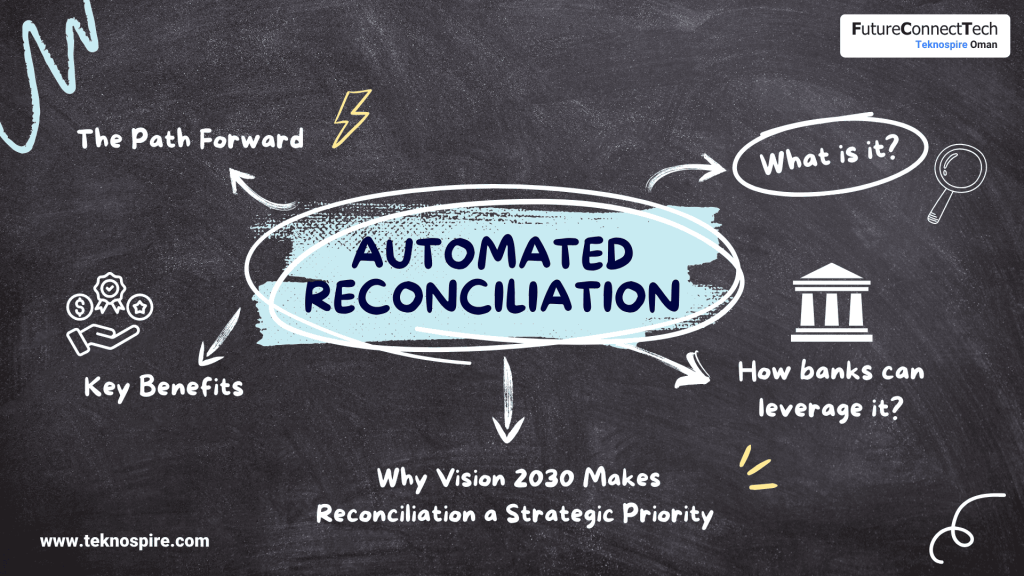
How Saudi Banks Can Leverage Automated Reconciliation Software Under Vision 2030

The Digital Imperative for Saudi Banking Saudi Arabia’s financial sector is undergoing one of the most accelerated transformations in the world. The Kingdom achieved a 79% cashless transaction rate in 2024 — surpassing its original Vision 2030 target ahead of schedule (Source: Saudi Central Bank / SAMA). By 2025, electronic payments accounted for 85% of all retail payments (Source: Saudi Central Bank / SAMA). This pace of digitization is not just an opportunity — it is a mandate. For Saudi banks navigating surging transaction volumes, stringent SAMA compliance requirements, and growing competition from 260+ active fintechs in the Kingdom (Source: Fintech Saudi, Annual Fintech Report 2024), the ability to reconcile financial records accurately and in real time has become mission-critical. This is where automated reconciliation software — and specifically FinRecon — becomes a decisive operational advantage. What Is Automated Bank Reconciliation? Automated bank reconciliation is the use of software, AI algorithms, and real-time data matching to automatically compare and verify financial records across internal ledgers, core banking systems, payment gateways, and external bank statements – without manual intervention. For Saudi banks processing millions of digital payments daily across SADAD, MADA, SARIE, and open banking channels, manual reconciliation is no longer viable. A single mismatch or delay can cascade into compliance risks, audit failures, and reputational damage. In short: Automated reconciliation replaces spreadsheets and manual checking with intelligent, rule-based engines that match transactions in real time, flag exceptions, and generate audit-ready reports automatically. Why Vision 2030 Makes Reconciliation a Strategic Priority Saudi Arabia’s Financial Sector Development Program (FSDP) – a cornerstone of Vision 2030 – targets increasing the financial sector’s contribution to GDP to 8.2% by 2030 and boosting private sector credit to 200% of GDP (Source: Vision 2030 Financial Sector Development Program). To achieve this, Saudi banks must scale operations without scaling operational risk. Several Vision 2030 drivers are directly increasing reconciliation complexity for KSA banks: 1. The Cashless Economy Push E-payments surged to 79% of all retail transactions in 2024 (Source: SAMA). Every digital payment creates a reconciliation event. Higher volume means higher reconciliation demand and higher stakes for errors. 2. Open Banking Expansion SAMA launched its Open Banking Framework in 2022, with Payment Initiation Services (PIS) rolled out in September 2024 (Source: SAMA Open Banking Policy). API-based data sharing between banks and licensed fintechs multiplies the number of transaction sources that must be reconciled daily. 3. Real-Time Payment Infrastructure Saudi Arabia’s SARIE (Saudi Arabian Riyal Interbank Express) system demands reconciliation at the speed of the transaction – something only automated systems can reliably deliver at scale. 4. SAMA Compliance Intensification SAMA requires financial institutions to maintain rigorous AML controls, data protection policies, audit trails, and cybersecurity standards under its Cybersecurity Framework and the Personal Data Protection Law (PDPL). Automated reconciliation systems provide the documentation backbone that these requirements demand. 5. The Fintech Surge With over 260 fintechs active in KSA as of 2024 (Source: Fintech Saudi, Annual Fintech Report 2024) and international players entering the market, traditional banks face mounting pressure to modernize back-office operations. Automated reconciliation is a foundational step in becoming a competitive, digital-first institution. Key Benefits of Automated Reconciliation for Saudi Banks Automated reconciliation engines ingest data from multiple sources — core banking systems, payment switches, digital wallets, and external bank feeds – and match transactions in real time. This eliminates the end-of-day reconciliation backlog that many KSA institutions still face with legacy workflows.  When a transaction cannot be automatically matched, the system flags it immediately and routes it to the relevant team for resolution. This reduces the time spent hunting for discrepancies from days to hours or minutes. Saudi banks must maintain detailed audit trails under SAMA’s Cybersecurity Framework and the PDPL. Automated reconciliation platforms generate timestamped, exportable reports that are ready for internal and regulatory audits at any time eliminating last-minute scrambles during review cycles. From MADA POS transactions to SADAD bill payments, digital wallets to SARIE interbank transfers, automated reconciliation handles multi-source, multi-currency matching within a single platform, critical for banks operating across Saudi Arabia’s increasingly complex payments ecosystem. Manual reconciliation requires large back-office teams and is inherently error-prone. Automation reduces OPEX, reallocates human capital to higher-value tasks, and shrinks the error rate to near zero. AI-driven reconciliation tools detect anomalies, duplicate payments, unexplained variances, suspicious patterns faster than any manual process, providing an early-warning layer for financial crime and fraud that aligns directly with SAMA’s AML requirements. FinRecon: Built for the Complexity of Modern Saudi Bank FinRecon is purpose-built to address the reconciliation challenges facing banks and financial institutions in high-growth markets like Saudi Arabia. FinRecon helps banks to: FinRecon integrates naturally into a bank’s existing core banking infrastructure via open APIs, complementing the broader FinX platform suite, without requiring a full technology overhaul. For Saudi banks operating under SAMA’s evolving standards, this means faster deployment, lower implementation risk, and immediate operational impact. What Saudi Banks Should Do Now The window for proactive transformation is open. Here is a practical roadmap for KSA banking leaders: The Bottom Line Saudi Arabia’s Vision 2030 is rewriting the rules of banking. With 85% of retail transactions now electronic (Source: SAMA, 2025), open banking live, and SAMA’s compliance standards tightening, the reconciliation function has moved from back-office necessity to strategic capability.  Automated reconciliation is no longer a “nice to have”, it is the operational foundation that makes a modern Saudi bank possible. FinRecon is built to help Saudi banks meet this moment: reducing cost, ensuring compliance, eliminating errors, and keeping pace with the Kingdom’s ambitions. Want to explore how FinRecon can transform your bank’s reconciliation operations?  Contact us to request a demo or speak with our GCC team. Frequently Asked Questions

Account Reconciliation
Financial Reconciliation, Financial Inclusion

From Spreadsheets to Intelligent Account Reconciliation: The FinRecon Story

As of 2026, businesses in the GCC are processing billions of transactions annually. Yet inside the finance teams across Saudi Arabia, UAE, Qatar, Kuwait, Oman, and Bahrain manage those volumes through spreadsheets and disintegrated apps that still require manual processes for them to work. They spend up to 40% of their bandwidth on account reconciliation tasks, such as, data gathering, manual matching, chasing discrepancies over WhatsApp and email, and closing books over days, weeks, and sometimes months. The Hidden Cost of “Making Do” The financial and operational drain on teams is now measurable, but the problem goes deeper than just lost hours. As the regional compliance environment tightens, manual systems are simply failing to keep up. Many businesses have tried “partial fixes,” but these often make the situation worse: This fragmented landscape is exactly why we built FinRecon. Our Mission When We Built FinRecon “When we built FinRecon, our thought was that the account reconciliation process should not require a team. The back office was consuming some of the best financial talent in the region. We believe that 98% of reconciliation should run without human intervention and the remaining 2% should be handled faster and smarter than any manual process could manage.” What FinRecon Does Today: Measuring Capabilities Across Industries FinRecon is a purpose-built AI-augmented reconciliation platform for the transaction volumes, regulatory requirements, and operational complexity of GCC and MEA enterprises. It automates up to 98% of reconciliations by pulling data from general ledgers, sub-ledgers, bank statements, ERPs, POS systems, payment gateways, and APIs — across every common format including Excel, CSV, PDF, and email attachments. The platform is not built for one industry. It handles the full spectrum of account reconciliation challenges that GCC businesses face: Across all of these, FinRecon maintains a complete, timestamped audit trail for every transaction with role-based access and view-only permissions for external auditors. Compliance with ZATCA, UAE FTA, and corporate tax requirements is built into the process, not bolted on at year-end. AI Influence over FinRecon Takes it Further Ahead Most account reconciliation platforms automate matching. FinRecon goes a mile ahead by embedding intelligence at every stage of the reconciliation process, from data ingestion through to exception resolution and compliance reporting. Real-World Impact: What FinRecon Has Delivered Progress is not measured in features. It is measured in what changes for the organisations that deploy the platform.  Riyadh-Based Multi-Sector Conglomerate A major multi-sector conglomerate in Riyadh was managing over 50,000 monthly transactions across Sarie instant payments and international vendors. Manual reconciliation took 12 days to complete, creating significant visibility gaps in their Saudi Vision 2030 expansion projects. After deploying FinRecon’s AI stack: Qatar-Based Payment Gateway A Qatar-based payment gateway deployed FinRecon to consolidate multi-source financial data and automate merchant settlement reports. It replaced a manual process that was creating reporting delays and accuracy gaps across all merchant accounts. Where FinRecon Goes Next This year and onwards, FinRecon will be recognised as a SaaS model with a self-signup journey, allowing you to start reconciling with minimal human intervention. FinRecon: The Smarter Way to Reconcile Your Accounts Account reconciliation is a process that runs in the background while finance teams focus on the work to take the business ahead. The automated reconciliation platform makes this possible. By replacing the entire manual cycle with an AI-first engine that matches, flags, explains, and reports automatically, continuously, and accurately enough that your auditors stop asking questions. FinRecon was built for the scale, complexity, and compliance pressure that defines doing business in the GCC and MEA today. It’s high time to free your team from piles of spreadsheets, manual data entry and reconciliation, and to enable them to indulge in strategic planning and growth. Frequently Asked Questions

Inventory Reconciliation in MEA
Financial Reconciliation

Why Is Accurate Inventory Reconciliation in MEA Critical for Businesses in 2026?

Traditional inventory reconciliation in MEA often complain to suffer from ghost stocks and stock outs. The complexity of matching physical goods to financial ledgers has surpassed human capacity. Inaccurate stock data doesn’t just lead to lost sales; it threatens IFRS compliance and leads to tax overpayments. These have disrupted the accuracy of inventory records and initiated several financial losses for businesses. To solve these inventory discrepancies and bring them into alignment under a real-time, unified intelligence layer; businesses have opted for an automated reconciliation platform – FinRecon. As an AI-first engine by Teknospire, the solution syncs physical stock, consumption data, and financial invoices thereby promising businesses to help reduce operational leakage by up to 15%. With the expansion of VAT frameworks across the GCC, accurate inventory reconciliation is necessary for all growing sectors – multi-channel e-commerce, retail, manufacturing, and logistics. CASE STUDY: Scaling Precision for a Pan-African Retail Conglomerate The Challenge: A leading retail conglomerate operating across the UAE, Kenya, and Nigeria faced a recurring reconciliation crisis. With over 150 outlets and 3 regional distribution centers, their manual month-end process took 18 days.  The FinRecon Solution: The conglomerate deployed FinRecon to automate the 3-way match between physical stock-takes, consumption data, and financial invoices. The Impact: How does FinRecon Streamline Inventory Reconciliation in MEA? FinRecon’s AI-augmented autonomous reconciliation framework follows the below steps: 5 Reasons to Choose an Automated Reconciliation Platform  Inventory teams prefer to choose smart solutions to replace manual matching of stock levels because of:  How do we ensure the data is ‘Audit-Ready’? For conglomerates in the MEA region, being ‘Audit-Ready’ is the baseline for survival. FinRecon maintains a timestamped, immutable record of every reconciliation and adjustment. This simplifies year-end audits and ensures 100% compliance with local regulatory bodies. How does FinRecon’s ‘Compliance by Design’ feature protect MEA business? In the GCC and Africa, regulatory scrutiny is increasing. FinRecon is built with Enterprise-Grade Security and Compliance by Design. Every reconciliation action is logged with an immutable audit trail. This means when regulators or internal auditors ask for proof of stock valuation, businesses can generate a report in seconds rather than weeks. Can FinRecon scale with multi-market expansion? Yes, the platform is natively designed for multi-currency and multi-lingual operations. Whether teams are managing a warehouse in Dubai, a retail outlet in Nairobi, or a distribution center in Lagos, FinRecon consolidates all data into a single, unified financial view. FinRecon: A Shield for MEA Businesses in a Complex Regulatory Landscape Inventory reconciliation in MEA has never been more consequential — or more solvable. By adopting FinRecon, MEA enterprises are installing a resilient, transparent, and immutable financial ecosystem. Businesses gain the bank-level trust and proven scalability that defines the next generation of global market leaders.  Don’t let legacy processes cannibalize your profits. It is high time for conglomerates to eliminate the human margin of error, secure the supply chain with AI-driven precision, and reclaim the visibility required to scale across borders.  Join the digital transformation journey of MEA’s supply chain: https://teknospire.com/fin-recon-software-automate-reconciliation-process/ Request a personalized FinRecon demo and reclaim your operational leakage. Frequently Asked Questions

Bank Reconciliation with FinRecon
Financial Reconciliation

Why Manual Bank Reconciliation Is Costing GCC Businesses Millions in 2026?

Manual bank reconciliation consumes up to 40% of a finance team’s time. For a region which is growing rapidly like the GCC, they are still following traditional ways of matching transactions across various piles data spread across excel sheets. Businesses across Saudi, Kuwait, Qatar, Bahrain, UAE and Oman are scaling rapidly in terms of adding subsidiaries, expanding across borders, and processing millions of transactions a month. According to PwC, finance teams spend up to 40% of their time gathering data, not analysing it. History keeps repeating itself in the back office because finance teams continue to perform bank reconciliations on spreadsheets, chase discrepancies over WhatsApp and email, and close books for days, weeks and even months often. Financial Complexities are Growing in GCC Countries in 2026 Starting from Saudi, Qatar, UAE, Kuwait, Oman, and Bahrain, the region’s financial complexity has always been growing with time. Conglomerates across sectors – real estate, manufacturing, retail, automobile, logistics, etc. are continuously expanding with multiple subsidiaries, various bank accounts in several currencies. Each day they continue to transact in high volumes which forces the finance team to stretch and go extra miles. The regulatory mandates are getting upgraded every now and then making it rigid and difficult to align with. All tax and compliance keep requiring accurate, audit-ready financial records always. What makes the GCC uniquely challenging is the convergence of multiple compliance frameworks, all requiring accurate, real-time, and audit-ready financial records always: Against this backdrop, manual reconciliation is not just slow, but a compliance liability. What Manual Reconciliation Is Actually Costing GCC Conglomerates? GCC businesses are running into millions of costs when it comes to reconciling fragmented data across PDFs, CSVs and emails. Around $21,000 per analyst per year is wasted in salary alone by conglomerates to serve this purpose. Why Businesses Failed with Partial Fixes? Finance teams across sectors tried with a better approach to modify and improvise the manual reconciliation process. However, they fail badly – Rather, GCC businesses need a faster and smarter version of the same process but with a different approach. Conglomerates demand something that automates bank reconciliation end-to-end, handles exceptions intelligently, and connects directly to the systems where financial data already lives. FinRecon: Automated Reconciliation Platform to Digitize and Simplify Reconciliation Processes FinRecon by Teknospire is a purpose-built reconciliation platform designed for the transaction volumes, regulatory requirements, and operational complexity of the GCC market. To better understand the functioning of the reconciliation system, here’s a note on the excellent features to resolve the bank reconciliation worries of GCC businesses:  Automated Data Ingestion Intelligent Matching Engine Smart Exception Handling Real-Time Dashboards Audit-Ready Compliance Seamless Integration and Scalability Feature  Key Details and Benefits  Automated Data Ingestion  Pulls data from multiple sources including ledgers, bank statements, ERPs, and APIs. It supports common formats like Excel, CSV, and PDF, eliminating the need for manual data entry.  Intelligent Matching Engine  Automates up to 98% of account reconciliations using custom matching rules based on amount, date, or transaction type. It also supports simultaneous multi-way matching of invoices, bank statements, and ledgers.  Smart Exception Handling  Automatically flags and routes unmatched items to case managers in real time using rule-based workflows. This ensures faster resolution and maintains a full audit trail.  Real-Time Dashboards  Provides a 360° view of reconciliation status and ageing reports. It can accelerate month-end close by up to 70% and reduce time spent on reconciliation by up to 85%.  Audit-Ready Compliance  Features a timestamped audit trail for every action and offers role-based access for external auditors. It automates regulatory reporting for VAT filings and audits.  Seamless Integration & Scalability  Integrates into existing ERP workflows without disruption and scales as transaction volumes grow. It has been proven in production to improve reporting accuracy and reduce manual effort.  How has Automated Bank Reconciliation Impacted on GCC Businesses? Platforms like FinRecon not only bring change to the business but also regulate the way finance teams manage the reconciliation process better and help CFOs and leadership teams gain a unified view of the business finances. For CFOs and finance leaders: For finance teams: For the business: The Cost of Clinging to Unreadiness: Time to Switch to FinRecon In 2026, the GCC’s regulatory environment is more demanding than ever. Saudi Arabia alone processed 10.8 billion transactions in 2023, growing 24% year-on-year, with volumes continuing to climb. Transaction volumes are higher and 57% of CFOs are now expected to drive strategy at the leadership level. However, most of them are still waiting on month-end closes which take longer than a week. Every month that manual bank reconciliation continues, the cost compounds. Only 18% of finance teams close their books in 3 days or less. Six in ten organisations still rely heavily on manual processes. FinRecon was built specifically for the transaction volumes, regulatory frameworks, and multi-entity complexity that define doing business in the GCC today. It automates up to 98% of reconciliations, accelerates month-end close by 70%, and maintains continuous audit readiness without adding headcount or disrupting existing systems. The question for GCC finance leaders is how quickly they can automate bank reconciliation. Book a demo with us and find out how fast FinRecon can transform your reconciliation operations. Frequently Asked Questions:

Automated Reconciliation Software
Financial Reconciliation

How do AI-Powered Reconciliation Platforms Transform MEA Enterprises?

In the high-velocity markets of the Middle East and Africa, transaction volume is not just a sign of success but also a test of infrastructure. The adoption of digital payments is a success for businesses, but for the finance team, it often feels like a nightmare. The digital paradox lies here. Reconciliation becomes difficult because digital payments create separate records: one in the Payment App, one in the Bank Statement, and one in the ERP. Manually matching these transactions leads to missing money, audit errors, and exhausted teams. So, what do we actually need? An automated reconciliation software. For a modern AI-native CFO, even a 1% error rate is a systemic leak that threatens IFRS (International Financial Reporting Standards) compliance, investor trust, and operational agility. We are now entering an era where human teams can no longer keep pace with the data they generate. With billions of financial flows moving through digital ecosystems, the question is no longer if we should automate, but how quickly we can transition to AI-augmented autonomous reconciliation to secure our financial future.  What is automated reconciliation? Automated reconciliation is a technology-driven process that uses AI and Machine Learning (ML) to automatically compare and match financial records from disparate sources (banks, ERPs, and payment gateways) without much human intervention. Why is automated reconciliation critical for MEA businesses in 2026? With the expansion of VAT frameworks in the GCC and the rise of digital payments in Africa, the complexity of tax and ledger reconciliation has surpassed human capacity. Automation ensures 99%+ accuracy and audit-readiness. Can it also handle non-financial data? Yes. Modern automated reconciliation softwares are engine-agnostic; they can reconcile everything from inventory stock-outs to intercompany transfers and loyalty point ledgers. FinRecon, AI-First Reconciliation Platform for the Modern MEA Enterprises FinRecon, the flagship engine of Future Connect Technology (Teknospire), is an AI-first financial ecosystem. The platform utilises an AI-driven approach to automate, predict, and resolve financial discrepancies autonomously. It serves as a unified intelligence layer that bridges the gap between fragmented data sources, including banks, ERPs, Payment Service Providers (PSPs), and internal ledgers. Key FinRecon Benefits: How does FinRecon Address Reconciliation Challenges across Industries? Industries have been dealing with a list of reconciliation challenges: decentralised, time-consuming processes that lead to multiple errors, missing transactions and control deficiencies. Powered by state-of-the-art technology, the automated reconciliation software addresses these with acute precision and intelligence to enable industries overcome regular reconciliation hurdles: 1. Retail & E-Commerce: Mastering Sales (AR) Reconciliation 2. Procurement & Supply Chain: Purchase (AP) Reconciliation 3. Operations & Inventory: Stock vs. Consumption 4. Utility Bills and Expenses Reconciliation Impact of Automated Reconciliation across MEA Conglomerates FinRecon is trusted by global enterprises to handle millions of transactions with an AI-first approach. Let’s understand the benefits and strategic insights that businesses can derive from the automated reconciliation software: Key Benefit Manual (Status Quo) AI-Powered (FinRecon) Strategic Insight Data Accuracy 60% – 75% 98% AI-Driven Precision Eliminates human fatigue and entry errors. Time Efficiency 100% (Baseline) 85% Time Reduction Reallocate talent to high-value strategy. Staff Utilization 80% Data Entry 10% Oversight Reallocates talent to financial strategy. Scalability Fixed Capacity Elastic Growth Adapts to unique business flows as you grow. Exception Resolution Manual Hunting Auto-Flagging Issues are caught as they happen, not weeks later. Cost Savings High Leakage Minimized Discrepancies Eliminates unnecessary expenses through automation. Can FinRecon handle fragmented data sources in the MEA region?  Yes. FinRecon extracts and reads data from diverse formats, including Excel, CSV, and PDF, and can even pull files directly from email attachments to ensure no data is left behind. How do we handle Exceptions or unmatched items?  The automated reconciliation software features a dedicated Case Management and Approval Workflow. Users can define an authorisation matrix to assign, track, and close exceptions via a centralised dashboard. AI-Powered Automated Reconciliation is the New Standard for a Financial Future The landscape of the MEA region is shifting toward total transparency and digital-first operations. For conglomerates and high-growth firms, automated reconciliation is the baseline for survival. By adopting FinRecon, conglomerates are building a resilient, audit-ready foundation. Our AI-powered platform promises to expedite workflows, establish clear rules, and enhance decision-making capabilities. Want to learn more about the impact of FinRecon on the travel industry? Read the FinRecon case study here! Frequently Asked Questions:

Automated Reconciliation Software
Financial Reconciliation

How Automated Reconciliation Enhances Financial Accuracy

In the fast-paced markets of Dubai, Riyadh, and Nairobi, speed is a competitive advantage. However, it needs to be backed by precision. For many MEA finance leaders, the month-end close is more than just a report. It’s a race against fragmented data, shifting tax laws, and manual spreadsheets that are prone to failure. If the finance and accounts team is spending 80% of their time matching rows instead of analysing growth, they’re losing the visibility required to lead. What is automated reconciliation, and why does your business need it? Automated reconciliation is the process of using AI-driven software to match financial records across bank statements, internal ledgers, and payment gateways. For businesses in the rapidly evolving MEA markets, it is essential to ensure data integrity, achieve IFRS compliance, and reduce manual error rates by up to 98%. Why Manual Reconciliation is Failing MEA Finance Teams? In high-growth regions like the UAE, Saudi Arabia, and Kenya, transaction volumes are surging. Traditional spreadsheet-based matching is no longer sustainable. Modern conglomerates are abandoning manual reconciliation because they face several hurdles, such as: How Does FinRecon Address Financial Accuracy and Efficiency? FinRecon brings in financial accuracy and efficiency for businesses by providing: Can it handle multi-currency transactions? FinRecon is designed for the MEA landscape, handling complex multi-currency settlements and cross-border payment matching with real-time accuracy. How does it improve the month-end close process?  By automating data ingestion and matching, businesses experience a 70% faster month-end close, allowing teams to report financial health almost instantly. Is the platform compliant with regional regulations?  Absolutely. The system is built to support local regulatory frameworks, providing a standardised audit trail that satisfies both internal and external auditors. Can we reconcile non-financial data, like inventory vs. sales?  FinRecon is engine-agnostic. It can match any two data sets; whether it’s bank-to-ledger, POS-to-inventory, or gateway-to-merchant, the platform ensures 360-degree operational accuracy. How does the system handle unmatched items?  Instead of hunting through rows, the system flags Exceptions in a central dashboard. The team only spends time investigating the 2% that don’t match, while the 98% is processed instantly. Case Study: Digital Transformation for an MEA Retail Conglomerate Al-Zaman Global Holdings is a tier-1 conglomerate in Dubai with 15+ subsidiaries across Retail, Hospitality, and Real Estate. The Crisis: The group was managing 400+ bank accounts across 5 different countries. Their month-end close took 14 business days, meaning leadership was making decisions based on data that was nearly three weeks old. Discrepancies in intercompany transfers were leading to a $2M unexplained variance annually. The Intervention: They deployed FinRecon as a centralised Reconciliation Hub. The platform automatically pulled data from 12 different regional banks and the group’s central SAP ERP. The Results: Measuring FinRecon’s Impact on Al-Zaman Global Holdings The Insight: The 85% reduction in time spent represents a Talent Upgrade. The finance team stops acting as calculators and starts acting as strategic advisors to the CEO. Metric Manual (Status Quo) FinRecon Impact Strategic Insight Accuracy Rate 60% – 70% 98% Eliminates the Human Fatigue factor in high-volume data Time to Close 10–14 Days 3 Days Faster reporting = Faster capital reinvestment Exception Handling Manual Search Auto-Flagging Shift your staff from “Data Entry” to “Data Analysis” Audit Prep Time 4 Weeks Instant Reduces the cost of external auditors and legal risk FinRecon: The New Standard for Financial Accuracy In an era of instant payments and globalised trade, the margin for error in the MEA region has vanished. For conglomerates and high-growth firms, automated reconciliation platforms have introduced total transparency and digital-first operations.  Don’t let manual errors dictate your business strategy. By adopting FinRecon, one isn’t just fixing a spreadsheet, but rather building a resilient, audit-ready foundation for the next decade of growth. Ready to eliminate financial blind spots? Book a personalised FinRecon demo with our experts today! Frequently Asked Questions

Scroll to Top