FinTech Content

Finternet by Nandan Nilekani- Teknospire
FinTech, FinNews, FinTech Content, Fintech Regulation, FinTech Trends

Finternet: Revolutionizing the Future of Finance

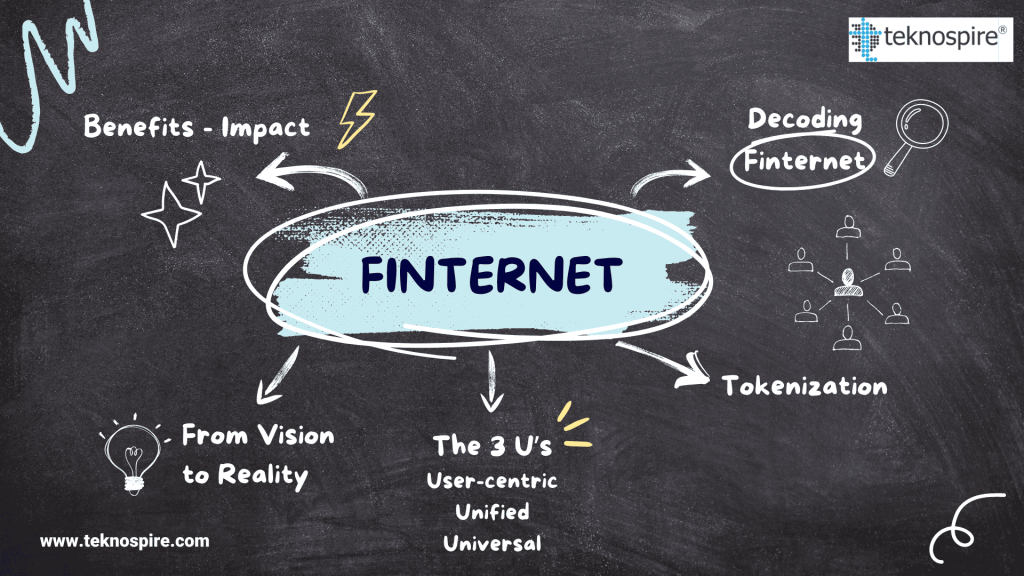
In the rapidly evolving world of financial technology, a new concept is emerging that promises to reshape how we interact with money and assets.  Finternet – a term coined by Nandan Nilekani, the visionary co-founder and chairman of Infosys along with Agustín Carstens. But what exactly is Finternet, and why should it matter to you? Let’s dive in. What is Finternet? Finternet represents the next leap in financial systems, blending the best of regulated finance with revolutionary tokenization technology. It’s not just another buzzword, it’s a paradigm shift that’s already underway. The Three U’s of FinternetNandan Nilekani describes Finternet using three key characteristics: The Power of Tokenization At the core of Finternet is the concept of tokenization. Imagine being able to represent any asset – be it land, bonds, artwork, or traditional investments – as digital tokens. This opens up a world of possibilities for how we manage and transfer value. Why Finternet Matters? The Road Ahead While Finternet might sound like a concept from a distant future, Nilekani asserts that it’s already taking shape. Labs worldwide are working on bringing this vision to life, implementing it step by step. Conclusion As we stand on the brink of this financial revolution, it’s clear that Finternet has the potential to transform how we think about and interact with our assets. At Teknospire, we’re excited about the possibilities this brings for financial inclusion and empowerment. Stay tuned as we continue to explore and innovate in this exciting new frontier of finance! Are you ready for the Finternet revolution? Share your thoughts and let’s discuss the future of finance in the comments below!

digital banking customer
FinTech Content

Digital Banking Customer – Are you?

Just few days more and we would finish the first quarter of 2019, the year of technology, data, and innovation. So, for a while lets pause and think about the Digital you? When one of my friends told me – you are a digital person, I shrugged my shoulders NAAH! I still withdraw cash from ATM, prefer going to a shop and book tickets on phone. His next question was – What about Banking? When was the last time you went to a branch? How often have you written a cheque and deposited in the nearest bank branch? Have you used any digital wallets to avail cashback on bill payments? Haven’t you chatted with a chatbot to get an answer to your queries? “Managing money digitally” is one of the key indicators of your digital life. Are you a Digital Banking Customer like me who calls himself/herself as “Not so Digital”? If yes, the post of today would help you recognize some of the fascinating “digital tools and products” of banking that you may be using but aren’t aware of –   Accessing Your Banking Account How do you access your savings/salary account? Visiting the nearest branch or logging in via a web browser through your bank’s website? Checking of account statements, funds transfer are currently done by 45 million users in India as per a report of 2017. The report also cites that by 2020 online banking users would reach 150 million.   Analyzing Spending’s/Expenses Have you used an app like SpiltBill or Monefy or inbuilt tools from your bank to analyze the expenses made in a particular month? Many users also link their bank accounts to such tools that use Open API architecture and bank details could easily flow from bank to such apps.   Managing Personal Financial Portfolio Living in a tier-1 and tier-2 cities have you received a call from Sharekhan, Arthyantra offering their services to trade online and manage your financial portfolio? The products again use the Open API concepts and fetch the banking details [with your consent], based on your allotment of capital and risk you are willing to take, they suggest plans and products that could earn a good ROI.   eKYC Have you been asked by your banks to refurbish the updated documents for KYC? What were the channels provided? And which one you chose? Many banks have now started accepting eKYC that is hassle free and fast.   Availing Value Added Services via Digital Wallets Amazon is spending gigantically to lure Indian customers, recharge a prepaid avail cashback, shop groceries online get cashback. Same goes with paytm, in fact during demonetization in India in 2017, paytm made huge profits and got massive new users. Have you used any of the digital wallets then that portrait your digital personality?   Chatting with a ROBOT – Chatbot A decade back “Customer Care” was a booming sector, I remember my stay in Gurgaon [now known as Gurugram] way back in 2004 which was considered to be a hub of call centers. Indeed the sector is still growing, but now with the advent of Machine Learning and Artificial Intelligence many times you are actually talking to a robot who is programmed to answer your query just as a human representative. While firm like niki.ai helps you to book cab, recharge your phone or order food, mypoolin assist you to pay with your friends. If you have missed even one of the tools/products to experience, ask your bank to contact Teknospire. A leading technology provider from Bangalore India could help your bank in launching these services and there is a lot more to choose from our innovative product bouquet. Contact us now.

FinTech Content

Innovation In Retail Banking Report 2018 Highlights

Infosys Finacle, part of EdgeVerve Systems, an Item subsidiary of Infosys, and Efma, a not for profit organization, launched the 10th annual study on innovation in retail banking. The report is written by Jim Marous, Publisher of the Digital Banking Report and Co-Publisher of the financial mark. Celebrating the 10th anniversary of the research, the report investigates a decade of banking innovation and looks ahead at what is in store for banking in 2022. The study, wherein over 300 banks practitioners reviewed a decade in banking innovation and also glanced into the future considered Open Banking APIs as the top technology to the future of innovation, with it being stronger than areas like machine learning, chatbots,and RPA[Robotic Process Automation]. The study found that in the brief term, banks will leverage Open Banking for compliance like the Payment Services Directive, Unified Payments Interface, and the New Payments Platform. Vincent Bastid, Chief executive officer, Efma, stated-In the last few decades, financial institutions have been facing disruption head-on, with advancements in client support, personalization, and mobile applications via a combination of Open APIs, AIs,and automatic learning. The 10th edition of the report highlights improvements made in the last decade, but additionally predicts a stunning transformation in mobile pockets[ like Amazon Go, Amazon’s checkout-free store, Barclaycard in the UK created Grab+Go, which transforms a shopper’s smartphone into a ‘pocket checkout’], payments,and lending. The research also highlighted that overall, organizations are taking a view on the need for innovation ROI. 31% of companies had an innovation ROI view of one year i.e. the time period for measuring success in innovation, compared to only 17% this year. Additionally, 63% looked for a Return on investment in 1-3 years as compared to 54 percent in the year 2017. Bankers surveyed believed big-tech firms, digital commerce platforms and fintech start-ups will be the most innovative competition in 2022. Similar to past years, the most significant effect of transformation is likely to be in the regions of payments, mobile pocket,and lending at the next three decades of investment in Banking Innovation. With traditional technology being identified among the top few barriers to innovation, 74% of banks are increasing investment in technology modernization. 50 percent of the businesses believe that product delivery channels followed by new product innovations will be where innovation will take place in the next four decades. On asking banking organizations what channels will be the most important in 2022, the majority saw mobile and online being the primary channels. The survey also highlighted branches and relationship managers as low rated indicating they may not be the preferred choice of future generations. After present digital channels, digital assistants, social network and 3rd party channels are anticipated to be the main channels of the bank in 2022. Close to 50% of respondents consider that less than 40 percent of the current workload will move to the public cloud by 2022. According to 70% of the respondents, AI is anticipated to have a substantial influence in transforming client support / service by 2022. On seeking an answer to a question about the impact of advanced technologies in the next 12 months, Open APIs were thought to have the largest potential impact (with a score of 5.68 on a 7 point scale). As the report ends it sums up the most important highlight- Remember, it is not another bank that people want … it is a better experience. Tech giants could easily become a financial services hub to facilitate the relationship between consumers and traditional providers of financial services. However, as it may appear but Millennials “do not want another bank” and might give a try to a tech-giant for their banking services. Here are KEY TAKEAWAYS The presence of an innovation strategy in the organization has increased by 6% For the nest four years, 50% of organizations stated that their primary area of innovation is product delivery channels Banking organizations are driving innovations primarily by partnering with business partners, start-ups and large tech firms. Most innovative for Bankers believe most innovative competition in 2022 would be with fintech start-ups, big tech firms and digital commerce platforms..   References: Edgeverve Image Courtesy – Edgeverve

Vishal-Gupta-CEO-Teknospire-e1546267789671[1]
BAAS/SAAS, FinTech Content, FinTech Trends

Teknospire: Connecting FinTech Technologies for Better Living

The growing demand for cloud computing and need for uninterrupted banking and payments services have forced the financial institutions to look at innovative solutions. Consequently, data-driven approach has become the key to business growth. More and more businesses are engaging in data mining and hence, it is important for technology providers to offer solutions that are ready for the future. Teknospire, a FinTech business company is leading in similar way, which delivers “BaaS” – Banking as a Service platform –over the cloud infrastructure. It focuses on FinTech platforms with an active presence in emerging markets. As the name of the company suggests, everything it creates is inspired by technological innovation. Meet the Entrepreneur Vishal Gupta as the CEO leads the financial inclusion strategy of the company along with the core team, delivering together a solution that is most relevant and required by the financial institutions and population in the last mile. According to him, the only way to enable the digitization for over two billion people globally is to obtain a holistic banking payments solution to the financial institutions, who serve that market. After realizing the fact that almost fifty percent of Indian population is still unbanked and the lack of transparency, Vishal came up with an idea to have a banking solution with features like mobile compatibility and offline data access for last mile. The solution should be lightweight, easy to use and should be compatible with any handset. Finally, Teknospire was born with the idea planted firmly in the ground to enable banking as the fundamental. The Flagship Product The only way for financial institutions to evolve digitally would be to adopt “Digital Banking Platform” in a box and the company’s flagship product “FinX” address all the digital banking hindrances. “FinX”-cloud ready- is the digital banking platform in a box, which ensures that these financial institutions can gain on digital growth quickly with capital, resources, and integrations dependencies. FinX integrates with the CBS/ESB of all the sponsor banks via open APIs based interfaces, for smaller banks to carry out the micro-payments in the semi-urban and rural areas where setting up branches and executing banking operations are CAPEX intensive. The smaller FIs can enjoy their brand equity in their respective markets while riding over the core connectivity engines through sponsor banks. “FinX” has the modular, cloud-ready, open APIs enabled platforms, which offer services such as; Lean Banking, Mobile Banking; Digital Wallet Services Suite, Micro-Payments switch, Digital Cash Management, and cash collections platform, BI and Analytics Engine, Reporting and Reconciliation platform, Merchant Payments platform, and much more. Solving Financial Quandaries Financial inclusion along with the digitization of transaction set at last mile has been a challenge for the financial institutions over the past few decades. There are various reasons behind the lack of digitization at the last mile. The mid-size financial institutions serve the last mile, which includes corporation banks, RRBs, DCCBs, Agri Banks, MFIs etc. These institutions have been trying to replicate similar technology stack as of the bigger banks working with CBS vendors, ESB vendors, merchant payments platforms, and agency banking platforms from multiple vendors. The lack of technical resources to support multiple technologies and understanding the integration and support structures presents a major challenge. The lack of capital to be able to procure the minimum set of institutional platforms towards the digital transformation can halt companies in digitizing process. Packing all of this in a “Baas” offers the banks to reach to remote areas very quickly and build new consumers and revenue streams. Fluid Environment The company states, “Sharp minds work the best when they are let free and that has been the strategy for us, which has worked amazingly well. We follow a flat organization structure, open seating with open discussions policy. It’s a small family and friends working together”. The firm celebrates every single milestone and believes that it helps in keeping the employee spirits up. One measures employee development at Teknospire largely with cross-functional accountability and ownership. In terms of benefits gained by the client, Teknospire has made choices on databases such that, all the transactional data uses the relational properties of a DB while the non-relational and big-data properties allow the firm to build the analytics layers on it with specific data structures. This has really helped the company in churning the relevant offerings for its clients. Global Presence With the mission to enable banking for every individual, Vishal and his team have expanded their reach to other countries like Mozambique, Zambia, Nepal, Bangladesh, and Zimbabwe. The firm is on a mission to build and deliver the right technology, and keep it rolling with its partner banks for the masses. Teknospire has made an impact with quick adoption of the flagship banking platform “FinX” across four countries and had completed over twenty million transactions towards digitization. Future Aid Teknospire wants to stay as a global technology provider and wants to support thousands of financial institutions and SMEs. It will continue to build use cases for the various transactions. It will improve its integration with APIs that will allow multiple participants, including producers and consumers, to connect and interact with each other, and create value beneficial to all stakeholders. Through API integration, the firm will establish consistency in common operations such as authentication, authorization, data models and entitlement. Source :-The 10 best Oracle Partners to Watch in 2018 This blog was originally published at Insightssuccess
Fintech Puzzle Teknospire
FinTech Content

Fintech – Word Game

Answers: Biometrics Teknospire offers solutions that could be linked to a biometric database like Aadhaar and speed up credit finance, micro-financing or financial inclusion of the unbanked population in rural areas. [Rich_Web_Video id=”2″] UPI Teknospire UPI enabled solutions for corporate and financial institutions could allow customers to send and receive money instantaneously without adding additional bank details like IFSC code etc. Unbanked Teknospire is on a mission to Bank the Unbanked, our range of products assist the unbanked population to access banking services via digital channels. OpenAPI Teknospire Open Banking API for Banks and financial providers could cause digital disruption thereby enabling financial inclusion and last mile banking. RegTech Need to address regulatory requirements in an innovative manner? Join hands with our simple intuitive line of product that is creating waves of financial inclusion and solving compliance issues.

FinTech Content

Quiz: How Well Do you know Fintech and Payment Industry?

Fintech had made an impact in people’s lives, be it with Last Mile Banking, Microfinancing or integration with HealthTech to provide seamless medical care. Its evolving and fascinating to witness technology managing your financial portfolio, getting help from Robo-advisors, or looking for health insurance. The buzz is now a part of our life. How much do you know about it? Did you know the first public bank to launch a credit card in India was Central Bank of India? And LIME, started by AXIS in 2015, was the first mobile app in India to integrate wallets, shopping, payments, and banking? Do you know if UPI, NPCI BHIM are government initiatives to facilitate interbank transfers? To explore many such facts, take Teknospire Fintech Quiz Number of Questions – 10 Estimated time ~ 1 minute Loading… Do check out to know if you are better than your colleagues. If you are not able to access the above link, click here to take the quiz.

Biometrics empowering Digital banking
FinTech Content

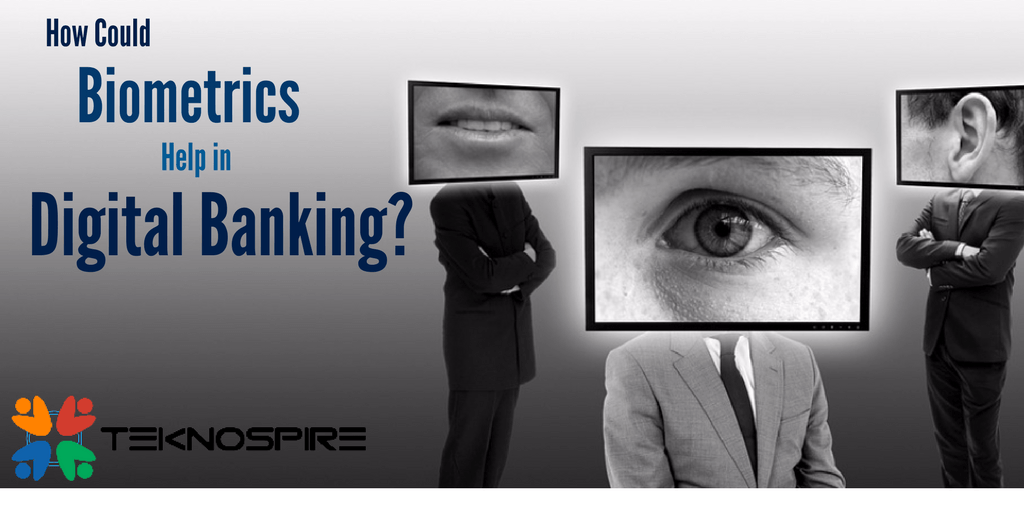
How Could Biometrics Help in Digital Banking?

With biometrics and its application trending the social media, firms and organizations are jumping the bandwagon to reap benefits. But you would be surprised to know that Biometrics is an age-old process used for your identification. Surprised? If we trace the history of biometrics, as per wiki in 1891 fingerprints catalog of criminals was formulated based on Francis Galton’s theory of fingerprints and physiognomy.And today this buzzword is helping in redefining the banking to rural people by being used as primary authentication or second dimensions authentication. In fact, Biometrics Banking is another trendsetter, and this post would talk about the same, on how Biometrics could enable banking empowering the financial and social inclusion.   What is Biometrics Technology? Biometrics or biometry is the measurement and statistical analysis of people’s physical and behavioral characteristics as defined by searchsecurity . This science is now used by firms to design authentication and access control features for software and hardware applications. There are different forms of identifiers that are used as authenticators like – Fingerprints DNA Face Hand Retina Ear features Odour Typing Rhythm Fingerprints Gait Gestures Voice While the above identifiers are being used as features, some of the evolving identifiers are still under tests like brainwave signals, electronic tattoos and password pill [ a microchip that could be swallowed and is powered by the acid present in the stomach. Once at a required position could emit unique radio signals turning your whole body into a password. Sounds a bit crazy!] Why You Need Biometrics? According to a research study done by Telesign , passwords that are used to protect our systems are quite vulnerable and could be easily hacked. The studies also report the stats that in the US and UK 73% people use the same password for everything. While experts recommend changing the password every six months, 47% rely on the password that hasn’t been changed since last five years. Biometrics empowering Digital bankingSo to SECURE OUR SYSTEMS in an efficient yet secure way, biometric identification is needed. How is Biometrics Helping Banking? Banking is all about money handling. People often look for fool-proof ways while storing or handling currency, and biometric technology could be a savior to many of us who are looking for a dependable system that could be accessed by only you. The biometric technology not only strengthens the banking infrastructure but also helps in protecting the individuals banking profiles, thereby avoiding identity theft and fraud. Let’s dive to know how – Biometrics usage In-Branch Banking/ Branchless Banking You enter a bank branch, get a token with the iris scan and wait for your turn. As your number is displayed on the board, you reach the counter. But to your surprise, there is no bank official, but a screen that knows if you are an existing bank customer or not based on the iris scan, and what are the other services you are availing. As you mention you are looking for a personal loan, the necessary paperwork is done in few minutes with e-verification, and there you go with the loan amount credited to your account. A simple and hassle-free way of availing banking! Biometrics usage in Mobile Banking You are driving on a highway, stopped at services, bought stuff for your journey and got your petrol tank full. Opened your bank’s wallet with fingerprint authentication and paid the bill through your mobile. No need to carry cash or remember different PIN and password, just enjoy your drive. Biometrics usage in ATM/Kiosks No need to remember different configurations of the PIN as with simple voice recognition you could get cash from an ATM. Or you went to kiosks to transfer money to your distant cousin; you could use one of the biometric identifiers to get it executed. Biometrics usage in Online Banking No worry that someone might be peeping onto your keyboard when you type the password, or if you are using a public computer it may save it, Use a Face recognition or fingerprint identifier and log into your banking portal. Transfer funds or avail a new loan with no pressure to remember login and transaction password. Biometrics usage in Agent/Offline Banking Another fruitful case for rural people living in remote areas with no or inadequate connectivity. The people are mostly illiterate and not skilled enough to use online/mobile banking. The agent walks in with a biometric system, gets their fingerprint scan looks at the available balance and provide them with the cash. The rural people could use these biometric identifiers as e-KYC to open a bank account and avail other banking services. The above were some of the use cases that could work well with biometric technology. Now talking about the biometrics identifier that is being used across the globe, the graph is perfect to help us with that – Biometric in Banking Challenges/Risks of Biometrics Technology Biometrics Authentication does offer convenience, but it also comes with the risks/challenges. Your fingerprint or iris scan is just the data [as the traditional password], and so comes the risk of data theft which could be resolved by biometric tokenization [on similar lines as Apple Pay] that instead of sending the biometric information sends a unique number. Another challenge is the device capturing your biometric and the enrolment procedure. A frequent case that I witnessed was while linking Aadhar to sim cards [ BSNL], after making an umpteenth attempt when the device did not recognize my fingerprints, the officials asked me to come the other day. Despite the concerns, biometric authentication or access control is expanding and evolving. Enterprises, individuals or government agencies all are trying best to leverage the technology. And why not when we know security is a soothing phenomenon! Be it tech-enthusiast or a rural person unless the security aspect of any matter is crystal clear, people do not invest in such stuff. Biometrics verification helps in trusting, that unless you provide your fingerprint or iris or voice or any identifier, you would not be able to perform

Banks and fintech firms
FinTech Content

Digital Banking – Would it lead the Banks and Fintech to Merge or Conquer?

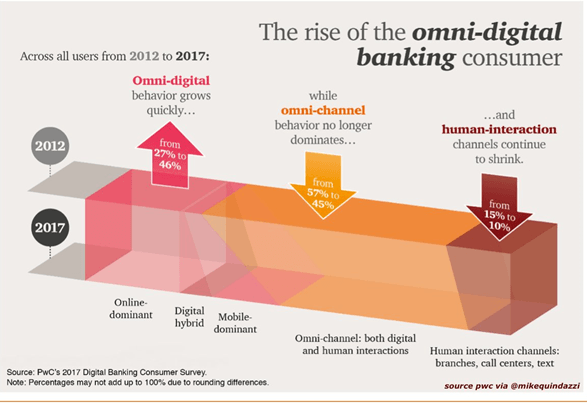
The world is under the spell of digitization! Just a decade back, when people were skeptical about making a transaction online, the recent reports are highlighting the mass adoption of technology into their lives. Sample these – As per stats, the rise of Omni-digital banking customer has grown from 27% in 2012 to 46% in 2017. As per a post from Yourstory , in India post-demonetization there was an increase in availing services like mobile banking, mobile wallets, other digital payment solutions like Sodexho, pre-paid cards and debit cards transaction on PoS. Image Source – PWC 2017 Such a massive growth is a collaborative effort of fintech firms and banks. So, could we say Digital Banking is dependent on fintech firms? Or Are banks dependant on their technology providers? Could we in future see banks more like regulators and fintech firms as an operating wing? With concepts like branchless banking, contactless banking evolving would bank be merged? Do we foresee fintech firm expansion that results in bypassing banks? To answer many such questions, we decided to come up with this post. Banks and fintech firms What is Digital Banking? In layman terms – any of the banking services/activities when availed via digital/electronic mode is referred to as Digital banking. So, if you are using your e-wallet or logged in to your bank website for funds transfer or online shopping. In fact for banks like e-KYC or automation of opening a bank account are also some of the examples of digital banking. The Present state of Digital Banking in India In India, as per 2017 Oracle J.D. Power India Retail Banking Study , 94% of retail banking customers have visited the branch/store at least once in the past 12 months that signifies how services are availed via digital means. Only 51% of retail banking customers have a reliable online banking experience with their primary financial institution. While individuals specified concern of security as the prime reason for non-usage of digital channels. The most surprising fact highlighted in the study was – ~94% of urban customer prefer to visit a branch to avail banking services indicating lack of trust on digital channels. While these are the stats lets check on health meter of banks and fintech firm and their contribution towards Digital banking. Banks and Fintech Firms – Walking Hand in Hand Well, that’s our present situation! Banks and fintech and not competing with each other, there is no overlap. Banks are learning to adapt to digitization and fintech firms are providing solutions to make banker and their customer’s life easier. Traditional banking processes are evolving as now people have an option of Electronically transferring funds and via cheque/demand draft Shopping through their mobile wallet Crediting salary directly to employees bank account So Bank needs to offer the traditional products but also adopt the modern ways of handling money, that’s why they need fintech. On the other hand, fintech firms have hands-on experience on latest technology but to build a customer base, to build the trust, to get accredited by regulatory authorities they need to prove their worth. Hence they need banks. Both entities need each other to progress – strengthen their customer base, build customer’s trust and outgrow their competition. As per a report from CBinsights , these 78 India based fintech start-ups are building the ecosystem to support Digital India move. While the solutions are offered under various categories like Payments, Lending, Insurance, Trading platform, and taxes, experts believe that simplified yet intuitive UX designing has led fintech firms to gain customers attention and win loyalty. Banks and fintech firms  Many fintech firms like Teknospire or ElectronicPay collaborates with Banks to use their fintech solution for better transparency and growth of their client. Other businesses like FundsIndia or NukkadShop or Veritas Finance directly deal with their clients acting as a mediator between banks and customers. In short, we could say that currently the banks and fintech firms are working in parallel lines to accumulate a rich customer base, penetrate in every nook and corner of India. While this seems to be a healthy competition but what happens when you have achieved all that and established yourself as a brand? What happens when your product is significant, but you are not able to reach out to the mass? A merger or an acquisition? Only time can tell. The Future State of Digital Banking in India One of the recent articles on economic timese read – In the match for India’s financial services future, fintech just scored twice while banks are still struggling to retrieve the ball they scuffed into their net. While ET predicted [based on facts] that fintech would lead and banks would be slaughtered by them, let’s quickly glance other facts – The HNI[High Net Worth Individuals] individuals – What do they choose? That’s the hard reality, despite traditional institutions[banks] juggling between modern and old approach, they[banks] are still the first choice of HNIs and corporate offices. You pick any office across India, none of them [corporate accounts] yet have an account [ because of the regulatory constraints] with fintech firms. Be it crediting salary to your employees or managing your business financial portfolio banks are still the preferred choice. Fintech firms are trusted by Urban People but need penetration in rural areas Search a term on google, and it would show you the result of location, contact numbers, and review. With such an ease of availing services at the urban location, residents find it easy to encash offers and convenience provided by fintech firms. However, tier2 cities and specifically remote areas are untouched by this handiness. Hence banks may again be a preferred choice for people in rural areas. With technology innovation like Robots, Biometrics and Virtual Reality, Banks may be redundant As you approach a branchless bank, you are greeted by a robot who ask you your account number, with your biometrics valid authentication, he/she then ask- How could I help you? Or how about your

Scroll to Top