Digital Banking

Inventory reconciliation
Digital Banking, Financial Inclusion, TekBull

Meet TekBull: Your New Guide to Smarter, Faster Inventory Reconciliation

Before We Begin – A Quick Question  Which is faster? A. A professional athlete completing a 100-meter sprint.  B. Your finance team completing the month-end close.  If you answered A, we have a reality check ahead. If you answered B, you are likely the target audience I’m speaking to because you know the truth: The month-end ‘close’ and the complex, manual inventory reconciliation that supports it has become a month-long marathon.  Who Am I? I’m TekBull. I am the strategic guide at Teknospire and am here to help you and your team navigate the complexities of modern finance. I will show you how to build a strong and reliable finance function in the current market. In the financial world, to be ‘Bullish’ is to look forward, stay strong, and commit to growth. While your competitors are stuck looking backward at old spreadsheets, I’m here to help your team trade that chaos for the strength of automated, data-backed precision. I have seen 21 day month-end closes and met brilliant analysts who spend their weeks buried in spreadsheets to reconcile manually. There is a better way, and it has been available for a while now. I have something interesting for your finance and accounts team to know.  What is the real-time scenario faced by businesses in the GCC and MEA now? Across the GCC and MEA, finance teams are managing more transactions than ever before. More subsidiaries. More currencies. More regulatory frameworks demanding audit-ready records at shorter notice. And yet – the dominant tool in most finance functions for inventory reconciliation is still the spreadsheet. Teams are manually exporting data from ERPs, converting file formats, matching rows by hand, chasing discrepancies over WhatsApp, and discovering million-dollar leakage problems three weeks after they happened. Month-end closes that should take days are stretching into weeks. Skilled professionals who were hired to analyse and advise are spending 60% of their time on data entry. If you can connect and recall the situation at your office premises, I’ve something advisable for you to know! To start with, let’s understand the basic difference between traditional and modern reconciliation processes and what are the smart tips for the finance team to let go of bottlenecks and seek faster financial close. Traditional Reconciliation vs Modern AI-Augmented Reconciliation The Traditional Way Someone walks around with a clipboard or a basic scanner. They count items. They type those numbers into a spreadsheet. They compare the spreadsheet against the ERP – manually, row by row. By the time the count is complete, new sales have already moved the numbers. The data is stale before the ink is dry. Then comes the matching. Hundreds or thousands of transactions, cross-referenced by hand across purchase orders, sales records, and inventory logs. Errors creep in. Discrepancies get missed. And when month-end arrives, the whole team works overtime to close something that should have been running continuously all along. The Modern Way AI-augmented reconciliation platforms do not wait for month-end. They sync continuously – pulling purchase orders, sales records, and digital inventory logs automatically, matching them in real time, and flagging discrepancies the moment they occur. No manual export. No format conversion. No row-by-row matching. The system handles the transactions. The team handles the strategy. TekBull’s 5 Tips for Finance Teams Ready to Upgrade Five things your finance team should be doing differently – starting now. Tip 1: Data Collection is not Finance Work but more of Admin work When the finance team is spending hours every month exporting files, converting formats, and copy-pasting numbers from one system to another, business owners are just investing into the team’s time and efforts which could be easily utilised for something more. Modern AI-augmented platforms plug directly into your ERPs, warehouse management systems, and payment gateways. Once connected, data flows automatically across every site, every currency, every format. The gathering phase disappears entirely. TekBull’s rule 1: If a human is doing it every month without thinking, a machine should be doing it instead. Tip 2: Replace the Spreadsheet Match with a 3-Way Intelligence Engine When we talk about the core of inventory reconciliation, matching 50,000 transaction rows by hand is not a finance strategy but a punishment.  A modern 3-way matching engine reconciles physical stock levels, consumed inventory, and invoiced sales simultaneously in minutes, not weeks. We are talking about 94% of reconciliations running without any human intervention at all.  TekBull’s rule 2: Your analysts should be reviewing exceptions – not creating them by making manual errors. Tip 3: Find Your Phantom Inventory Most finance teams discover leakage after it has already compounded for months. Phantom inventory – stock recorded in the system that does not exist in the warehouse. Vendor over-billing that slips through because nobody has time to cross-check. Shrinkage that sits undetected until the year-end audit. Effective inventory reconciliation via AI-augmented platforms can catch these in real-time. One GCC conglomerate identified $2.1 million in annual leakage within a single quarter of switching to an automated platform.  TekBull’s rule 3: Leakage you cannot see is leakage you cannot stop. It’s important to get real-time visibility first. Tip 4: Demand Mismatch with Explanations A discrepancy demands an explanation that tells the team/leaders whether it is an FX variance, a partial settlement, a duplicate entry, or a counting error in plain language, before we even start investigating. Modern AI platforms retrieve the most relevant historical records and surface the explanation automatically. CFOs should be getting answers before they ask questions to the finance team. TekBull’s rule 4: 2026 is a timeline where leadership teams need a system that not only finds problems but also solves them. Tip 5: Build Your Audit Trail in Real-time Every time a finance team scrambles to compile audit documentation at year-end, it is a sign that compliance was treated as a destination instead of a process.  AI-augmented reconciliation platforms build an immutable, timestamped audit trail continuously — every transaction, every exception resolution, every approval logged automatically. When ZATCA, the UAE FTA, or any regional tax authority comes knocking, the documentation is already there.  TekBull’s rule 5: Compliance readiness must be a daily output and not a month-end task.   Final Takeaways from TekBull’s Diary A 21-day month-end close doesn’t prove of how much efforts your team is putting up but needs a certain kind of technology to adopt to streamline the process. The shift to AI-augmented inventory reconciliation is available now, and the businesses that have made the

liquidity management solution
Digital Banking, Treasury Management

Why Modern CFOs and Treasury Teams Need FinStream?

CFOs and their treasury teams are responsible for managing cash, controlling expenditures, and ensuring regulatory compliance. Known as ‘guardians’ of an organisation’s finances, we often find them engaged in reconciling bank statements, processing payments, preparing for audits and managing liquidity. However, this fast-paced world demands transformation in the role played by CFOs and treasury teams. They have now grown to be strategic partners responsible for shaping the future of the organisation by making better decisions using valuable financial data. But, how to consolidate all the scattered data and access it in real-time? Are there modern approaches to bring in a transformation from a reactive, manual approach to a proactive, data-driven one? This is where our liquidity management solution, FinStream, comes in – to handle the complexities of today’s financial ecosystem. Key Challenges Facing CFOs and Treasury Teams Governments and large conglomerates in the GCC and beyond struggle with fragmented and inefficient treasury operations. The current system presents several major pain points: With all these challenges, treasury banking heads and group CFOs find it essential to adapt to modern liquidity management solutions, such as Treasury Single Account (TSA) platforms. Why is a Treasury Single Account (TSA) Essential? In simple terms, a TSA solution addresses the challenges mentioned above by centralising cash management, automating treasury functions, enhancing risk management and providing real-time transaction monitoring. Our Single Account Treasury Management platform, FinStream, promises to be an essential part of large conglomerates as it enhances transparency and improves overall financial control by: How Finstream supports CFOs and Treasury Teams? FinStream’s true value lies in its ability to empower financial leaders with the features they need to succeed. The liquidity management solution allows financial leaders to: FinStream TSA is the Need of the Hour By now, we must have realised that accepting high operational costs, idle cash, and a reactive financial posture is no longer a choice. And, relying on a technological upgrade is no longer an option but a vital necessity for all conglomerates. FinStream’s smart features and powerful capabilities have led to a major shift in the way CFOs and treasury teams approach their roles, moving from being reactive guardians to proactive, strategic leaders. Time to leave behind all the scattered data and complex processes and walk through a modern financial ecosystem with the FinStream by their side. Connect with our experts to discover how the liquidity management solution can help you manage idle cash and optimise strategic capital through treasury automation. Frequently Asked Questions:

liquidity management solution
Digital Banking, Treasury Management

CFOs Convert Idle Cash to Strategic Capital with FinStream’s TSA

Strategic Capital is a major concern for all CFOs. It refers to a company’s cash that is actively managed, fully visible, and intentionally deployed to support core business goals. All financial resources and investments that support the overall long-term goals are defined as strategic capital of the organisation. With the increased complexity of treasury management across every subsidiary or segment of an organisation, idle cash, cash visibility, cash pooling, and optimised liquidity are growing headaches. A vast amount of idle cash is sitting unoptimized across a fragmented network of bank accounts. This lack of cash visibility is hindering strategic decision-making. Thus, every finance team is in search of a liquidity management solution that can solve all these issues through effective cash pooling. To address all of these challenges, we have introduced a modern treasury single account solution: FinStream, designed to centralise cash management, provide unparalleled visibility, and transform idle funds into a strategic asset. Fragmented Financial Operations: Hidden Costs  Companies face a number of challenges that drain resources and create unnecessary risk. Let’s unveil the hidden costs of a fragmented treasury: FinStream Blueprint: Unified Liquidity Management Solution FinStream’s Treasury Single Account platform is built on four core pillars: Converting Idle Funds into Strategic Capital By implementing FinStream, CFOs and treasury teams have witnessed a profound and measurable impact on a company’s financial health: Finstream’s TSA: Turning Features into Real Advantages FinStream’s liquidity management solution is more than just a collection of features; its functionalities are engineered to directly enable a CFO’s strategic goals: The Future of Treasury is Here: Level Up with FinStream’s TSA In today’s fast-paced, unpredictable economy, moving from a reactive, manual treasury to a proactive, automated one is no longer a luxury—it’s a necessity. FinStream’s TSA platform is more than just a liquidity management solution; it’s a strategic platform that transforms the treasury management from a cost centre into a powerful engine for business growth. By centralising and automating cash management, CFOs and finance leaders can eliminate the silent drain of fragmented operations and, most importantly, unlock the strategic potential of their company’s most vital resource: its cash. Ready to unlock the strategic potential of your idle cash? Discover how FinStream’s TSA can transform your treasury management system today. Frequently Asked Questions

a diagram of a company
Digital Banking, Escrow

Escrow Management for Real Estate market – Rewritten for the Real World

If you’ve ever been part of a large real estate transaction, either on the banking side or the builder’s, you know it’s rarely as smooth as the brochures suggest. Between milestone payments, documentation chaos, and regulatory friction, the process often feels more like juggling than managing. That’s where escrow steps in: a buffer zone of trust, a safety net for both funds and expectations. But even escrow, in its traditional form, is showing signs of strain. Old systems weren’t built to handle today’s pace, complexity, or the number of hands involved in a single deal.  The Escrow Gap We Don’t Talk About In practice, managing escrow isn’t just about holding money. It’s about coordinating between banks, developers, buyers, government bodies, and sometimes, third-party consultants. And it’s here, in this messy middle, that many transactions slow down or derail. Delays in verifying documents. Confusion around payment triggers. Disputes over whether a milestone was truly met. These issues don’t make headlines, but they quietly stall projects, stress out teams, and tie up capital.  A System That Understands the Workflow  What if escrow management respected the complexity instead of resisting it? That’s the principle behind FinEscrow. It wasn’t built to add another tool to your tech stack. It was built to mirror how real estate transactions actually unfold.  FinEscrow pulls these moving parts into a single narrative. One that’s visible, verifiable, and less prone to costly misunderstandings.  Milestones Aren’t Just Checkpoints – They’re Conversations  One of the more thoughtful features is how FinEscrow handles milestones – not as rigid checkboxes, but as live status updates across stakeholders.   A consultant verifies a phase. A bank gets notified. A buyer sees progress. And only then does the system trigger a fund release. This avoids the classic “he said, she said” bottlenecks that plague escrow flows.  Integration That Actually Makes Life Easier  In real estate finance, tools should make things simpler – not create more work. FinEscrow connects easily with the systems banks and developers already use. It shares updates with government portals like the Ministry of Housing and works smoothly with the bank’s core software, so there’s no need for manual updates or switching between platforms. It also handles agreement creation digitally cutting out paperwork and back-and-forth emails. Because if it still takes a dozen emails to release one payment, something is not working. Not a Product – A Quiet Enabler  Here’s the thing: you shouldn’t notice FinEscrow doing its job. You should just feel like things are…less stuck. Documents flow, alerts ping the right people, approvals line up, and money moves when it’s supposed to. That’s not magic. It’s just design that starts from reality, not aspiration.  Conclusion  Escrow has always been about trust. But in today’s fast-moving world, that trust comes from transparency, timely updates, and clear handshakes between all parties. In real estate, where payments are tied to milestones and multiple stakeholders are involved, FinEscrow brings structure and clarity, thus making the process easier to manage for both developers and banks. Beyond real estate, FinEscrow also helps financial institutions handle other escrow use cases with the same reliability, simplifying approvals, reducing delays, and improving coordination where it matters most.

AI Agents in Financial Services
Digital Banking, Ai In Finance, FinNews

The Rise of Specialized AI Agents in Financial Services

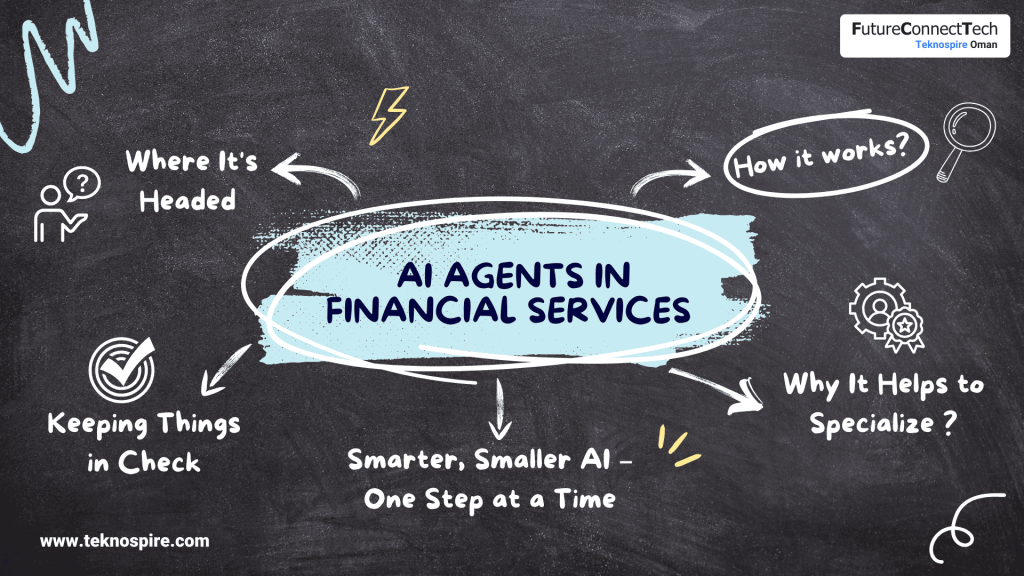
AI in financial services is no longer just a buzzword. It’s quietly working behind the scenes, not in the form of big, futuristic systems, but as focused, practical tools built to solve specific problems. These tools are known as specialized AI agents. They’re not trying to do everything at once. Instead, each one is designed to handle a particular task, like matching payments to invoices, checking for compliance issues, helping customers open accounts, or assisting finance teams with reconciliation. And they’re getting really good at what they do. Why AI in financial services Helps to Specialize The benefit of using task-specific AI is simple: it’s more accurate and efficient. Since these agents are trained on relevant data and rules for just one area of work, they’re quicker and more reliable. That’s especially important in finance, where mistakes can be costly or non-compliant. Here are a few ways they’re being used today: Smarter, Smaller AI – One Step at a Time Financial institutions are moving away from the idea of building one giant AI system. Instead, they’re adding small, focused agents into different parts of the business. It’s a more flexible and lower-risk approach. For example, a bank can add an AI agent just for detecting failed payments without needing to replace its entire system. These small changes add up and make a real difference in speed, accuracy, and customer experience. Keeping Things in Check With more AI in use, there’s also more responsibility. It’s not just about what AI can do – it’s about making sure it’s doing it right. That means keeping track of how it works, protecting data, and ensuring fairness. Luckily, these smaller agents are easier to monitor and manage than big, complex systems. Their focused nature makes them more transparent and easier to govern. Where It’s Headed You won’t always see them, but specialized AI agents are becoming important team members in financial organizations. They’re helping people work smarter, faster, and with fewer mistakes. Instead of chasing the next big thing, financial service providers are now focused on what works and these agents are proving to be a smart, steady way forward.

FinStream-Best quick bill payment service in india
Digital Banking

How to Streamline Bill Payments with AI?

With the rapid evolution of technology, every business and financial institution demands operational efficiency to streamline complex payment processes, handle volumes of transactional data and comply with stringent regulations. All these can only be possible when we scrape out traditional methods and walk along the path of Artificial Intelligence (AI) to automate quick bill payments, effectively comply with business and banking regulations and minimise risks and financial losses. AI plays a huge role in optimizing payment operations for businesses and financial institutions so that they can automate bill capturing, schedule payments, customize payment approval workflows, and facilitate cross-border payments. Want to stay ahead of the curve in the evolving payments landscape? FinStream is your partner for the future. It is the key to automating manual billing processes. This blog covers the challenges of age-old payment processing methods, how the platform leverages AI to resolve them, the advantages of quick bill payments and optimised working capital management. The Pain Points of Traditional Bill Payments The key challenges faced by businesses and financial institutions when dealing with traditional billing payments are: AI-powered solutions like Finstream standardize quick bill payment processes, reduce additional costs, control billing payments and improve overall financial performance. How Artificial Intelligence Optimizes Business Payments? AI is broadly used to automate and streamline various aspects of billing payment processes, resulting in significant benefits for businesses of all sizes. The shift from traditional paper-based payments to quick bill payments is powered by AI. Key Benefits of AI-Powered Payment Solutions Small business payments optimized by AI-powered quick bill payment solutions add several benefits to businesses and financial institutions by offering: How FinStream Leverages AI to Streamline Quick Bill Payments? By integrating AI into its platform, FinStream empowers businesses and financial institutions to streamline payment processes and enhance financial operations through: Experience AI-Backed Future of Business Payments AI-driven quick bill payments have the potential to revolutionize and streamline workflows, capture bill information, schedule payments, and optimize working capital management. This opportunity has enabled banks and businesses to gain a competitive edge, enhance customer satisfaction and confidently navigate the evolving financial landscape.  With Finstream, financial institutions can offer comprehensive payment solutions to their customers. Also, businesses can access and manage all payment-related activities through a user-friendly dashboard and carry out cross-border payments seamlessly. Ready to take your small business payments to the next level? Contact us today to learn more about how FinStream can help you. Frequetly Asked Questions

Embedded Payments
Embedded Payments, FinNews

Embedded Payments: A Seamless Future for Digital Transactions

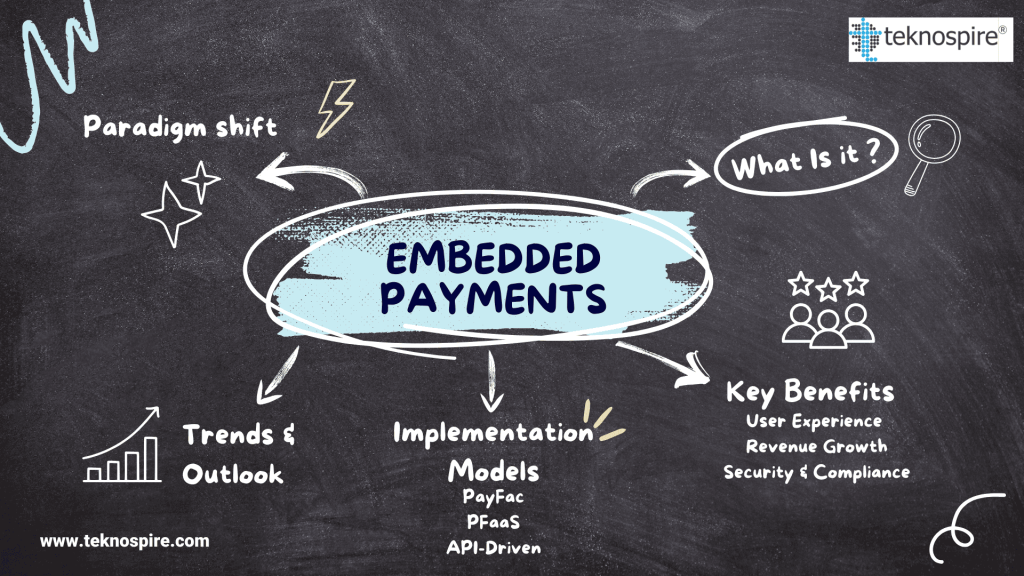
Embedded payment solutions are transforming digital platforms, allowing users to make secure, instant payments without ever leaving the platform they’re using.  This shift represents a major advancement in digital finance, enhancing customer experience, improving operational efficiency, and opening new revenue opportunities for businesses. With embedded payments, digital transactions are no longer separate steps but integrated, seamless parts of the user journey. What Are Embedded Payments? Embedded payments are a core component of embedded finance, where financial services like lending, insurance, or payments are integrated directly into a platform’s user experience. Unlike traditional payment processing that redirects users to third-party payment gateways, embedded payments enable transactions directly within a website or app, whether it’s for purchasing a product, paying for a service, or transferring money. This type of integration is already used by companies in industries like eCommerce, transportation, SaaS, and digital banking. For instance, ride-sharing and food delivery apps often offer in-app payment options, allowing customers to pay instantly without any additional steps. Benefits of Embedded Payments Popular Implementation Models for Embedded Payments The Future Outlook of Embedded Payments The embedded payments trend is expected to grow as companies seek to provide frictionless, end-to-end experiences. Industries such as healthcare, real estate, and digital finance are exploring how embedded payments can simplify billing, reduce administrative work, and increase customer satisfaction. The adoption of open banking regulations and API-based financial services is also facilitating a more interoperable, customer-centric payment landscape. Embedded payments represent a paradigm shift in digital finance, offering not only a more efficient payment method but also a strategic tool for business growth, customer retention, and revenue expansion.

Digital Banking, Financial Inclusion, FinTech Trends, Mobile Wallet

Financial Inclusion and Union Budget 2020

Financial inclusion is increasingly being recognized as a key driver of economic growth and poverty alleviation across the globe. Studies have found that access to formal finance can boost job creation, reduce vulnerability to economic shocks and increase investments in human capital. Seven of the United Nations Sustainable Development Goals (SDG) of 2030 view financial inclusion as a key enabler for achieving sustainable development worldwide. Union Budget 2020 and Enabling Financial Inclusion  While presenting Union Budget 2020, Hon’ble Finance minister Mrs. Nirmala Sitharaman said Technological tools like Artificial Intelligence, Internet of Things, 3D printing, drones, data storage, Quantum Computing are helping change the way the country functions, these emerging technologies need to be focussed to drive financial inclusion in the country.” How Artificial Intelligence Can boost Digital Financial Inclusion? Most of the rural population looks for a “credit” facility with a financial institution but in the absence of “credit score or history” the loans are not granted or provided at a very high-interest rate. AI can be used to build a rural credit score for individuals based on their crop turnover, business profit or sales. Data collected from SMS logs, contact details could assist in identifying the user who can be trusted in repaying the loan. Based on this a score could be assigned to him and FI can impart credit for individual’s needs. How the Internet of Things Can boost Digital Financial Inclusion? Internet of Things [IoT] of wearable technologies bridges the gap and open access to formal finance to rural/immigrants of a country.  A live example has been seen in Africa where people struggle to get a continuous supply of electricity. Hence Solar powered chargers and lanterns evolved, but they cost a lot and with people having limited income, putting a lump sum amount at the start is difficult. Hence they came up with Pay-as-you-go model that connects the solar-powered device to their SIM card for remote management and integration to payment network offering customers to pay installments easily and ability to service providers to manage device remotely in case of issues. How Drones Can boost Digital Financial Inclusion? Last-mile delivery in rural and remote areas is still a struggle and startups, brands are looking for a feasible solution. Drones could offer assistance here.   While delivering cash to the last mile may have its risk, but delivering couriers [containing clothes, books, grains, etc] with a digital-based interface that enables payment could assist in social inclusion.  Drones could also aid to insurtech in investigating, inspecting the home/vehicle/shop under an insurance claim and send the report for faster processing. This would help in getting rural people under insurance assuring a good quality of life. How Quantum Computing Can boost Digital Financial Inclusion? Quantum Computing may not directly impact the unbanked individuals, but it can help  Investors in evaluating the business cases for Banks and FI with the innovative products  In Localizing banking to regional flavor with the use of data  Supply Chain in scanning and quickly coming up with the best route to meet the logistics timelines. Our Hon’ble Finance Minister not just made sure to include these emerging technologies growth plans in the budget but she confirmed that all the public institutions at a Gram Panchayat levels will be given digital connectivity, and Fibre-to-home through BharatNet will link 100,000 Gram Panchayats in the financial year 2020-21 itself. Sitharaman said, “Anganwadi centers, health and wellness centers, post offices, police stations, and other rural welfare centers to get 100 percent digital access. The government’s vision is that all public institutions be provided with digital connectivity.” For last four years Teknospire, a technology provider to Banks and NBFC’s is doing its bit in enabling Financial and Social Inclusion. If you are looking for a Digital Banking, API Banking or Mobile Wallet solution, we are just a call away. References RBI, Finextra, Nextbillion, finovate, bobsguide

Digital Banking, FinTech Trends, Mobile Banking, Mobile Wallet

Mobile Wallets in India 2020

Mobile Wallets has grown rapidly in India. As per a BI Mobile Payments report, in-store mobile payments would grow to $503 billion by 2020.  As per another report Mobile Payment Volume would increase tenfold by 2021. Who are The Enablers to Mobile Payment? Growth of e-commerce Increased Penetration of smartphones Free and easy access to the Internet In fact with such supportive ecosystem from government, technology, and people adopting the change, numbers below show the positive growth trend in the adoption of mobile wallets in India. Quarter Feature Data Growth/Decline Q2 2019 Number of transactions done INR 1.08 billion an increase of 18.4% over Q2 2018   Q2 2019 the value of transactions INR 474 billion an increase of 17.5% over Q2 2018   Mobile Wallets vs UPI in India UPI is giving a tough competition to mobile payments in merchant recharges and transactions. Here are the numbers comparing the growth – Q2 2019 the number of transactions  done on mobile wallets 1.08 billion INR an 18.4% increase Q2 2019 the number of transactions done on UPI 2.27 billion INR The increase was a massive 263%. However, Customer behavior shows that UPI and wallets, both easily accessible via mobile apps, are considered interchangeable as each offers their own set of advantages – Mobile Wallet UPI Can be easily loaded with Cash or Credit Card  Can be directly linked to a Bank Account Less and limits the risk of Cyber Fraud No need for KYC as directly linked to a govt account Due to its long presence, customer get more offers and Cashback Offers direct cashback to the bank account Irrespective of the mode one chooses, the only thing that matters is the customer’s experience and is he satisfied with the services? Mobile wallet offer convenience, security and seamless customer experience. If you are keen to assist your customers with digital wallet services, we are just a call away. You can read about our services here. 

Digital Banking, FinTech Trends

Digital Banking and its Allies for 2020

USA Number of digital banking users in the United States from 2014 to 2019 161.6 million a twenty percent increase from 2014. Source – Statista Great Britain Online banking in Great Britain from 2007 to 2019 73% of users avail online banking In 2007 – 30%, 2014 – 53% and in 2019 it is 73% Source – Statista UAE 90 percent of people in the UAE use digital banking, while the number of ATM users reached 100 percent. Source – Federal Competitiveness and Statistics Authority Nordic countries including Norway, Denmark, Finland and Sweden As of 2018 had online banking penetration rates of over 80 percent. Source – Statista India As of 2017, India had 45 million active urban online banking users And it is expected to reach 150 million in 2020 Source – Report by Facebook and The Boston Consulting Group (BCG) With such massive growth across the globe, what is in store for Banking technology, Banks, Fintech in 2020? Let us explore who could be their allies this year that can boost its growth manifold. Innovation with Guards While shopping, payments, funds transfer or buying nay financial product is at your fingertips, it has also raised cases of fraud and hacking. So, to keep the money safe on internet many regulatory bodies and governments across the globe have come up with initiatives to provide fintech start-ups an environment with a framework that is guarded and under radar by the authorities to keep an eye on illegal activities. In India, RBI or Reserve Bank of India has launched a framework for start-ups to test their services in a controlled environment. In Singapore to promote innovation, the FinTech Regulatory Sandbox allows players to simulate and experiment their products and services in a regulatory sandbox On similar lines is South Korea’s Financial Services Commission that inducted 60 firms under their sandbox framework In the UK, the regulators collaborated with the Global Financial Innovation Network (GFIN), a global FinTech sandbox to offer a safe and more inclusive environment for innovation. The Payment Service Directive [PSD2] came into picture to help Banks and Fintech in providing innovative banking service to its customers without the risk of data loss or unauthentic access. Location-based Banking Location-based notifications and marketing tactics have been in the industry for a long time. While the tech firms adopted it to offer customized services, the customer hugged the personalization touch and yearn for more. Fintech firms and Banks could combine the Banking with location to offer services that cater to a person’s need. Just for example – if your customer is traveling within a country a notification or a message mentioning nearby ATMs or restaurant partners that can offer a discount on your debit and credit card could help him. If a person is traveling abroad, even the forex rates and nearby partners that can help in providing food deals and sightseeing could be added bonus. Location-based banking can also help you in detecting fraud, in case a phone is stolen or the person has logged in from a different location, you can notify him immediately about the login and action can be taken. Capital One used location-based data and analytics to deliver personalized offers with its channel partners. Yes, Bank surprised its customers with location-based offers. Paywear Gold, Platinum or Diamond may be the costliest wearables, but if you want your customers to combine technology and trend Paywear is the thing. Fashionable, convenient and most importantly allows you to pay and in case its stolen, your customer can track it or even wipe its data remotely that not be a possibility with gold and diamond jewellery. Watches, wristband or rings can all be crafted with technology to pay at any merchant site. Some of the recent launches by the bank are – Heritage Bank’s wearable wrist band HOVA Bankwest’s payment ring HALO What are your plans for empowering Digital banking and payments in 2020? Do let us know in comments or if you are keen on exploring Digital Banking or Digital Wallet solutions we are just a call away.

Scroll to Top