Financial Inclusion

Corporate Social Responsibility
Financial Inclusion, FinTech, Industry Observation, Social Cause

Corporate Social Responsibility and The Impact of FinTech

Creating a strong business and building a better world are not conflicting goals – they are both essential ingredients for long-term success”. – William Clay Ford Jr., Executive Chairman, Ford Motor Company. With corporations becoming more responsible towards the society, this concept has evolved into what we today know as Corporate Social Responsibility (CSR). CSR has been increasingly recognized as a means for businesses to serve communities in the best possible manner. It has also made the consumers feel a sense of attachment with the business entity. What is Corporate Social Responsibility? Corporate Social Responsibility can be understood as a business model that is aimed at Corporates to become socially responsible and answerable to its stakeholders and to the public at large. Corporate Social Responsibility, on one hand, has helped businesses with better interaction with consumers and on the other hand, has had stakeholders develop loyalty towards the business. It also has enhanced overall reputation – a powerful statement of what they stand for, in an often cynical business world. Jason Potts, a senior associate with the International Institute for Sustainable Development (IISD), who is taking care of  sustainable markets and responsible trade initiative, says: “CSR is fundamentally about ensuring that companies forward broader public objectives as an integral part of their daily activities and this can only be ensured with the appropriate communication channels with stakeholders.” “CSR policies need to be considered as a core and inseparable component of the overall service or product offering”, he further adds. Importance of CSR to Corporates Companies that display their concern towards various social causes are surely better off than those that don’t. CSR has the ability to change dynamics for any given corporate. For  Klara Kozlov, head of corporate clients at the Charities Aid Foundation, “CSR allows businesses to demonstrate their values, engage their employees and communicate with the public about how they operate and the choices they make, to ensure a sustainable future. CSR helps pave the way for partnerships between businesses and civil society that are based on common goals and shared actions to deliver impact-driven outcomes.” Few of  its benefits include: Public Image Social responsibility not only improves an entity’s public image but also helps it become a consumer-favorite in no time. Enhances Engagement of Employees Companies, which show their interest in improving the society’s well being, attract and retain hardworking as well as valuable employees. Not only this, those hired demonstrate better productivity and strive for better profit margins. Retention of Stakeholders Investment in Corporate Social Responsibility indicates a company’s strong ethics and high standards. Such outlay, in the eyes of investors, prove that the company does not solely care about profits but also has a sense of duty towards citizens. Such a display of sound business policies certainly attracts and retains investors. Reduction in Operational Costs The concept of CSR also helps a business reduce its operational costs to a great extent by opting for business practices that do not affect the public adversely. For instance, by option for green technologies and reducing emissions & waste, companies save a great deal of cost. It can be said that CSR has a dual positive effect on both, the consumers as well as the business. Problems Companies Face with CSR Corporate Social Responsibility has become a complex phenomenon with companies developing holistic policies to address the demands of the public. As such, there come several problems related to the execution of initiatives such as disbursal and tracking of funds, cost-benefit issues, etc. We try to highlight the major problems that companies, the world over, face with respect to CSR. Disbursement of Money Every company indulging in CSR has an exclusive monetary account through which the company disburses money for various causes. However, due to lack of digitization, such money is disbursed in the most haphazard manner, making it practically difficult to keep track of the amount. Accountability of Money: Once disbursed, there is hardly any check on how such grants are being deployed and utilized by those concerned. This makes it almost impossible for an entity to recognize the cost benefit of their contribution. Sans any digitization of money movement, amount once paid out is nowhere to be accounted for, indicating lack of answerability and utter pecuniary wastage. Sustainability of CSR activities: More often than not, the amount spent with huge fanfare falls short of giving estimated returns to the business over time due to lack of diligence and monitoring. Initiatives become difficult to sustain owing to a deficiency in digital regularization.   Role of FinTech Companies in CSR Over time, FinTech companies have been recognized as an imperative element of business operations, especially with respect to CSR activities. FinTech companies or simply put, companies designing and developing technological and digital programs to aid financial or banking operations and services help businesses immensely in regulating the financial approach. Employing a FinTech company to CSR activities can contribute greatly to any business. Digital Payments Mobile wallets and app-regulated payment disbursal portals have made the transfer of money as smooth as ever. Corporate entities save on crucial time and money spent on such disbursal while opting for digital methods. Bridging the Gap: The core area of all CSR activity for a majority of companies are the rural and underdeveloped areas where financial exclusion is a major problem. However, FinTech companies are bridging the gap between the lender and borrower and even reaching people who do not own a bank account. They are further helping the customers by providing assistance before, during and after the financial transaction by extending the ecosystem of the banking system. Countries that have a majority of the population thriving in rural areas have finally had access to banking, thanks to the inception of FinTech. For instance, Bangladesh has about 70 % of people living in the rural areas where not even half of them own a bank account. To cover the deficiency, ‘bKash’, a FinTech initiative, allows such people to receive as well as send money through mobile phones. Crowdfunding: FinTech’s

Finance, Financial Inclusion, FinTech Trends, Payment Banks

How wallet Helps in Last Mile Banking?

You might have been using your ATM card as an easy substitute for checkbook, but did you know then, that it was just the start of an era? As more time passed, more and more alternatives for traditional banking arose, changing the scenario forever. Not to mention the lack of traditional banking infrastructure which also promoted the growth of digital banking methods. As per the official data, even as of today, only 27% of villages in India have a bank in 5 km radius. A large mass of India’s population lives on the environs of the formal economy. Living in far-flung corners of the country, Illiteracy, lack of financial education, not being aware of the availability and/or value of financial services and lack of connectivity are few of the many reasons why consumers in these areas remain unbanked. Moreover, banks in rural areas are few and far in-between, making the reach difficult for many during working hours. To address these obstacles and to broaden financial inclusion, Indian government came up with solutions to help in reach built out for last mile banking which aimed to give every household access to banking facilities by offering them zero-balance accounts across all commercial banks. After the prime minister of India launched Jan Dhan Yojna, we saw a world record number of bank accounts opening in a single day and things seemed promising. But, a study done 3 months after the scheme was launched, revealed more than 75% of accounts to be dormant. Neither banks nor ATMs are located within reach of all. Opening an account was way easier than to actually keep it rolling on regular basis and encouraging them to have some savings too. People living in remote areas and the people at the base of the economic pyramid, the ones who are underbanked and unbanked, are in true need to be financially included. But then did JDY, despite having the genuine concern and the intention of solving it, actually served its purpose? The answer is NO, well not completely. This was further trodden by the demonetization move and the impact it had on traditional currency and transactional methods. In an interview with CNN two weeks after demonetization move, India’s key player in digital wallet industry Paytm CEO Vijay Shekhar Sharma said and I quote, “I Don’t Need to Sleep, I am Living a Dream.” Paytm saw an increase in traffic as much as 4x times, app downloads increasing by 200%  and an overall increase in transactions by 250%. Mobile-wallets-adoption-in-India The Indian government is emphasizing on making India digital, a major example of which is roping e-wallets to digitize rural economy. With the government realizing the potential of digital wallets in helping built out for last mile banking and taking major official steps for it, India is a promising hub. Treading along with the Government are the entrepreneurs and VC backed FinTech companies who have come up with solutions to help in reach built out for last mile banking, thanks to the feasibility and accessibility of digital wallets through the country. At present just about 300 million Indians have a Smartphone and 66% of Indian population still don’t have access to the internet. FYI:  (On a lighter note) India has nearly as many Smartphone users as the U.S. has people, and it’s about to get many millions more. This, however, is bound to change after the Digital India initiative of the Indian government with India being a sweet spot in terms of Smartphone market growth in the upcoming years. Another example of how digital wallets are helping make last mile banking a feasible reality is that of Zimbabwe, located in the African continent. Zimbabwe has shown tremendous growth in terms of mobile banking. In the year 2017, almost 96% of total banking transactions which amounted to a total of 98$ billion were carried out via digital methods such as e-wallets, net banking etc. Further data shows that out of around 18 million people of Zimbabwe, 6 million of them are registered on the leading digital wallet in their country i.e. EcoCash and about 1.5 million being highly active on it, total transactions carried out via this app reaches to 30 million per month. Oracle Statistics_Customer Paying Behaviour The above statistics clearly depict the changing scenario in ‘customer’s paying behavior’, as people are preferring to become cashless. In the UK, cash withdrawals reached the lowest number of transactions in 2016 after 2010 (which was after the economic depression). In the same year, plastic transactions overtook cash-based transactions. Supporting this ongoing ‘cashless’ trend less than half of the population (about 43%) thinks cash still will be used in 2022 about 54% think they will be using cash very less in the upcoming years 47% expect to use more mobile payments and digital wallets. The emerging and developing economies are successfully making the last mile banking a reality with the help of digital wallets due to the benefits and feasibility of it which allows even the poorest and scarcely located people to avail banking benefits. First, it was the plastic money that slowly started to banish cash from transactions, now it is the turn of digital wallets. With ATM’s further making banking within everyone’s reach, it’s still not possible to open an ATM within walking distance of everyone. Digital wallets solve this problem by being accessible to each and everyone at a whim. However, it’s not all apples and oranges, they have their own sets of downsides and challenges like: Fear of adoption among users due to transacting online Unearned Interest on money sitting in the wallet as opposed to a bank a/c Lack ‘brand recall’ among the rural population Inadequate merchant tie-ups As per the new upcoming scenario, mobile penetration is very high in urban as well as in rural areas. This tremendous penetration of the mobiles could be used to bring financial inclusion to the last mile. With almost every mobile carrier in India now offering its own digital wallet, you need not even

Finance, Financial Inclusion, FinTech, TechFin, Technical Updates

TechFin or FinTech

Sometimes you need to look at things….from another point of view. This is exactly what you need to do when you have to decide between Fintech and TechFin as there is a very thin line which differentiates them from each other. It’s your pick between the innovator v/s the reigning. While, the Innovator is ‘Taking process to technology’, coined as term FinTech, the Incumbent is ‘Taking technology to process’, coined as term TechFin.   So, What’s so technical about FinTech and TechFin? Technically speaking, Fintech is a space where financial services are delivered through a better user experience using cutting edge technology. TechFin on the other hand is where a firm that has been delivering technology solutions, launches a new way to deliver Financial services. You need to comprehend  both to decide on your pick. The technology and finance are common between the two; the difference lays in the way you apply it.   This difference is much higher than just spelling them or writing them in two different ways: Fin-Tech or Tech-Fin   TechFin When the banks plan on utilizing technology to improvise or enhance existing financial processes and operations, their focus remains on how to use technology to bring superior efficiency and productivity from existing financial processes and operations. The same is done with the objective to magnify the existing experience and capabilities in financial services domain. The aspirations of transformation or disrupting the process are eliminated. The reason behind TechFin companies not looking towards disruption is the fact that their customers demand- Safety Reliability Stability Legacy No risk and minimal change Therefore, large retail commercial banks seldom make changes in their mobile apps, as a slight change in the app invites customer complaints and inconvenience. For their customer, change implies exposure to risk and any change is interpreted as offensive. Such banks avoid changes to skip the negative publicity from these incidents.         TechFin companies, therefore, stick to what Jack Ma coined them as – “Rebuilding system with technology”.         Jack Ma during the China Conference organized by the South China Morning Post emphasized and I quote, “Fintech takes the original financial system and improves its technology, TechFin is to rebuild the system with technology. What we want to do is to solve the problem of a lack of inclusiveness.” The best example of a TechFin company Ant Financial Services Group, an Alibaba affiliate company, in June 2017, launched “Fortune Accounts”, a new feature on its wealth management app- Ant Fortune. The platform which allows consumers to buy a huge range of investment products will now allow third-party financial institutions to set up an “Account Page” of their own. By doing so, they will directly reach consumers without the traditional way of competing on online supermarket format, and help customers get financial advice or promote their products. This is a classic case where the process of investing in financial products has been improvised using technology, helping financial institutions receive backend data of users to receive traffic on their company’s stores. Firms like Amazon (US), Apple (US), Facebook (US), Google (US), Microsoft (US), Samsung (Korea), Baidu and Tencent (China), Vodafone (UK, India and Africa), and Uber (US) all offer various forms of payment, lending and/or other financial services. The entry of these firms signals a shift from financial intermediary (FinTech) to data intermediary (TechFin). FinTech  FinTech, on the other hand, takes the financial process and transforms it utilizing technology to make its mark. Generally, start-ups use FinTech to create Apps, APIs, and analytics, grab diversity, to disrupt and evolve. For example, the existing products or services like – loans, savings, investments, payments or trading are redefined to profitability, speed, and prudence. They prefer transforming the process using technology, usually eliminating the middleman and intermediaries.     Taking the example of traditional and P2P lending, traditional lending will allow an investor to deposit funds and earn interest. A borrower can borrow money from banks, following a cumbersome documentation and approval process, which takes time and at times may face rejections. The approvals are based on pre-historic financial transactions.           A FinTech P2P platform allows the lender to directly lend money to the borrower and earn interest, while the borrower uses an online platform to receive instant approval and funds.   FinTech Vs TechFin FinTechs take the risk and have been welcomed by millennial and customers who are ready to explore and experience innovation. People who are ‘on the go’ and use the mobile platform embrace transformation. FinTechs are ready to disrupt existing processes and financial services ecosystems with use of emerging technology. The limitations of FinTechs are different as compared to TechFins. Unlike TechFins, who have the limitation of huge credit risk, FinTechs face the challenge of regulators. The global economic ecosystem has still not completely accepted the way FinTechs work. There are rules and regulations which they need to adhere to remain operational. Another most critical hazard which they are greatly exposed to is Safety. The chances of privacy risk and hacking always haunt them. To summarize the difference between the two, checkpoints are: TechFin Process first approach. The incumbent, usually large banks participate. Improvise the existing process Do not take the risk Customers prefer legacy and trust Enhance the proficiency of staff for the betterment of process using technology Huge credit risks   FinTech Technology first is the approach. Start-ups, usually participate Follow transformation in the process Do not hesitate in disrupting the existing process. Youngsters, millennial and professionals appreciate them. Eliminate the middleman for faster and superior experience. Limitations of privacy, safety, and regulators.   Closure There is no better way to summarize, the difference between the two, by quoting Jack Ma, the father who coined the term TechFin: “There are two big opportunities in the future financial industry. One is online banking, where all the financial institutions go online; the other is internet finance, which is purely led by outsiders.”   Though a lot of

Governance and Financial Inclusion
Financial Inclusion

HOW GOOD GOVERNANCE COULD HELP IN FINANCIAL INCLUSION

Could adequate governance enhance access to financial services? While the short answer is yes, the long-form answer is the review of standards, processes, and act of governance, that could bring in a more profound level of financial inclusion.  We all know how growth and financial inclusion are directly proportional to each other, specifically in emerging economies both at macro and micro levels. Laying of concrete legal structures, managing social performance, responsible exits and managing risk crisis are few of the areas where good governance could help in enabling inclusion at all levels. Why Is Good Governance a Prerequisite to Financial Inclusion? Governance or decision makers are responsible for monitoring the policies, framework, processes and the entire structure of financial inclusion programmes. And to achieve that the policymakers need to plan carefully in detail that supports the long-term vision of inclusion. Just to envision a role of governance imagine yourself architecting a house for your family that consists of your elderly parents, teenage children, and spouse. All might have different needs – like your parents might not like high rise buildings and an adolescent boy wants his room to be spacious enough to play cricket and girl want her room to be painted in pink. How do you take care of each of the stuff? Now broaden your imagination and think this small house as big as the country like India, would it be possible for you to know the needs of each person? How vast is the effort, to build a structure, to implement policies, communicating with subsidiaries or correspondents, deploying solutions, collecting feedback and then reworking on failures. That’s the hardest part of governance, and to create a robust governance structure – one need to carefully pick the ingredients to integrate it with the framework and employ solutions that support the vision. Only well-functioning and proficiently governed financial institutions can deliver financial services to meet the rising needs of the economy. As mentioned by Deputy governor of RBI Dr. K.C. Chakrabarty, – through various measures initiated by the regulator/Government in the post-independent period resulted in impressive gains in rural outreach and volume of credit, the structure suffered from inherently weak governance. The achievements were ‘quantitatively impressive, but qualitatively weak.’ Due to the target-driven approach to social banking, the initiatives were not part of the business strategy of banks. The effort on the part of the banks was always aimed at somehow meeting the lending targets, mostly at subsidized rates of interest, or with the subsidy from the Government under various government directed schemes. Good Governance Approach to Financial Inclusion Financial Inclusion a process that ensures banking services to all individuals in a fair and transparent manner by regulated players. With good governance in place, new methods and means could be executed, regulation and authorized players would be dealing with people’s money. It would also lead to empowering individuals with financial literacy and knowledge, tailored services and products could be offered, and most importantly technology could be used to approach the remote areas. BANK LEADING THE WAY When a firm appointed/approved by governance serves different financial offerings and products, it helps in enabling financial inclusion. In most of the cases, Banks are those trusted entities that are recognized at the global level and have the power to facilitate inclusion. Banks can cross-subsidize across various product/services and offer the FI products most efficiently and cost-effectively. Just for example as per RBI – Banks have been advised to make available Basic Savings Bank Deposit Accounts (BSBDAs) for all individuals with zero minimum balance and facility of ATM card/ Debit card or self-certification of documents helping in relaxed KYC norms. All these are possible because of governance pushing and allowing the regulated players to approach individuals and access banking.  In fact, there is also a push for Banks to increase their brick and mortar presence and also adapt to modes such as Kiosks, off-site Rural ATMs, mobile vans, etc. IMPARTING KNOWLEDGE Inclusion and Banking are not just about opening a bank account, but “knowing the benefits banking offers.” For all of this governance takes up extra steps to educate people about finance and banking. Initiatives and programs are running by recognized institutions and RBI; just, for example, RBI has a booklet FAME (Financial Awareness Messages) that is available in 13 different languages for banks and other stakeholders to use. Another firm Ujjivan along with Parinaam Foundation has conducted classroom training teaching its participants about its participants on cash flow, income and expenditure budgeting, savings and savings options and debt management. Another initiative has been taken up by NSE [ National Stock Exchange]and SEBI[Securities and Exchange Board of India]  to impart financial knowledge to children with its programme. The resource covers sessions on Money matters, Budgeting, Investments, and Stock market. SUPPORTING WITH HARD GOVERNMENT STRUCTURES While planning to enable financial inclusion in a country like India, policies and execution need to handled at ground level. So how does the governance takes care of these? At Zero level we have Business correspondents, Agent bankers or Nonprofit organization, volunteers and most importantly banks that make the execution possible. With representation at panchayat, tehsil, village, district level, next level is the state level. The infrastructure at state level also known as the State Level Bankers Committee (SLBC) helps in resolving issues at zero level and even passing the policies, obligation, and laws from Apex/State to lower levels. Lastly, we have The Financial Stability and Development Council (FSDC) that has subgroup headed by RBI governor and RBI deputy governor that exclusively focus on financial inclusion and financial literacy. The group has a representation from other regulator groups to make policies and decision in favor of each segment of the society. Apart from this, there is another group headed by RBI Deputy Governor Financial Inclusion Advisory Committee (FIAC) that’s in place to gauge the performance of banks and to continuously review the various models adopted under Financial Inclusion OFFERING CUSTOMIZED RANGE OF PRODUCTS Better governance not only ensures

Bank - FinTech Merger
Finance, Financial Inclusion, FinTech, FinTech Trends, Mergers & Acquisitions

Bank – FinTech Merger Importance and repercussions

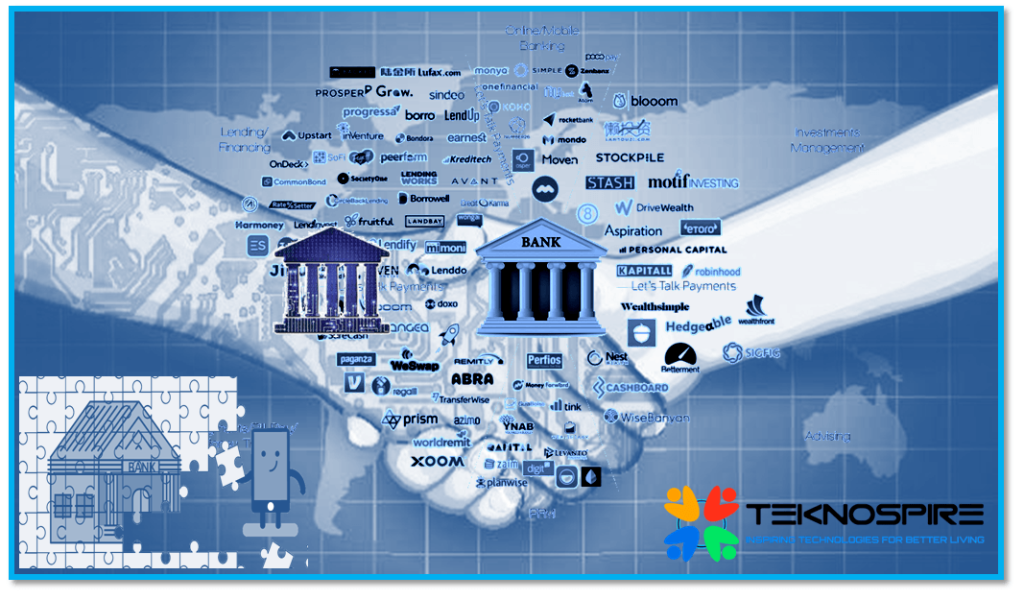
The financial services industry has entered 2018 with a focus on digitizing services to better meet customers’ needs. But do the banks understand that previously inefficient, paper-based processes and messy ‘not so friendly’ user interfaces are no longer going to be good enough in today’s technologically advanced environment? Banks are needed to connect digitally to succeed. With FinTech continuing to gain momentum, it’s just a matter of time, to see them fully integrated into business-as-usual banking. One of the world’s largest Deutsche bank calls for “a shift in mindset from one of competition to collaboration,” arguing that traditional banking providers and new innovators must work together in order to revolutionize the payments market and the wider financial sector for the benefit of all. They said it and I quote: “For both parties, a partnership should liberate them to focus on their core competencies and contribute these areas of expertise to the innovation process.” Fintech, no doubt, is the talk of the day amongst investors, financial service providers, entrepreneurs, and even big corporate houses. The phenomenal potential of creating innovative services and business model makes it disruptive in nature. Realizing the immense potential of the technology, “Banks” are looking to integrate with FinTech solutions. In short Bank+FinTech merger  is next on the cards in the coming years. Welcome to the Era of FinTech. FinTech Nudged All FinTech, the technological innovation in the financial arena, registered its birth as a back-end activity, and today is nudging everything across the globe. It has transformed, almost everything, in such a way that you are about to witness the impact of the “fourth industrial revolution”. More than anything, it has created its own “FinTech Ecosystem” by embracing  the following: Digital Payments Remittances Insurance Lending Financial and Wealth Management Retail Banking FinTech has impressed the Banking Sector and its customers, which is why the transformation in banking has touched a new height. The “2016 World Retail Banking Report” states that almost two-thirds of the retail banking customers across the world use FinTech products or services like cards & payments, loans, Investments, financial advice and mortgages. This is because of the UX standards they offer to their customers. 81% of the customers feel that FinTech offers faster services and extends a great experience. In addition, FinTech firms are fast catching up bank’s “niche parameter”- TRUST. The percent of customers who have complete or partial trust in FinTech firms is as high as 87.9% across the globe. FinTech-Globally Embraced Global acceptance of FinTech is evident from a recent comparative study by EY (formerly Ernst and Young) which reported FinTech adoption between 2015 and 2017 has increased across various countries like- Australia, France, Germany, China, and India. The figures indicate adoption of past (2015), present (2017), and future (as responded in the survey). The adoption of FinTech in these countries has climbed exponentially: Australia- From 13% in 2015             to       37% in 2017 France-     From 27% in 2015             to       40% in 2017 Germany- From 12% in 2015             to       35% in 2017 China –     From 69% in 2015             to       77% in 2017 India –       From 52% in 2015             to       80% in 2017 ‘Banking with FinTech’ attraction Like any other sector, Banks have started reacting to FinTech, and since 2015, FinTech Banks have started emerging. Banks and Financial inclusions have initiated startup programs to constitute FinTech companies. Across the globe, 43% banks created such startups. Another 20% set up VCs to fund FinTechs. There are obvious reasons behind banks being forced to or influenced by FinTechs. EY FinTech Adoption Index 2017 released in June 2017 indicates that the appetite of digitally active consumers has risen considerably, from just one in seven digitally active consumers in 2015 to one in three in 2017. The report also shows that in 2017, there are 84% consumers aware of the fintech facilities in comparison to just 62% in 2015. The same reports show that the fintech adoption rate is expected to reach an average of 52% globally from the current rate of 33% in 2017. Such growth in numbers could soon blur the boundaries between different financial services, laying down new standards for the industry during the process. To stay ahead of the curve, financial firms would benefit from the technical assistance from the fintech startups. Why FinTech Lures Banks Unlike traditional banking, FinTech reduces  structural cost and operational deficiencies. The communication between branches or P2P transactions happens in real-time environments. Real-time updates, proactive alerts and agile innovation are an integral part of an enhanced customer experience. When right technology is used, it can reduce the need for manpower and even the “Brick and Mortar” locations. FinTech provides simplicity of design and power of contextuality that consumers are increasingly expecting. Another customer expectation of ‘externally simple yet internally efficient’ service platform is forcing the banks to rethink their policy of ‘working alone in stumbling mode’ or ‘working and staying ‘in the game’ powerful mode. It also enhances  regulatory compliance and better service to customers. Fintech firms like Teknospire are delivering convenient and affordable services by providing sustainable solutions for digitization of financial ecosystem to market segments (unserved and underserved) by taking care of their need for microloans and grants to the last mile, that till today were thought as unprofitable zone for  banking organizations. User friendly, data focused seamless technology is bringing more personalized offerings. With the security aspect, well taken care of, with biometric advances, the virtual reality solutions are helping customers interact with the banks in innovative ways which were unheard of, with traditional banking. The fast and efficient products and services of FinTech have attracted Banks to offer P2B services. This is evident from the fact that many have started offering traditional in-bank services on mobile devices as well. This has helped them offer high levels of access to consumer, and hence, a better usability and User Experience (UX) standards. Advantages of the Alliance betweenFinTech and Banks With FinTech and Bank partnership, the ultimate

banking-is-necessary-banks-are-not
Financial Inclusion, FinTech, FinTech Trends, Open Banking, Technical Updates

Open Banking – Is it comforting to customers or not?

Big changes are on the horizon. You may have seen or heard about Open Banking, PSD2, and CMA in the news over the past year. Or, you may be hearing about them for the first time right now. Fortunately, Open Banking is right here and it is going to stay. In the banking sector, the concept of “open” can seem contradictory. Banks traditionally have a “duty of care” to protect their assets rigorously, as required by regulators and customers. Traditional Banking is been the same for…just about forever. For the most part, the power dynamic between banks and their customers has stayed about the same. Whether you bank in person, over the phone, online or mobile, the relationship with banks hasn’t changed much alongside the technological advancements. You set up an account with your bank, they facilitate the ebb and flow of your money, and, as a result, they hold the data around that money. All of the histories around your purchases, loans, payments, debits, and credits rests with them. Now banking is about to undergo a major shift. With the ‘Open Banking’, (the outcome of the beautiful blending of Financial and Technology sectors), all of that is going to change. With…… Improving overall customer experience by engaging them and to attend to customer needs in a secure, agile, and future-proof method. New Revenue streams by increasing digital revenue from new channels. As rightly said by Kristin Moyer, Vice President of Research and Distinguished Analyst at Gartner and I quote……“Open Banking is about making everything for sale. It provides a new way to increase digital revenue for the banks that are willing to think differently about what it means to be a bank.” Sustainable service model for underserved markets. ………… open banking is definitely a welcoming change. BANKING: THEN & NOW In 1872, when first wire transfer happened nobody would have imagined how the entire scenario will change from wire transfer to ATM’s in the 1960s to telephone banking in 1980s.  1997 saw the rise of internet banking which paved the way to contactless payment in 2007 and mobile banking in 2010, but still, the traditional ways of banking continued. But NOW  Human-Centered Fintech is making way for personalization and open banking. What is Open banking? Open Banking is a financial services term as part of financial technology that refers to: The use of Open APIs that enable third-party developers to build applications and services around the financial institution. Greater financial transparency options for account holders ranging from Open Data to private data. The use of open source technology to achieve the above. Thus, “Open Banking is the possibility of creating new digital business and ecosystems through APIs provided by the banks. How does Open Banking work? Open Banking will enable companies to give more accurate personal financial guidance, tailored to your particular circumstances and delivered securely and confidentially. To provide tailored advice, companies need to know how you use your account. At the moment, to get personal financial guidance, you have to hand over your confidential banking information to price comparison websites. Source: by Wikimedia Commons Open Banking will use APIs (Application Programming Interfaces) to share customer information securely. Companies will be able to use open banking APIs to see your transaction information to tell you what you might save when considering the current account best suited to you. Or if you run a small business you could find the best deals for your business accounts and loans. No in-betweens, no interruptions, just pure and simple direct customer-to-service relations Open Banking at its best. HOW BIG IS OPEN BANKING?? ….. well the picture says it all Source: https://goo.gl/VmjhSy WHO’S WHO ……ZOOMING ON OPEN BANKING Source: https://goo.gl/VmjhSy So, how does it help, and why does it matter to you? To answer these questions, let’s take a look at what open-banking brings to the digital market and on your FinTech plate.                                                      Source: europa Transparency of Data Companies connect with third-party APIs by developing apps which provide financial services for their customers and connect with banking sectors/firms for access to customer data and personal info. This transparency of data leads to the establishment of improved customer relations. Through open-banking services, you’ll be able to invest in financial products manage your money get detailed financial statements generated pay from one platform to the other (like how you use Paytm for paying your BESCOM bills or the Simpl/LazyPay wallet to pay for other services). Think open-banking, think big-picture. No back and forth dialogs, no payment hassles or dealings with banks. Direct peer-to-peer payments and transactions between customers and businesses. Period. Image Source: Medium.com Safety Benefits If safety wasn’t a priority, we’d all be worried. Open-banking doesn’t compromise on security and leverages Fintech services to adapt to growing security needs. With Agile technologies operating on robust platforms, open-banking is built on a platform of secure systems which means your personal data doesn’t leak to anonymous parties or get hijacked. Banks share personal data through APIs and intermediaries and connects developers with payment networks like VISA and MasterCard for the seamless exchange of money balances and financial information. Cybersecurity measures and anti-intrusion technologies come integrated with APIs, thus building upon layers of transactional security. Image Source: Zanders.EU Consumer-Centric Approach At the end of the day, we love our services and open-banking matches consumer expectations. From Uber’s APIs integrating Google Maps and payment gateways to companies using Big Data, Analytics, and FinTech services to leverage creative products and services, open-banking gives users total control over their financial exchanges. Customer engagement as is (left) and after PSD2 (right) Source: europa Data sharing in financial services tend to be the risk- and permission-based, with required audit trails, and subject to regulation and risk management. If done well, however, it can deliver increased security through enhanced know-your-customer capabilities, identity validation, and fraud detection. The current

Digital Banking
Financial Inclusion, Social Cause

FinX Digital Banking Solutions For Financial Inclusion In India

The 2015 ”Digital India” campaign along with the 2016 “Demonetization” drive paved the way for the digitization of the Indian economy. With digitization coming in, the Indian banking industry having withstood the previous changes(Eg automation), accepted the change and opted in for digitization. With all the sectors of the Indian economy embracing digitization digital banking has become the new norm. By digital banking, I refer to the composite services provided over the web with the aim providing convenient ,faster,better banking experience when compared to traditional banking to the banks and customers. Digital banking was slowly introduced to the Indian banking customers through ATM initially then online banking and mobile banking. However digital banking trend has inclined more towards E -wallets, P2P lending, Cloud technology in the last 5 years. With the Indian banking industry transforming from brick to mortar to digitization below are some of the advantages that it would enjoy with digital banking adoption. Digital Banking Advantages Pic Courtesy: Finserv.com Having made digital banking an integral part of our economy it is equally important that we contribute towards digitizing financial inclusion. We at Teknospire realize this and contribute to this cause through our flagship product “FinX”. Finx helps financial institutions to bring FinTech driven banking solution for the last mile. About FinX FinX is a complete digital banking suite that enables the financial institution to digitally offer basic and transactional banking services both with B2C and B2B2C based models. How FinX Solutions aide Financial Inclusion The FinX suite assists financial institutions in launching solutions through web and mobile, using which a Customer can sign up instantly with minimum KYC details. With minimum KYC details customers can open a”No Frills” account instantly and deposit money into this account using the various payment gateway options. Also, deposits can be made at branches or retail distribution network comprising of agents. On signing up, customers are financially included through the below various services :- Viewing Account Balance Load Money into the Account Apply for Loans/Credit Cards Generate Virtual Cards Recharge Mobile Phone Pay Utility Bills Pay Insurance Premiums Purchase Tickets View Pass Book and Transaction History Upgrade to a Regular Bank Account Fund Transfers using IMPS, both P2P and P2A Merchant Payments through Scan and Pay Using the FinX suite financial institutions can successfully draw customer initially for basic services and then bring them to mainstream banking. Using simple aggregation of service providers institutions can build a digital payment ecosystem by providing for transactional sets like subsidy distribution, donations, agri -payments, micro payments and loans in the FinX suite. FinX solutions can be easily integrated with the CBS (core banking system)for simplified Accounting and GL. Standard Interface Specification is made use of in our solutions. IMPS and AADHAAR Payments/KYC on this platform can be enabled using our existing integration with NPCI. Currently the FinX Suites available on our platter are Finx Payment switch FinX agency banking Finx Mobile money #FinX Products Thus our FinX solutions play an important role in digitization of financial inclusion and are coming out with more suites to capture the entire last mile transactions.

Catalyst
Financial Inclusion, FinTech Trends, Social Cause

Agent Bankers – The Catalyst Of Financial Inclusion In Emerging Markets

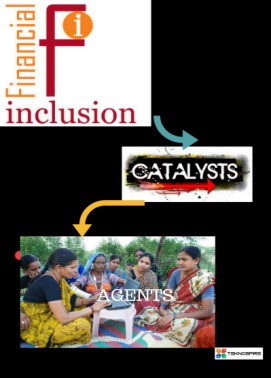
After a short break, I am back again to take my readers on an another tour of agency banking. While my previous tours Agency banking and Bitcoin , importance of agent banker gave us a peek into what is agency banking and their importance in emerging markets, this time let’s tour and get a peek into the catalyst role played by agent bankers to bring about financial inclusion in emerging countries like India. My tour would be through info-graphics and the tour itinerary comprises of what makes agent bankers most apt for this role, how can agent bankers become catalysts, what tools can be used by them to become enablers of financial inclusion. Welcome aboard on the tour and here we are at our first halt to find out why agent bankers are the enablers of change. What makes agent bankers suitable for the catalyst role Ticking off our first destination on our itinerary let us move on to our final and last destination “The Signboard”. “The Signboard” showcases the tools provided by Teknospire (such as MAKash e-wallet and Lean banking solutions provided to the MannDeshi foundation ) that can be of use to the agent bankers in achieving financial inclusion. However, let us walk through the ways in which agent bankers can contribute to financial inclusion before we arrive at our landmark signboard. The ways by which agent bankers can become catalysts are :- They conduct classes to educate people on the financial matters and create financial awareness. They sign up with a financial institution like a bank and start providing agency banking services. They initially handhold the customers to use different tools and then gradually wean them off the hand-holding by either making the customers self -reliable or by building a hierarchy of agent bankers below them to handle specific areas. Having walked through the above ways we are here at the sign board that displays Teknospire’s tools. Request you to have a good look at it before we return back to our point of origin. Teknospire’s agent banking tool Hoping that this tour has been enjoyable, I hope my guests would urge more agent bankers to use Teknospire solutions to achieve financial inclusion.

GST
Financial Inclusion, Social Cause

GOI initiatives to boost Social and Financial Inclusion

Hon’ble Indian Prime minister Mr. Narendra Modi said – I dream of Digital India where mobile and e-banking ensure financial inclusion. We might have heard many such quotes from our leaders, but what has been the ground reality? Has the government made any progress? What were the initiatives taken to boost social and financial inclusion? Demonetization? GST? MadeInIndia? JanDhanYojna Or DigitalIndia? Let’s dig in to explore – Images Source – Collage What is the Scope of Financial Inclusion? What all services could you think that needs to be included in Financial Inclusion? Deposits? Funds Transfer? Loans? While we do not have an official information on what all services need to be included in Financial Inclusion, but here are the basic banking services that could enable Social and Financial Inclusion – Access to Banks Accounts Instant Credits Instant micro loans for small business, education or agriculture Savings and Deposits Health Insurance Funds Transfer Investment or advisory services Pension for elderly individuals In general, any financial transaction through regulated channel as overall objective Challenges in Enabling Financial Inclusion in India India is the land of villages and farming, yet banks and banking haven’t reached around 19% of Indian population. Few of the challenges faced by Institutions, NGO’s, Fintech firms are – Missing Business model No digital reach and coverage Lower rate of education Setting up a bank branch locally is a costly affair Initiatives by GOI to Enable Social and Financial Inclusion Pradhan Mantri Jan Dhan Yojana One of the primary and significant schemes that allow individuals to open a bank account, basic banking no-frills account with nil/very low minimum balance as well as charges. Insurance and Pension Scheme GOI launched Pradhan Mantri Suraksha Bima Yojana (Accident Insurance), Atal Pension Yojana (Unorganized Sector) and Pradhan Mantri Jeevan Jyoti Yojana (Life Insurance), to enable social and economic security to the underprivileged sections of the society. MUDRA Bank to support Entrepreneurship Micro Units Development and Refinance Agency Bank (MUDRA Bank), launched in April 2015 provides loans at a low rate to enable enterprise for founders on rural/remote areas. Stand up India Another scheme initiated by GOI, each branch of public sector banks need to support one entrepreneur from Women and minority society. Direct Transfer of Government Benefits As we are witnessing LPG subsidies now getting credited directly to your accounts, on similar lines through Pahal Scheme GOI is keen to transfer grants and funds directly to beneficiaries account, removing the middle layer. Micro finance companies[MFC] MFC that provide micro loans to farmers, stall owners, women’s help in structuring the financial loan service and helping people from the money lenders debt trap. GST As cleartax defines Goods & Services Tax Law in India is a comprehensive, multi-stage, destination-based tax that will be levied on every value addition. GST also brings in the benefits of enabling financial inclusion by – Simplifying the Tax We all know that apart from CA’s, accountants and some learned, tax and its rules are still a bouncer to many of us. We have seen a debate on why the restaurant charged a VAT or service charge or service tax on my bill? Or have we not witnessed a Tv commercial showing how a farmer from his mobile phone ordered seeds for his farming? Do you think he would ever understand why he has to pay VAT? or if stays in Maharashtra why he has to pay Octroi ? Or how about a rural individual selling his handcrafted products to Maharashtra, would have a tough time to know why while processing in Pune Octroi charges applies. With uniform tax system, it’s easy to learning making it simpler for individuals to absorb it. One System Digitization Digitization automation demands one system that could track the tax channels. With multiple tax laws integrating them into one system is tough. Hence many times we have seen people ignoring paying the tax because there was no system to track or pay it outside the formal system via cash. With solutions available now on mobile devices, it’s easy for any rural person to track down his selling/purchasing in all cases. Unorganized Sectors to be Structured with no middlemen With initiatives like Digital India, Aadhaar linking to Bank accounts, PF and PAN cards, the GOI is trying to tie individuals to one identity. Taking a step further with the introduction of GST linking of the identification to tax system would be easy for small businesses and unorganized sector to follow formal tax rule. Just imagine a potter trying to sell his products across pan-India would now have a single identity card linked to his Bank account and GST Registration. Standard Pricing With formal tax-system retailers cannot mark product pricing as per their wish. GST also has an anti-profiteering clause, that mandates all businesses to pass on the benefits to the end customers. With such initiatives, one could expect products to be available and consumed in remote areas enhancing their standard of living. Use of technology With the ease of technology and availability of mobile phones – solutions like Agent banking are enabling financial inclusion in the remotest areas of the developing countries like India, Bangladesh, and Zimbabwe. General Purpose Credit Card [GCC] GCC allows the holder with a credit facility of up to 25,000 in rural and semi-urban bank branches. The primary objective of this scheme is to provide instant and hassle-free credit to its customers. How Teknospire a fintech firm is enabling Financial Inclusion in India Teknospire with its tagline Inspiring technologies for better living is a proud contributor to help in financial Inclusion. With its range of Fintech and HealthTech solutions to provide secure Agent Banking or Mobile Money suite or to credit grants to beneficiaries account , Teknospire is making it possible. GOI is putting extra efforts to bring the change, however firms like Teknospire are adding value to these plans and making execution a possibility with our skilled team and latest technology. The financial architecture in place thanks to GOI; we have the

Financial inclusion for rural people
Financial Inclusion, Social Cause

How important is an agent banker in the rural banking sector ?

Financial inclusion for rural people In continuation to our earlier blog ”Benefits From Agency Banking”, this blog would highlight the importance of agent bankers in rural banking. For a country to be fully developed rural development has to take place. Of late rural development has become the new buzz word for the developing economies. The central government bodies, local government bodies and the financial institutions in these economies are the primary development providers to the rural areas and its residents. While the local authorities are developing the rural areas with better infrastructure facilities, the financial institutions are following suit by providing financial inclusion to the rural residents. Currently, huge chunk of the rural population are unbanked and prefer to remain unbanked due to reasons such as :- Lack of banking awareness No banking need Banks having an intimidating presence Limited bank presence in the particular rural area owing to high operational costs Distance to be covered to reach the bank Unsafe travelling conditions Lack of technological awareness Financial institutions especially rural banks of the developing economies play a crucial role in the rural financial development. To ensure a successful rural financial development, the rural banking sector needs to grow by laying thrust on :- Sustainable community- focused banking Networks value Providing advanced banking solutions apart from basic banking solutions Creation of banking awareness amongst the rural population Lower cost of reach Supporting their growth, the rural banking segment is opening up to policies that promote financial inclusion. Rural banks are steering away from traditional branches and are looking forward to alternative forms of banking to provide financial inclusion. A few steps taken by the rural banks in enhancing their development include :- Use of intermediaries, in-house or contract agent bankers and not their own staff or branch networks. The agencies employing agent bankers are postal outlets, retail outlets such as groceries stores, pharmacies, petrol pumps. Providing doorstep banking using latest technology and agent bankers. Customer service point /Agent Bankers Scope for rural banking sector development through rural financial inclusion has given rise to agency banking. But how important are the agent bankers to the rural banking sector? Agent bankers help in stepping up the success of thrust areas laid above. Also, they enhance financial inclusion of the unbanked by :- Being delivery channel in providing basic banking facilities like deposits, withdrawals, remittances at the doorstep or at a place closer to rural population than the banks. Offering banking services in a low-cost manner which wouldn’t be possible for the rural banks. Ensuring 24*7availability unlike rural bank branches that work for limited hours in a day. Providing accessibility to bill payments and other utility payment facilities. Educating about the need for banking and its advantages in a more efficient way than the banks. Exposing the unbanked to various banking forms using technology such as mobile banking. Mobile Banking In Rural Areas Increasing the customer base for the banks by signing up new customers using their wide social contacts. Developing a good rapport with the customers and urging them to make frequent use of banking services with confidence. A branch seems intimidating to the rural people and would not provide the same comfort level. Using cost effective technology for their transactions help the rural banking sector to be tech savvy. Such as the agent bankers banking suite and mobile money suite used by the Ndasenda’s agents for their transactions.   Agent bankers by providing benefits to the rural banks and the rural customers,have attained a prominent place in the rural banking sector and their importance in the rural development cannot be overlooked. References: International Journal of Management Research and Business Strategy Diversified Channels in Rural Banking Worldwide Agent Banking: Penetrating Markets, Rural Communities For Financial Inclusion

Scroll to Top